VESDA
®
Refrigerated Storage Design Guide
Offset clips are preferable since they attach to the ceiling via an adhesive pad and, if required, can
be screwed on to the ceiling. The design of offset clips also allows easy movement of the pipes
during expansion or contraction.
To further minimise the possibility of pipe disconnections, pipe mounting clips MUST not be
positioned next to pipe joiners. Clips MUST also be more than 300 mm from the ends of the pipes
so that a pipe contraction will not cause its end caps to be forced off.
3.6 In-rack Protection
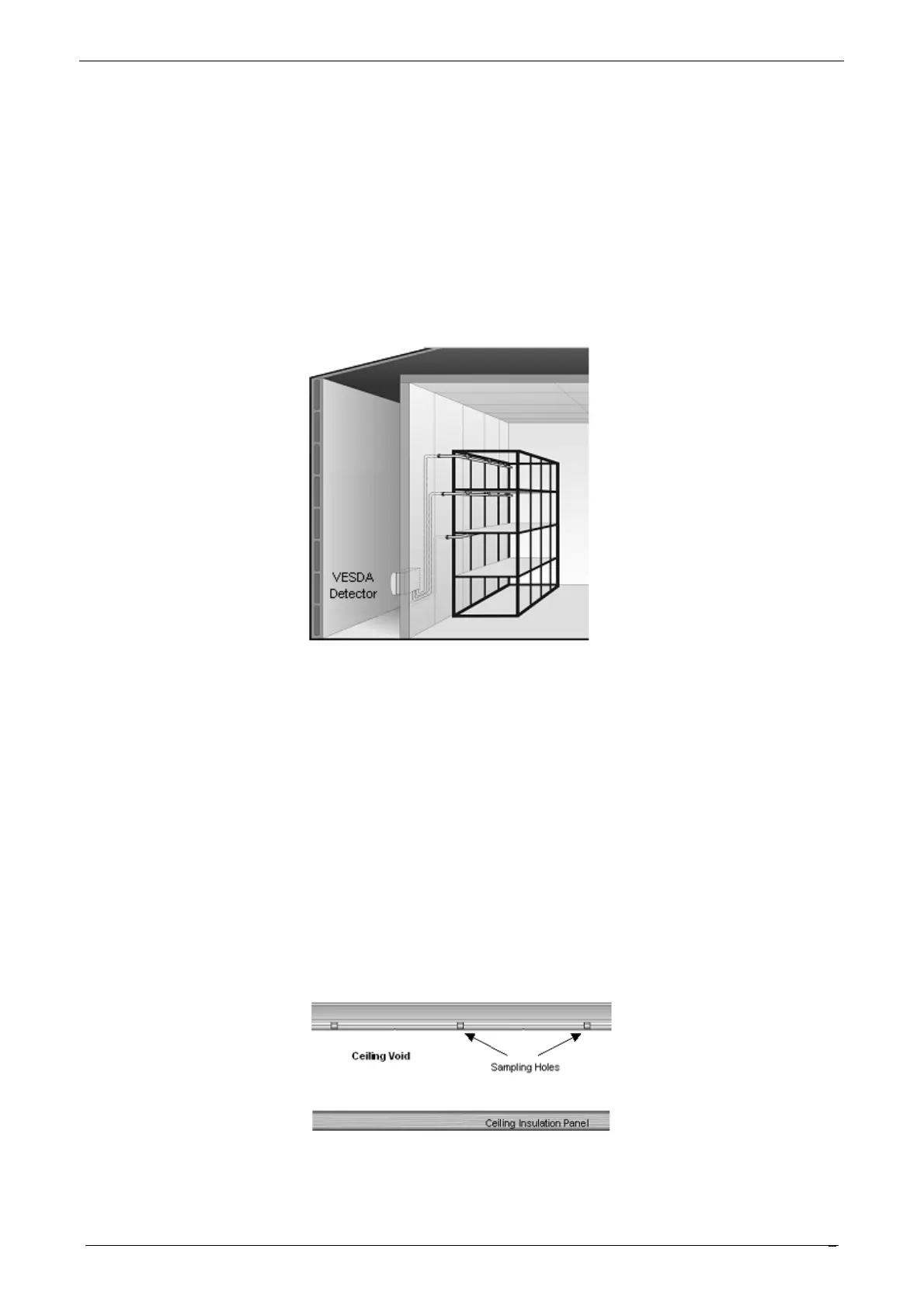
In most cases, placing a VESDA pipe network on the ceiling is all that is needed. However, sample
pipes can also be located along the racks used for storage in the refrigerated area as shown below
(Figure 6).
Figure 6 – Example of in-rack air sampling.
Wherever possible, the in-rack sample pipe should enter the protected area through the wall at the
height that the pipe will be positioned in the rack.
Note: Capillary air sampling is not recommended for in-rack sampling.
3.7 Ceiling Void Protection
Very early smoke detection is essential due to the high incipient fire risk presented by the electrical
cabling and refrigeration control equipment normally housed in the ceiling void. Some local codes
and standards specify that ceiling void protection must be a component of the fire protection
system.
The sample hole spacing is determined, with reference to local codes and standards, according to
the grid presented earlier (Figure 1) and is shown below (Figure 7).
Figure 7 – Example of ceiling void air sampling.
9



 To Next Page