EasyManua.ls Logo

VistaLab MLA Series - User Manual

VistaLab MLA Series
2 pages
Print Icon
To Next Page IconTo Next Page
Loading...
Operators Manual
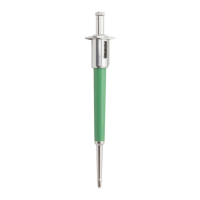
MLA Digital Pipettes
Introduction
MLA Digital Pipettes are to deliver air displacement adjustable volume instruments. Three
models are available covering a volume range of 10 to 1000µL. Volume is adjusted by rotating
the plunger. The plunger clicks in place for any desired setting. The volume display is located
in the body of the pipette.
Pipette Tips
It is recommended that MLA Pipettes be used with MLA Pipette Tips. The use of tips from
other sources may degrade the pipette performance. For information on MLA Pipette Tips
refer to the Pipette Information Table.
Pipetting Procedure
a. Rotate the plunger to display the desired volume (clockwise to decrease and
counterclockwise to increase).
b. Using MLA Pipette Tips, press the pipette nozzle firmly into a fresh tip.
c. Fully depress the pipette plunger and then immerse the tip into the solution (approximately
1/8 inch-3mm deep).
d. Smoothly release the plunger and allow the solution to enter the pipette tip.
e. Remove the tip from the solution and touch the tip against the side of the vessel to remove
any solution that may have adhered to the outside of the tip.
f. Place the tip against the side of the receiving vessel as close to the bottom as possible or,
if the vessel contains liquid, as close to the liquid as possible. Smoothly depress the plunger.
g. While holding the plunger depressed, slowly withdraw the tip keeping it against the wall of
the container.
h. Release the plunger and remove the tip by applying a slight upward pressure to the bonnet.
(See Figure 1)
VistaLab Technologies, Inc.
27 Radio Circle Drive
Mt. Kisco, NY 10549 USA
(888) 652-6520
www.vistalab.com
326720 Rev. C
Volume Range Catalog No. Color Increment
10 to 50µL 1136 Green 0.1µL
50 to 200µL 1137 Red 0.2µL
200 to 1000µL 1138 Gray 1.0µL
Specifications Table
Volume Volume Change Volume Acceptable Accuracy
per 1/2 revolution
Setting Range (µL)
10 to 50µL 2.5µL Low 10µL 9.5 - 10.5 ±5%
Mid 30µL 29.1 - 30.9 ±3%
High 50µL 49.0 - 51.0 ±2%
50 to 200µL 5.0µL Low 50µL 49.0 - 51.0 ±2%
Mid 125µL 123.75 - 126.25 ±1%
High 200µL 198.0 - 202.0 ±1%
200 to 1000µL 25µL Low 200µL 198.0 - 202.0 ±1%
Mid 600µL 594.0 - 606.0 ±1%
High 1000µL 990.0 - 1010.0 ±1%
Pipette Information Table
MLA Pipette Tips
Volume Color Seal Kit Stacked Bulk Sterile
Rack
10 to 50µL Green 9091
9025
4025 2025
50 to 200µL Red 9092
4225 2027
200 to 1000µL Gray 9094 9026 4026 2026
4226 2028
Accessories
Nozzle Inserts 8066
Pipette Stand 1700
pipette
Question and Answer IconNeed help?

Do you have a question about the VistaLab MLA Series and is the answer not in the manual?

Summary

Introduction to MLA Digital Pipettes

MLA Pipette Tips

Recommendation to use MLA Pipette Tips for optimal pipette performance.

Pipetting Procedure

Pipetting Steps

Detailed steps for aspirating and dispensing liquids using MLA Digital Pipettes.

Pipette Handling Tips

Pre-wetting Tips

Pre-wetting tips with sample liquid to improve accuracy with certain fluids.

Plunger Control

Smooth and consistent plunger action is crucial for accurate pipetting.

Air Bubble Prevention

Tips to prevent air bubbles during liquid aspiration for accurate volumes.

Pipette Handling

Advice on maintaining verticality and consistent tip immersion depth.

Nozzle and Insert Maintenance

Instructions for cleaning and checking nozzle inserts and assemblies.

Pipette Calibration

Calibration Procedure

Detailed steps for testing and adjusting pipette volume accuracy.

Pipette Maintenance

Lubrication and Cleaning

Guidelines for routine lubrication and cleaning of pipette internal parts.

Seal Check and Replacement

Procedure for checking seals for wear and instructions for replacement.

Overview

The MLA Digital Pipette is an air displacement, adjustable volume instrument designed for precise liquid handling. It operates on a "to deliver" principle, meaning it dispenses the set volume of liquid. Three models are available, covering a total volume range from 10 µL to 1000 µL.

Function Description

The pipette's primary function is to accurately aspirate and dispense specific volumes of liquid. Volume adjustment is achieved by rotating the plunger, which clicks into place at desired settings. The current volume is displayed on the pipette body.

Important Technical Specifications

Volume Ranges and Increments:

  • 10 to 50 µL Model (Catalog No. 1136, Green):
    • Volume Change per 1/2 revolution: 2.5 µL
    • Increment: 0.1 µL
    • Accuracy:
      • Low 10 µL (9.5-10.5 µL): ±5%
      • Mid 30 µL (29.1-30.9 µL): ±3%
      • High 50 µL (49.0-51.0 µL): ±2%
  • 50 to 200 µL Model (Catalog No. 1137, Red):
    • Volume Change per 1/2 revolution: 5.0 µL
    • Increment: 0.2 µL
    • Accuracy:
      • Low 50 µL (49.0-51.0 µL): ±2%
      • Mid 125 µL (123.75-126.25 µL): ±1%
      • High 200 µL (198.0-202.0 µL): ±1%
  • 200 to 1000 µL Model (Catalog No. 1138, Gray):
    • Volume Change per 1/2 revolution: 25 µL
    • Increment: 1.0 µL
    • Accuracy:
      • Low 200 µL (198.0-202.0 µL): ±1%
      • Mid 600 µL (594.0-606.0 µL): ±1%
      • High 1000 µL (990.0-1010.0 µL): ±1%

Recommended Pipette Tips: MLA Pipette Tips are recommended for optimal performance.

  • 10 to 50 µL (Green): Seal Kit 9091, Stacked Rack 9025 (Bulk 4025, Sterile 2025)
  • 50 to 200 µL (Red): Seal Kit 9092, Stacked Rack 9025 (Bulk 4225, Sterile 2027)
  • 200 to 1000 µL (Gray): Seal Kit 9094, Stacked Rack 9026 (Bulk 4026/4226, Sterile 2026/2028)

Accessories:

  • Nozzle Inserts: 8066
  • Pipette Stand: 1700

Usage Features

Pipetting Procedure:

  1. Volume Adjustment: Rotate the plunger to set the desired volume. Clockwise rotation decreases volume, counterclockwise increases it.
  2. Tip Attachment: Firmly press the pipette nozzle into a fresh MLA Pipette Tip.
  3. Aspiration: Fully depress the plunger, then immerse the tip approximately 1/8 inch (3mm) into the solution. Smoothly release the plunger to draw the solution into the tip.
  4. Excess Removal: Remove the tip from the solution and touch it against the side of the vessel to remove any external solution.
  5. Dispensing: Place the tip against the side of the receiving vessel, as close to the bottom as possible, or near the liquid surface if the vessel contains liquid. Smoothly depress the plunger.
  6. Withdrawal: While holding the plunger depressed, slowly withdraw the tip, keeping it against the container wall.
  7. Tip Ejection (D-Tipping): Release the plunger and remove the tip by applying slight upward pressure to the bonnet (as shown in Figure 1).

Pipetting Hints for Optimal Performance:

  • Pre-wetting: When pipetting serum or other biological fluids, pre-wetting the tip with the liquid to be pipetted can reduce liquid film retention and improve accuracy.
  • Smooth Operation: Depress and release the plunger smoothly and consistently for all samples. Avoid letting the plunger snap back.
  • Preventing Air Bubbles: Fully depress the plunger before inserting the tip into the solution to prevent air bubble formation.
  • Vertical Alignment: Hold the pipette as vertically as possible and insert the tip to the same depth each time.
  • Addressing Air Bubbles during Intake: If an air bubble forms in the tip during intake, discard the sample and tip, and use a fresh tip.
  • Nozzle Maintenance: Remove and clean the nozzle insert daily. Replace if necessary.
  • Secure Assembly: Ensure the nozzle assembly is firmly screwed into the pipette body.

Calibration: MLA Digital Pipettes are factory calibrated at three settings across their pipetting range (low, mid, high) at 21.5 ± 2°C using distilled water.

  • Calibration Adjustment Procedure:
    1. Determine the delivered volume at the lowest setting using gravimetric or colorimetric techniques.
    2. Unscrew and remove the plunger cap by rotating it counterclockwise while holding the plunger. Increase the digital display to a higher volume to extend the plunger for easier handling.
    3. Allow the plunger cover to drop to release the plunger gear shaft.
    4. Rotate the plunger shaft with a small bladed straight slot screwdriver or fingers: clockwise to decrease volume, counterclockwise to increase volume.
    5. Approximate volume change per 1/2 turn: 2.5 µL (10-50 µL), 5 µL (50-200 µL), 25 µL (200-1000 µL).
    6. Pull the plunger cover up, re-engage the plunger gear shaft, hold the cover up, and replace the plunger cap.
    7. Retest the pipette volume at the low setting.
    8. Test the pipette at mid and high settings.
    9. If further adjustments are needed, return to the low volume setting and repeat the plunger shaft adjustment. Retest all settings to ensure they are within the acceptable volume range (refer to the Specifications Table).

Maintenance Features

Routine Cleaning and Lubrication:

  • Internal parts (plunger, seals) are lubricated during factory assembly.
  • Routine cleaning and lubrication are typically needed only at 6-month intervals, unless the pipette is used with corrosive chemicals or solvents.
  • Lubrication is necessary if the plunger movement becomes rough or does not return to the "up" position.
  • The nozzle and nozzle insert should be cleaned regularly.
  • In case of accidental sample aspiration, the nozzle assembly and insert must be cleaned immediately with a lint-free cloth dampened with alcohol. Refer to Figure 2 for nozzle insert removal.

Seal Replacement:

  • If the pipette fails to operate or if the delivered volume is low, the seals should be checked for wear and replaced.
  • Instructions for pipette disassembly and seal replacement are provided in the appropriate seal kit.
  • When reassembling, align the display cutout on the pipette sleeve with the digital display. Twisting the sleeve once placed can cause the alignment pins to break.

VistaLab MLA Series Specifications

General IconGeneral
BrandVistaLab
ModelMLA Series
CategoryLaboratory Equipment
LanguageEnglish

Related product manuals