1. General
This intercom system requires no wires, so there is no need for a link between this connected stations. All you need is a normal
plug socket (220
V/50
Hz) in each room where an intercom is to be installed.
Connection:
1.
2.
First connect the WI 2202 or WI 2602 intercom to the light circuit by inserting the Euro-plug into the plug socket
Switch on the WI 2202 or WI 2602 using the ON/OFF-knob.
3.
Set both intercoms to the same channel using the channel switch.
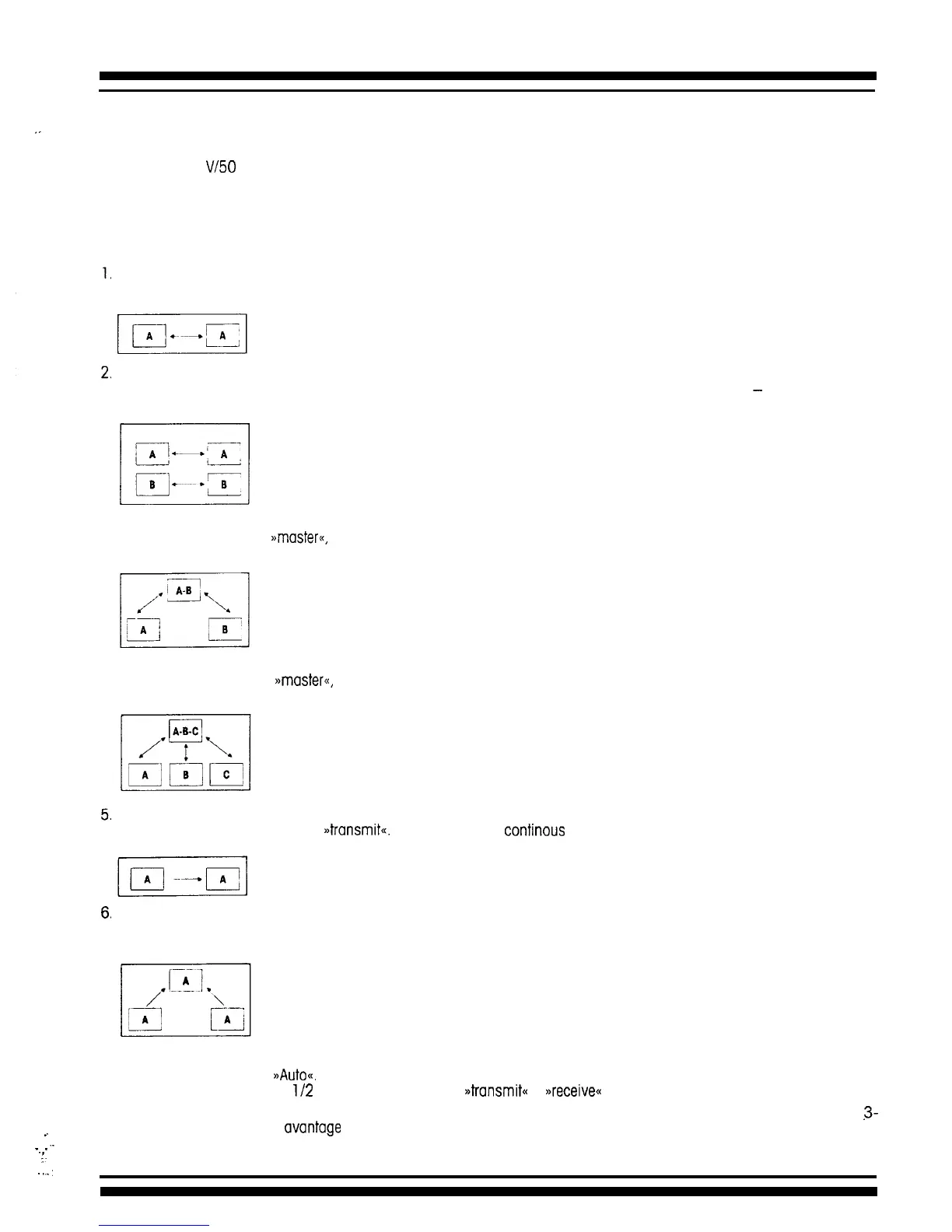
Possible applications:
3.
Selektive operation I:
4.
7.
8.
.-
.
.
‘-
-I
I
Normal’operation:
Alternate communication in both directions is possible.
Parallel operation:
If the two intercoms each are set to channel A or B respectively two speaking connections are possible
-
but not simultane-
ously. If channel B is in use, channel A can hear nothing and vice versa,
One station serves as the
)>master(c,
while the other three are
set
to
different channels. In this way each sub-station can be called
seperately.
Selektive operation II (WI 2602 only):
One station serves as the
)>master(c,
while the other three are set to different channels, In this way each sub-station can be called
seperately.
Continuous operation (supervision):
One station is set permanently to
)&ansmitc(.
This means that a continous check can be called seperately.
Synchronous supervision:
Intercom system with automatic switching allow the simultaneous supervision of several rooms, e.g. two children’s rooms.
Any station switching automatically to transmission blocks the others.
Automatic two-way communication (WI 2602 only):
Press the button marked
)>Autocc.
You can now speak consecutively without having to touch any more buttons. Please note that
the station requires approx.
l/2
a second to switch from
ntransmit(c
to
)lreceive<c
when changing direction.
Please note that unfavourable conditions can influence the quality of reception in the power supply. If this is the case, 2 or
3-
channel systems have the avantage that the reception can be optimised by switching to another frequency (channel).
.
.._
:



 To Next Page
 Loading...