Pump control system
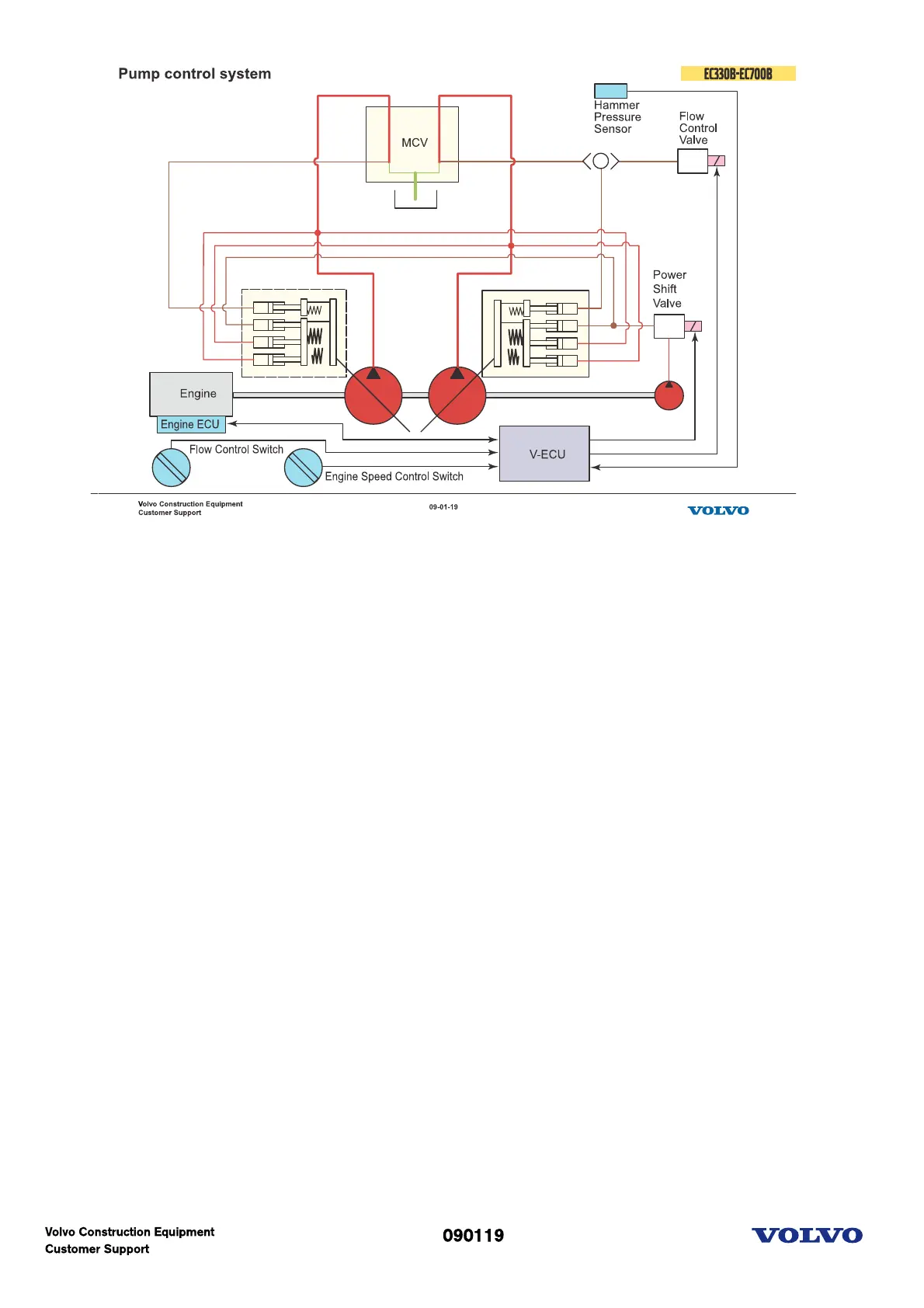
In this picture, there are 4 pistons.
From the top side,
First one: Negative control
Second one: Power shift control
3rd & 4th: Full horsepower control
**Actually 2nd,3rd,4th pistons are integrated into one component.
Full Horsepower control
As the delivery pressure of the pump P1 and mate pump P2 goes high, the delivery flow rate will be
reduced automatically, so the input torque will be regulated to a certain value. The regulator is the total
cumulative horsepower type that operates by the sum of load pressures of the two pumps in the tandem
double pump system. Therefore the engine can be automatically prevented from being overloaded
regardless of the loading conditions on the two pumps.
Power shift control
Changing the current of the proportional solenoid valve attached to the regulator will change the
horsepower setting. Only one proportional solenoid valve is provided. However, secondary pressure Pf
(power shift pressure) flows into the horsepower control portion of each pump regulator through an inner
passage, and shifts it to same horsepower setting, respectively. Delivery flow rate of the pump can be
changed, so the proper power level suitable for the work conditions can be acquired.
Negative flow control
Varying the servo hydraulic pressure Pi can control delivery rate of the pump. This regulator is the
negative flow control type that reduces delivery rate Q according to the increase of servo hydraulic
pressure Pi. As the servo hydraulic pressure corresponds to the flow required for the work designated, the
pump will deliver only the required oil so unnecessary power consumption will be prevented.
This regulator has 3 control functions, however when different control functions act at the same time, low
oil flow instruction will have priority by the mechanical operation.
X1 flow control
When we use X1 option, flow control valve will be activated and send signal to negative control piston. So


 To Next Page