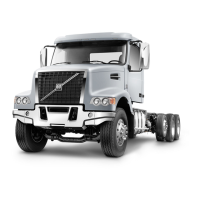
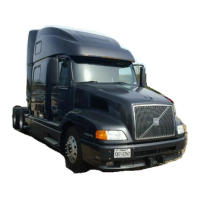
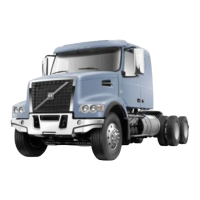
84 Heavy-Duty Service Schedule for VHD-Series
General and Check-Chart
Heavy-Duty Service is defined here for vehicles that typically travel an annual
distance of maximum 65,000 miles (105,000 km) per year or less and operate
under Heavy-Duty conditions. This include applications that travel primarily
on freeways with some or frequent stop-and-go driving. Typical applications
include: local transport with occasional freeway travel and a majority of stop-
and-go driving.
Vehicles may be equipped with liftable auxiliary axle(s) less than 14,000 lb
(6 metric tons) each. Typically, GVWR is less than 80,000 lb (36 metric tons)
or GCWR less than 143,000 lb (50 metric tons) or GAWR less than
46,000 lb (21 metric tons).
The service categories show maximum allowable intervals. It is very important
to tailor the service to the actual application. Adjust the recommended service
intervals to your operation.
For example, if the vehicle is used off-road, driving through deep, stand-
ing water, the lubrication schedule should be changed to lubricate
exposed lubrication points as often as every day.
Construction Application:
Typical operations include movement of
material to and from job sites, grades less
than 20%, only use one retarder and a
relatively high number of starts/stops. Op-
eration on road surfaces made of concrete,
asphalt, maintained gravel, crushed rock
and hard packed dirt or other similar sur-
face for 90% of the time and up to 10%
operation in muddy or sandy conditions.
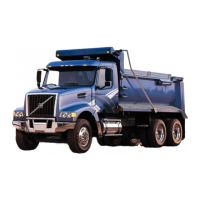
Vehicle types are: Concrete mixer/pumper,
landscaping truck, flatbed truck, material
hauler, dumper, asphalt truck, municipal
dump, block truck, tank truck, crane opera-
tion, utility truck or snowplow/blower.
Refuse Application:
Typical operations include grades less than
12%, residential refuse and recycle pickup,
commercial and industrial pickup, typically
a high number of stops per mile, 10 miles
or greater per trip. Operation on road sur-
faces made of concrete, asphalt, maintained
gravel, crushed rock and hard packed dirt
or other similar surface for 90% of the time
and up to 10% operation in muddy or
sandy conditions.
Vehicle types are: Rear, front or side
loader, liquid waste, roll-off, recycling or
residential pickup, transfer, scrap material
handling, sewer/septic vacuum, and com-
mercial pickup.


 To Next Page