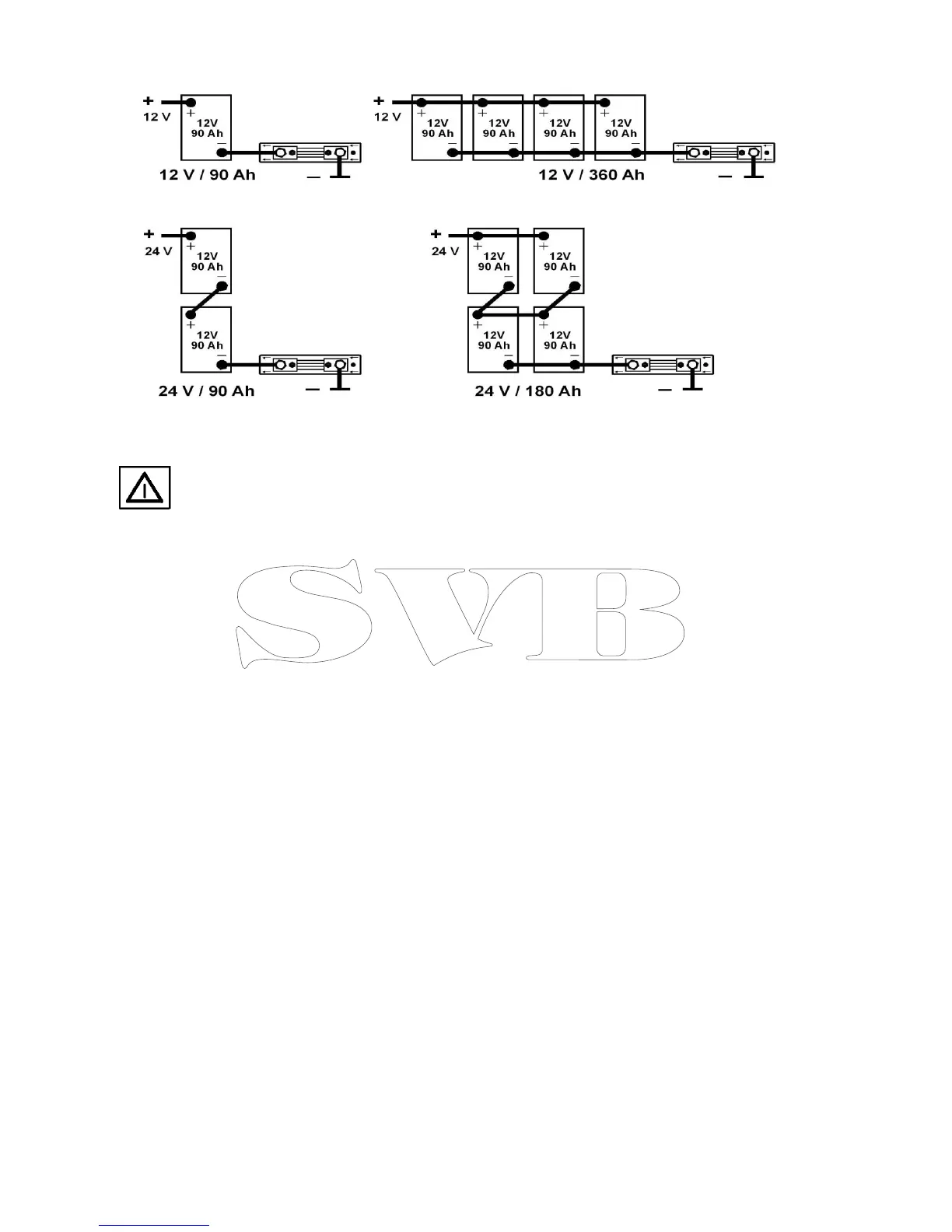
Except of the measuring shunt, no further connection should exist at the negative pole (-) of the battery or
at the negative pole of the entire battery system! This concerns consumers, vehicle ground, as well as
chargers.
Further connections have to be made either to the car body (ground) or, in case of insulated vehicle bodies, to the
minus distribution. See connection plan.
Ground straps at the connecting screws M8 of the measuring shunt are to be screwed in such a way, that one connection is
connected to the negative pole of the battery and the other one with the car body. The arrows on the base of the measuring
shunt should point to the direction of the battery (see connection plan).
The connections at the measuring shunt should always be tightened firmly to avoid any transition resistance. Permanent
high load of 200 A or 400 A might result in heating of the measuring shunt. Ventilate the battery room (gases).
Terminals
Connection +B1 (Board Battery)
For the voltage measurement of the board battery a direct connection from this terminal to the positive pole of the board
battery must be made. The cable is to be protected by means of a 3 A fuse directly at the battery. The connection cross-
section should be 0.75 mm², at least. This connection also provides current to the LCD Battery Computer S and to the
terminal.
Connection +B2 (Starter Battery)
For the voltage measurement of the starter battery a direct connection from this terminal to the positive pole of the starter
battery must be made. The connection cable is to be protected by means of a 3 A fuse directly at the battery. The
connection cross-section should be 0.75 mm², at least.
Connection Out (Terminal)
A freely programmable terminal is at disposal. Depending on the setting, this terminal can be used as timer or for capacity
disconnection.
In active condition (ON), the battery voltage (+12 V or +24 V) is here at disposal, and it is protected against overload by
means of a self-resetting fuse 0.5 A. The terminal can be reinforced by an interposed changeover relay.


 To Next Page
 Loading...