13
1) Always wear a heat resistant glove to touch the stainless steel probe or
wires during or just after cooking. Do not touch with bare hands.
2) Keep the stainless steel probe and wires away from children.
3) Clean the stainless steel probe and dry thoroughly after each and every
use.
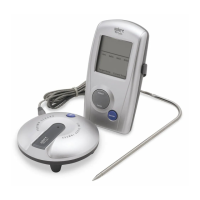
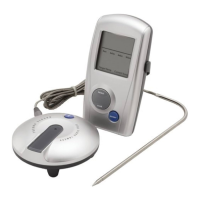
4) Do not use the receiver in the rain. It is NOT rain proof. The transmitter is
rain proof but not water tight. Do not immerse in water.
5) Do not expose the plugs of the stainless steel probe or the plug in holes
of the transmitter to water or any liquid. This will result in a bad
connecting and faulty readings.
6) Do not expose the Receiver or Transmitter to direct heat or surface.
7) Do not use stainless steel probes in microwave oven.
8) The Food Thermometer measures temperatures as low as 0 ℃ (32 ºF)
and as high as 199℃ ºF (390 ºF). LLL will be displayed below 32 ºF and
HHH will be displayed above 199 ºC.
9) Not Intended for Use by Persons ages 12 and under.
Cleaning
1) Always wear a heat resistant glove to touch the stainless steel probe or
wires during or just after cooking. Do not touch with bare hands.
2) Keep the stainless steel probe and wires away from children.
3) Wash the metal probe tips with hot soapy water and dry thoroughly. Do
not immerse the probe in water while cleaning.
4) Wipe the transmitter and receiver with damp cloth. Do not immerse either
in water.
FCC Statement
This equipment has been tested and found to comply with the limits for a Class B digital
device, pursuant to part 15 of the FCC Rules. These limits are designed to provide
reasonable protection against harmful interference in a residential installation. This
equipment generates uses and can radiate radio frequency energy and, if not installed
and used in accordance with the instructions, may cause harmful interference to radio
communications. However, there is no guarantee that interference will not occur in a
particular installation. If this equipment does cause harmful interference to radio or
television reception, which can be determined by turning the equipment off and on, the
user is encouraged to try to correct the interference by one or more of the following
measures:
—Reorient or relocate the receiving antenna.
—Increase the separation between the equipment and receiver.
—Connect the equipment into an outlet on a circuit different from that to which the
receiver is connected.


 To Next Page