Need help?
Do you have a question about the Welotec TK500 Series and is the answer not in the manual?
Provides copyright information and identifies registered trademarks of Welotec and other companies.
Lists contact details for obtaining technical support for the TK500 router.
Describes the TK500 router's capabilities and outlines important safety instructions for its use.
Specifies operating and storage temperature ranges, and humidity limits for the TK500.
Details the power supply specifications, including voltage range and connection type.
Lists the TK500 router's physical dimensions, weight, and housing protection class.
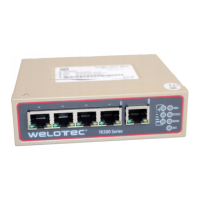
Details the router's interfaces, including serial, Ethernet, antenna, and SIM card slots.
Explains LED lights for serial interface signals, their states (on, off, flashing), and associated events.
Guides on inserting the SIM card and installing the antenna for optimal signal reception.
Covers connecting the power supply and establishing the initial Ethernet connection to a PC.
Details steps for PC network settings to automatically obtain IP addresses via DHCP from the router.
Details the steps for configuring dial-up connection parameters like APN, username, and password.
Step-by-step guide on how to reset the TK500 router to its factory default settings using the hardware button.
Lists the default IP address, Netmask, username, password, and serial parameter after a factory reset.
Explains how to restore factory defaults using the 'Restore default configuration' option in Config Management.
Details setting PC IP address, Netmask, and Gateway to match the TK500's subnet for initial configuration.
Allows adjustment of language and hostname for the TK500 router's configuration interface.
Allows changing the administrator username and password for router access.
Manages access to services like HTTP, HTTPS, TELNET, and SSHD via local and remote connections.
Configuration options for users without administrative privileges and login timeout settings.
Instructions for rebooting the router via the System > Reboot menu option.
Procedure for securely logging out of the TK500 router's system interface.
Details configuration for dial-up connections, including network provider, APN, and authentication.
Configuration steps for setting up a WAN connection using a static IP address.
Sets up the router as a DHCP server to dynamically assign IP addresses to network clients.
Configures default filter policy, blocking anonymous requests, and defending against DoS attacks.
Defines specific rules to filter network traffic based on protocol, source, destination, and port.
Limits and controls inbound and outbound bandwidth for network traffic.
Configures NAT-Traversal, compression, debug mode, and dynamic NAT ports for IPSec VPN.
Performs ping tests to verify network connectivity and measure response times.
Mentions Smart ATM functionality, noted as not currently supported by the manufacturer.
Displays detailed system information such as serial number, firmware version, and uptime.
Provides status information for the modem, including signal level, registration, and network type.
Details physical dimensions, operating voltage, and CE compliance of the TK500 router.
Specifies operating temperature, humidity, shock, free fall, and vibration resistance.
Lists frequency bands and transmission power for 4G LTE in Europe supported by the TK500.
States that the TK500 Industrial Cellular Router complies with relevant EU directives and standards.
 General
| Operating Temperature | -20°C to +60°C |
|---|---|
| Power Supply | 9-36 VDC |
| Ports | 2 x Ethernet |
| Wireless | Wi-Fi 802.11 b/g/n |
| CPU | Cortex-A7 |

 To Next Page