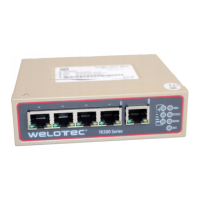
The Welotec TK800 series industrial routers provide stable connectivity for remote devices and customer sites over 2G/3G/4G networks. Designed for industrial environments, these routers operate within a voltage range of 12-48V DC and a temperature range of -25°C to 70°C, with a relative humidity of 5-95% (non-condensing). They adhere to numerous EMC standards, ensuring high stability and reliability. The TK800 can be used at a workstation or mounted on DIN rails. The TK800 series products support various VPN protocols, including IPSec, L2TP, GRE, and OpenVPN, to ensure secure connections between remote devices and customer sites.
Technical Specifications:
- Dimensions (W x H x D): 45 x 132.6 x 112.8 mm
- Operating Voltage: 12-48V DC (230V AC to 12V DC power supply unit included in some sets)
- Power Consumption:
- Standby: 3.8 W
- Active: 5.3 W
- Environmental Conditions:
- Operating Temperature: -25 to +70 °C
- Storage Temperature: -40 to +85 °C
- Air Humidity: 5-95%, non-condensing
- Concussions: IEC 60068-2-27
- Free Fall: IEC 60068-2-32
- Vibration: IEC 60068-2-6
- Radio Frequencies (Examples for Europe):
- LTE: Bands 1, 3, 7, 8, 20 (Transmit Power: 199 mW)
- UMTS: Bands 1, 3, 8 (Transmit Power: 251 mW)
- GSM: 900 (1995 mW), 1800 (1000 mW)
- WLAN (2.4 GHz): 2400 MHz – 2483.5 MHz (Max. Transmit Power: 40 mW)
Usage Features:
The TK800 series offers a comprehensive set of features for network management and connectivity.
- Quick Start: The device comes with a package checklist including the router, terminal blocks (2-pin and 9-pin for EX0/EXW variants), network cable, antennas (2 or 4 for EXW variants), and a power supply unit. SIM card installation involves pressing a yellow "Eject" button and inserting the card into SIM1 (or SIM2 for dual SIM). The router must be restarted after SIM card insertion as it is not hot-pluggable. Antennas should be placed at least 20 cm apart for optimal performance. Power supply installation involves connecting wires to the terminal block, ensuring proper grounding via the grounding screw to prevent electromagnetic interference.
- Cable Connections: The router connects to a PC via an RJ45 network cable (FE 0/2 for TK8x2, FE 1/4 for TK8x5). Serial interfaces and I/Os (for TK8XXX-EX variants) are connected via a terminal block on the front, with labeled contacts for RXD, TXD, GND, A(RS-485+), B(RS-485-), IN, COM, and RELAY. The "IN" contact is a digital input, and "Relay" is a potential-free output that can be controlled via SMS or the web interface.
- Startup and Configuration: The router supports automatic configuration via DHCP, where a connected PC obtains an IP address, gateway, and DNS server automatically. Manual configuration allows setting a static IP address for the PC in the same subnet as the router (default 192.168.2.1). The web interface is accessed via a browser at
http://192.168.2.1 with default credentials (username: adm, password: 123456).
- LED Status Lamps: LEDs indicate the status of power (PWR), errors (ERR), warnings (WARN), SIM card activity (SIM1, SIM2), VPN connection (VPN), and modem status (MODEM). Signal strength is indicated by a series of LEDs, ranging from poor (1-9) to perfect (20-31).
- Watchdog: The watchdog feature monitors the Internet connection by sending ICMP packets to a defined server. If the connection fails, it automatically restarts the dial-up, modem, or the entire system to ensure continuous availability. Users can configure the ICMP Detection Server and Interval.
- Port Mapping / Port Forwarding: This feature allows access to devices connected to the router via the Internet, configured through NAT rules. It requires a public IP address from the mobile network provider. The router supports SNAT (Source NAT) for devices with private IP addresses to access the Internet, and DNAT (Destination NAT) for providing server services. 1:1-NAT is also supported for accessing different sites via VPN with the same IP network addresses.
- SMS Functions: The TK800 can be controlled via SMS. Commands can be sent to query device status, start/stop dial-up connections, or restart the device. The "Connect On Demand" mode allows controlling the Internet connection via SMS commands like "cellular 1 ppp down" and "cellular 1 ppp up". Digital relays can also be switched on/off using SMS commands like "io output 1 on" and "io output 1 off".
- WEB Configuration: The web interface is divided into Main navigation (Administration, Network, Services, etc.), Detail navigation (Status, Basic Setup), a central area for status and configuration, and a right-side display for active alarms.
- Administration: Provides status overview and configuration for system time, user management (creating/modifying/removing users with different privileges), AAA (Authentication, Authorization, Accounting) services like Radius, Tacacs+, and LDAP, and configuration management (saving, importing, resetting to factory defaults, encrypting passwords). SNMP (Simple Network Management Protocol) is supported for monitoring network elements.
- Network: Configures cellular network settings (APN profiles, roaming, PIN code, network type, connection mode, redial interval, ICMP detection), Ethernet port settings (Primary/Secondary IP, Netmask, MTU, Speed/Duplex, L2 State tracking), VLANs (Trunk mode, VLAN ID assignment, member ports), ADSL Dialup (PPPoE) for external DSL modems, and WLAN (SSID, encryption, channel, client/AP role).
- Services: Includes DHCP (server, relay, client), DNS (server, relay), DDNS (dynamic DNS updates), SMS functions (access control, commands), GPS (position, enable, IP forwarding, serial forwarding), QoS (Quality of Service), and Data Usage monitoring.
- Link Backup: Allows using two Internet connections (wired and cellular) for increased accessibility. The router periodically checks the primary connection and switches to the secondary in case of failure. SLA (Service Level Agreement) monitoring uses ping tests to track connection status. VRRP (Virtual Router Redundancy Protocol) provides router redundancy in a network. Interface Backup allows defining main and backup interfaces for failover.
- Routing: Supports Static Routing (fixed paths) and Dynamic Routing protocols like RIP (Routing Information Protocol) and OSPF (Open Shortest Path First) for automatic route control. BGP (Border Gateway Protocol) is also supported for connecting autonomous systems. Route filtering can be configured. Multicast Routing (IGMP) enables IPv4 multicasting.
- Firewall: Includes ACL (Access Control List) for controlling network access based on IP addresses, TCP/UDP ports. NAT (Network Address Translation) is used for connecting different networks, including Source NAT, Destination NAT (port mapping/forwarding), and 1:1-NAT. MAC-IP Binding ensures devices can only access the router if their MAC and IP addresses match.
- VPN: Supports IPSec (Internet Protocol Security), GRE (Generic Routing Encapsulation), L2TP (Layer 2 Tunneling Protocol), and OpenVPN for secure network connections. Configuration involves setting up policies (IKEv1, IKEv2, IPsec), tunnels, and external settings. Certificate management is available for VPNs not using Pre Shared Keys.
- APP: Python scripts can be uploaded and executed. The APP Management allows installing and managing apps, and enabling IDE Debug.
- Industrial: For EX variants, industrial functions include digital input, relay output, RS-232, and RS-485 interfaces. DTU (Data Terminal Unit) connects devices with serial interfaces, supporting Transparent, TCP Server, RFC2217, IEC60870-5-101/104, Modbus-Net-Bridge, and DC Protocol.
- Tools: Provides diagnostic tools like Ping, Traceroute, Tcpdump (packet sniffer), and Link Speed Test.
- Wizards: Simplifies setup for New LAN, New WAN, New Cellular, New IPsec Tunnel, and New Port Mapping.
- CLI Commands: The router can be configured and managed via the Command Line Interface (CLI) using SSH or a serial console cable. Commands like
help, show (e.g., show version), ping, traceroute, reboot, and configure (for changing hostname, clock settings, passwords, and user accounts) are available.
Maintenance Features:
- Factory Reset: The TK800 can be reset to factory defaults via a hardware method (holding the RESET button during power-on until ERROR LED flashes, then pressing RESET again until ERROR and STATUS LEDs flash) or via the web interface (Administration > Config Management > Restore Default Configuration).
- Firmware Upgrade: Firmware updates can be performed via the Upgrade menu by uploading a *.bin or *.pkg file.
- Log Management: The Log menu displays current messages about network, operational status, configuration changes, ISP connection, IPSec, and OpenVPN status. Logs can be cleared, downloaded, and sent to a syslog server.
- Alarm System: The Alarm Input menu allows defining which alarm messages the router should output (e.g., Warm Start, Cold Start, Memory Low, Link Up/Down for various interfaces, Cellular Up/Down, Data Usage). Alarm Output configures an e-mail server to forward alerts. The Alarm Map defines whether alerts are displayed in the web browser or sent via e-mail/SMS.

 Need help?
 General

 To Next Page