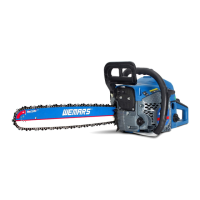
This document is an operator's manual for the WEMARS® 2-Cycle Chain Saw models 5218G, 5818G, 5820G, 6220G, and 6220C. It provides comprehensive instructions for safe operation, assembly, maintenance, and troubleshooting of the device.
Function Description
The WEMARS® chain saw is a powerful 2-cycle engine-driven tool designed for cutting wood. Its primary function is to fell trees, limb trees, and buck logs. The saw operates by a rapidly rotating chain with sharp cutting teeth that move along a guide bar. The engine's power output and maximum off-load speed are controlled by the high-speed screw on the carburetor. An automatic oiler system ensures continuous lubrication of the guide bar and saw chain, with oil flow increasing with engine speed. The manual emphasizes the importance of proper fuel mixture, chain tension, and safety precautions to ensure efficient and safe operation.
Important Technical Specifications
- Engine Type: 2-Cycle
- Models Covered: 5218G, 5818G, 5820G, 6220G, 6220C
- Fuel Mixture Ratio: 25:1 (Gasoline to 2-cycle engine oil)
- Gasoline Requirement: Unleaded gasoline with an octane number of at least 90 RON (87 AKI). Not to exceed 10% ethanol concentration (E10).
- Engine Oil Requirement: High-quality air-cooled two-cycled engine oil. Vegetable-based saw chain oil or standard chain oil for lubrication.
- Spark Plug: Recommended type, with correct electrode gap.
- Saw Chain Cutting Teeth Length: Replace when reduced to 4 mm (5/32").
- Chain Tension: Must be tensioned whenever the flats on the drive links hang out of the bar groove.
- Idle Speed Adjustment: Controlled by a screw marked "T".
Usage Features
- Starting the Engine:
- Cold Start: Engage chain brake, open switch button (1 open/0 stop), pull choke control fully, pull starter rope handle until engine starts (max 6 times), pull brake off, pull throttle trigger, then use.
- Warm Start: Push chain brake on, open switch button (1 open/0 stop), pull starter rope handle until engine starts, pull brake off, pull throttle trigger, then use.
- Note: Do not pull the throttle trigger when starting. Ensure decompression valve is always in.
- Stopping the Engine: Push the stop switch (0) to stop the engine.
- Fueling:
- Mix gasoline and 2-cycle engine oil at a 25:1 ratio in an approved container with an antispill valve.
- Ensure the engine is cool before refueling.
- Open fuel tank cap slowly to release pressure.
- Fill the fuel tank in a clean, well-ventilated outdoor area, away from open flames or sparks.
- Wipe up any spilled fuel immediately.
- Chain Lubrication:
- The product has an automatic lubrication system.
- Fill the saw chain oil tank with recommended saw chain oil.
- Check chain lubrication by pointing the guide bar nose at a light surface (20 cm away) and observing an oil line after 1 minute of running.
- Cutting Techniques:
- Felling a Tree: Remove debris from the tree, make a notch (1/3 diameter) perpendicular to the fall direction, make a lower horizontal notch cut, then make a felling back cut (at least 50 mm higher than the horizontal notch cut) parallel to the notching cut, leaving hinge wood. Use wedges if needed.
- Limbing a Tree: Use larger limbs to hold the log off the ground. Remove small limbs in one cut. Cut branches with tension from bottom to top to prevent pinching.
- Bucking a Log:
- If supported along its entire length, cut from the top (overbucking).
- If supported on both ends, cut 1/3 diameter from top, then underbuck the lower 2/3 to meet the first cut.
- If supported on one end, cut 1/3 diameter from underside (underbucking).
- When bucking on a slope, stand on the uphill side of the log.
- Safety during Cutting: Always hold the product with two hands (left on front handle, right on rear handle), keep feet firmly planted, distribute weight evenly, and maintain control. Avoid operating on ladders or in trees.
- Safety Devices:
- Chain Brake: Must be engaged during starting and disengaged before cutting.
- Throttle Trigger Lockout: Ensures the trigger is locked at idle when released.
- Guard: Prevents objects from being ejected and accidental contact with the saw chain.
- Personal Protective Equipment (PPE): Always use approved helmet, ear protection, protective glasses or face visor, gloves with chainsaw protection, trousers with chainsaw protection, and boots with chainsaw protection (steel toe-cap, non-slip sole). Keep a first aid kit nearby.
Maintenance Features
- Daily Maintenance:
- Clean external surfaces.
- Check lockout and trigger function.
- Clean and check chain brake function.
- Turn guide bar daily for even wear.
- Ensure lubrication hole in guide bar is not clogged.
- Clean guide bar groove.
- Check guide bar and saw chain for sufficient oil.
- Examine saw chain for cracks, worn rivets/links, and correct tension. Replace if necessary.
- Sharpen saw chain.
- Examine clutch center, clutch drum, and clutch spring for wear.
- Clean spark plug and check electrode gap.
- Clean external surfaces of carburetor and adjacent areas.
- Examine fuel filter and fuel hose. Replace if necessary.
- Examine chain catcher for damage. Replace if damaged.
- Weekly Maintenance:
- Check cooling system function.
- Check starter, starter cord, and return spring function.
- Check vibration damping elements for damage.
- File off any burrs from guide bar edges.
- Clean or replace spark arrestor screen on muffler.
- Clean air intake of starter unit.
- Check tightness of nuts and screws.
- Check stop switch function.
- Examine engine, tank, and fuel lines for leaks.
- Ensure saw chain does not rotate at engine idling.
- Yearly Maintenance:
- Examine spark plug.
- Clean external surfaces of carburetor and adjacent areas.
- Clean cooling system.
- Examine spark arrester mesh.
- Examine fuel filter.
- Examine fuel hose for damage.
- Examine all cables and connections.
- Intermittent Maintenance:
- Have an approved service center repair or replace the muffler after 50 hours of operation.
- Perform spark plug maintenance when power is low, starting is difficult, or engine idles incorrectly.
- Check saw chain lubrication each time you refuel.
- Adjusting the Carburetor:
- The carburetor is factory-set for optimum performance.
- Adjust idle speed (screw marked "T") clockwise until chain starts to turn, then counterclockwise until chain stops. Idle speed must be below the speed when the chain starts to turn.
- Caution: Lean settings can cause engine damage due to lack of lubrication and overheating.
- Cleaning Spark Arrester Screen: Use a wire brush.
- Spark Plug Maintenance:
- Examine for unwanted materials if hard to start or operate.
- Clean if dirty, ensure correct electrode gap.
- Replace if necessary with the recommended type.
- Caution: Incorrect spark plug can damage the product.
- Cleaning Air Filter: Remove air filter cover and filter. Clean with warm soap water and dry thoroughly. Replace if too dirty to clean or damaged.
- Adjusting Automatic Oiler: Turn adjustment screw clockwise to decrease oil flow, counterclockwise to increase oil flow.
- Adjusting Chain Tension:
- Stop the engine.
- Slightly loosen guide bar nuts.
- Hold up the end of the guide bar and tighten/loosen the saw chain by turning the chain tensioning screw.
- Lift the tip of the guide bar to check tension, then hold securely and tighten guide bar nuts.
- Note: New chains stretch and require frequent tension checks.
- Cylinder Flooded (Troubleshooting): Turn off switch, remove air filter cover and filter, remove spark plug, turn machine upside down, pull starting rope (5-8 times) to let fuel flow out, reassemble.
- Storage: Empty fuel tank before long-term storage. Clean product. Remove spark plug cable to prevent accidental starting. Store in a dry, high, or locked area away from children. Use a transportation guard or case.
- General Safety: Read and understand all instructions. Disconnect spark plug cable before maintenance. Do not operate damaged products or those with unapproved parts. Avoid breathing exhaust fumes. Do not start indoors or near flammable materials. Be aware of electromagnetic fields and their effect on medical implants. Do not allow children or untrained persons to operate. Always monitor persons with decreased capacity. Lock product away from unauthorized access. Be aware of ejected objects. Use common sense.


 To Next Page
 General