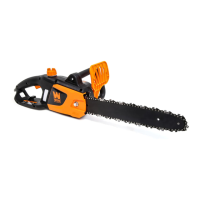
The WEN 14-inch Electric Chainsaw, Model 4015, is a corded power tool designed for sawing wood. It is engineered for dependability, ease of operation, and operator safety, providing years of rugged, trouble-free performance when properly cared for and used for its intended purpose.
Function Description
The primary function of this electric chainsaw is to cut wood. It features a 14-inch guide bar and a saw chain that is driven by a universal motor. The tool is equipped with an auto-oiling system to ensure the chain and guide bar are properly lubricated during operation, which is crucial for minimizing wear and maximizing the lifespan of the tool. An oil level indicator allows users to monitor the remaining oil in the reservoir, prompting refills when the level drops below one-quarter capacity.
The chainsaw is designed with user safety in mind, incorporating features such as a safety button that must be pressed before the trigger switch can activate the tool, preventing unintentional starting. The handles are designed for a firm grip, with the rear handle for the right hand and the front handle for the left, to help resist kickback forces and maintain control. A front handle guard further enhances safety during use.
The cable strain relief notch, located underneath the trigger switch, helps secure an extension cord, preventing accidental unplugging during operation. This ensures a continuous power supply and reduces interruptions.
Usage Features
Before operating the chainsaw, users must ensure several preparatory steps are taken. These include inspecting the chainsaw for any damage to the housing, saw chain, and guide bar. The oil tank fill level must be checked, and the reservoir refilled with standard bar and chain oil if necessary, as operating without sufficient oil can damage the chainsaw. Chain tension is also a critical aspect of safe and effective operation; it should be checked every 10 minutes, especially with new saw chains, and adjusted to ensure the chain can be lifted approximately 1/8 inch (3 mm) from the center of the guide bar.
When installing the guide bar and chain, users should place the saw on a firm, level surface. The blade cover nut is removed, and the saw chain is wrapped around the guide bar, ensuring the teeth face the correct direction, as indicated by a decal on the bar. The chain must be properly seated in the guide bar slot and around the sprocket. The chain tensioning pin needs to be aligned with the guide bar's pin hole, and the chain tensioning screw is used to adjust its location. After preliminarily tightening the guide bar, the cover is replaced and secured by tightening the blade cover nut. Final chain tension adjustment is then performed using a flat-head screwdriver to tighten or loosen the chain tensioning screw, followed by re-tightening the blade cover nut. Over-tensioning should be avoided as it can lead to excessive wear.
For turning the tool ON, the safety button must be pressed, followed by squeezing the trigger. The safety button can be released once the tool has started. To turn the tool OFF, the trigger switch is simply released.
The chainsaw is specifically intended for cutting wood and should not be used for plastic, masonry, or other non-wood materials, as this can lead to injuries, machine damage, and void the warranty. Users are advised to let the saw work at its own pace and avoid forcing the cut.
Special attention is given to preventing kickback, which occurs when the guide bar tip touches an object or when the wood pinches the saw chain. To minimize kickback, users should maintain a firm grip, avoid overreaching, and not cut above shoulder height. Only replacement bars and chains specified by WEN should be used, and the manufacturer's sharpening and maintenance instructions must be followed.
When felling a tree, users should plan an escape path, consider the tree's natural lean, branch locations, and wind direction. Dirt, stones, and other debris should be removed from the tree. A notch, one-third the tree's diameter, is made perpendicular to the direction of fall, starting with the lower horizontal cut. The felling back cut is made at least 50mm higher than the notching cut, parallel to it, leaving enough wood to act as a hinge. Once the tree begins to fall, the chainsaw should be removed, the motor stopped, and the planned retreat path used.
For bucking logs (cutting into lengths), proper footing and weight distribution are essential. Logs should be supported by limbs, other logs, or chocks. Different cutting techniques are applied based on how the log is supported: overbucking from the top for logs supported along their entire length, underbucking then overbucking for logs supported on one end, and overbucking then underbucking for logs supported on both ends. When bucking on a slope, users should stand on the uphill side. The saw chain should never contact dirt or soil, as this dulls the cutting links.
Limbing a tree involves removing branches from a fallen tree. Larger lower limbs should be left to support the log off the ground, while smaller limbs are removed in one cut. Branches under tension should be cut from the bottom up. Sawing techniques emphasize starting with lower branches, pulling the saw out of a cut only while it's running, and avoiding sawing with the guide bar tip or into branch formations. For smaller branches, the stop face of the saw is placed on the branch, and the saw is guided through from top to bottom with light pressure. For larger branches, a relief cut (one-third diameter from bottom to top) is made before sawing from top to bottom for the remaining two-thirds. Longer branches should be cut in sections to maintain control.
Maintenance Features
Regular maintenance is crucial for the chainsaw's longevity and safe operation. Before any adjustment, inspection, or cleaning, the tool must be unplugged to prevent personal injury and electric shock.
Cleaning involves brushing or blowing dust and debris out of the air vents using compressed air or a vacuum, ensuring they remain free of obstructions. The housing and plastic components should be wiped with a moist, soft cloth, avoiding strong solvents or detergents that could cause damage or shock hazards. It is important to routinely clean dust and debris that accumulates under the tension housing, around the oil outlet, and the bar and chain sprocket, as this can jam the sprocket, chain, and lubrication system.
For storage, the tension should be removed from the saw chain, and the oil tank drained. The chainsaw should be stored in a cool, dry place, away from direct sunlight or temperatures exceeding 104°F, such as inside a vehicle or metal building during summer. Before storing, users should thoroughly examine the chainsaw for worn, loose, or damaged parts.
Any repairs or replacement of electrical parts must be performed by a qualified technician using identical WEN replacement parts to ensure safety and prevent product failure. The tool's double-insulated electrical system eliminates the need for grounding, but servicing requires extreme care and knowledge of the system. For polarized plugs, if the plug does not fit the outlet, it should be reversed; if it still doesn't fit, a qualified electrician should install a proper outlet. A Ground Fault Circuit Interrupter (GFCI) is recommended for the circuit or outlet used for the power tool to reduce electric shock risk.
Extension cords must be properly sized for the current draw to prevent voltage drop and overheating. Users should examine extension cords before use, replace damaged ones, and avoid pulling on the cord to disconnect it. Extension cords should be protected from sharp objects, excessive heat, and damp/wet areas. A separate, 12-gauge electrical circuit protected with a 15A time-delayed fuse is recommended for the tool.


 To Next Page
 General