
 Need help?
Do you have a question about the Westinghouse Alloy and is the answer not in the manual?
Lists the essential tools needed for the safe and proper installation of the ceiling fan.
Illustrates downrod and vaulted ceiling installation options for the fan.
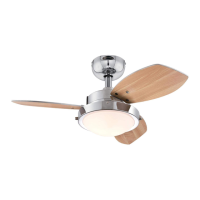
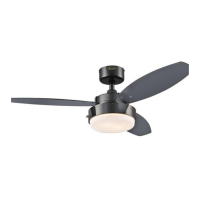
Details the dual-finish design of the fan blades, allowing style customization.
Instructions for installing the mounting bracket to the ceiling outlet box.
Diagram and guide for making correct electrical connections to the fan.
Remedies for issues when the fan fails to power on, checking fuses, wiring, and switches.
Solutions for fan noise, focusing on screw tightness and avoiding certain speed controls.
Procedures to eliminate fan wobble by checking blade and mount security, and blade interchange.
Troubleshooting steps for when the fan's light fixture is not functioning.
This document is an owner's manual for a Westinghouse Alloy LED ceiling fan, model number 7876435, with LED Module# SMJD-3V16W2P3. It provides instructions for installation, operation, and maintenance, along with safety tips and troubleshooting information.
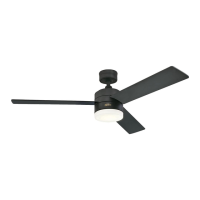
The Westinghouse Alloy LED ceiling fan is designed to provide air circulation and illumination for indoor spaces. It features a motor that drives fan blades to create airflow and an integrated LED light kit for lighting. The fan operates on a 240V~50Hz power supply. The fan's direction can be reversed to optimize airflow for different seasons: a downward airflow for cooling in warm weather and an upward airflow to circulate warm air off the ceiling in cool weather. The fan speed and light are controlled via pull chains.
The fan offers flexible installation options, including downrod installation for normal ceilings and vaulted ceiling installation, which may require a longer downrod (sold separately). A key feature is the "Combo-Blade" design, where each blade has two high-quality finishes, allowing users to choose the finish that best complements their decor by simply flipping the blade. The fan's operation is straightforward, with a pull chain controlling the fan speeds: one pull for low, two for medium, three for high, and four pulls to turn the fan off. A slide switch on the fan body controls the direction of rotation (forward or reverse). For warm weather, the fan should operate in the "down" position (counterclockwise) to create a cooling effect. For cool weather, it should be in the "up" position (clockwise) to move warm air off the ceiling. It is important to turn off the fan and wait for it to stop before changing the forward/reverse slide switch setting. The fan is designed for indoor use (IP20 rating) and is not suitable for bathrooms or damp areas.
Regular maintenance is recommended to ensure the fan's longevity and appearance. Users should periodically check the support connections, brackets, and blade attachments, ideally twice a year, to ensure they remain secure, as natural fan movement can cause connections to loosen over time. Cleaning the fan periodically helps maintain its new appearance. It is crucial to avoid using water for cleaning, as this can damage the motor, wood components, or cause electrical shock. Instead, a soft brush or lint-free cloth should be used to clean the fan to prevent scratching the finish. The plating on the fan is sealed with a lacquer coating to minimize discoloration or tarnishing. The fan's motor is permanently lubricated, meaning there is no need to oil it. In case of unusual oscillating movement, users are advised to immediately stop using the fan and contact the manufacturer, service agent, or a qualified person. The replacement of parts of the safety suspension system device or the light source should only be performed by the manufacturer, its service agent, or a similar qualified person. Troubleshooting tips are provided for common issues such as the fan not starting, making noise, wobbling, or the light not working, guiding users to check connections, switch positions, and blade attachments before seeking professional assistance.
 General
| Manual | Yes |
|---|---|
| Package type | Box |
| Package depth | 306 mm |
| Package width | 595 mm |
| Package height | 255 mm |
| Package weight | 6500 g |
| Type | Household blade fan |
| Airflow | 10440 m³/h |
| Placement | Ceiling |
| Noise level | 49 dB |
| Fan diameter | 1320 mm |
| Certification | CE, GS |
| Product color | Nickel |
| Fan speed (max) | 180 RPM |
| Auto oscillating | - |
| Housing material | Plywood, Steel |
| Number of fan blades | 3 |
| Bulb type | LED |
| Bulb power | 40 W |
| Number of bulbs | 2 bulb(s) |
| Fitting/cap type | E27 |
| AC input voltage | 230 V |
| Power source type | AC |
| AC input frequency | 50 Hz |
| Power consumption (typical) | 55 W |
| Sustainability certificates | RoHS |
 Weight and Dimensions
| Weight | 5700 g |
|---|

 To Next Page