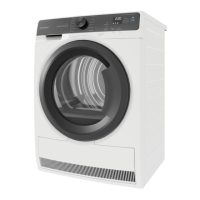
This document is a user manual for Westinghouse Clothes Dryers, specifically models WDV656N3WB and WDV556N3WB. It provides comprehensive information on safety, installation, operation, troubleshooting, and warranty.
Function Description
The Westinghouse Clothes Dryer is designed to efficiently dry clothes, towels, and linen. It offers various drying programs tailored to different fabric types and desired dryness levels, aiming to reduce drying times, save energy, and prevent damage to garments. The dryer incorporates features like an anti-crease cycle and a lint filter to optimize performance and garment care.
Important Technical Specifications
- Models: WDV656N3WB and WDV556N3WB.
- Capacity:
- WDV556N3WB Dryer: 5.5 kg
- WDV656N3WB Dryer: 6.5 kg
- Power Supply: Designed to be plugged directly into an AC power supply that is properly earthed and has the correct voltage. The serial number sticker provides voltage information.
- Venting Options:
- Front venting (standard).
- Rear venting (using an optional venting kit).
- Exhaust Duct: If a venting kit is used, the exhaust duct must not exceed 2 meters in length at 100mm diameter.
- Drum Rotation: The drum rotates in both clockwise and anti-clockwise directions to reduce tangling and ensure more even drying.
Usage Features
- Control Panel: Features a Program Selector knob, a Start/Pause button, and LED indicators for various states (Drying, Cooling, Anticrease, Paused, End, Alarm/Error).
- Drying Programs:
- Time Dry: Offers selectable drying times (30, 60, 90, 120, 150 minutes) for cotton fabrics.
- Extra Cottons Dry (Full load): For thick fabrics like cotton towels and jeans.
- Cupboard Cottons Dry (Full load): For cotton underwear and fabrics that do not need ironing.
- Iron Cottons Dry (Full load): For cotton polo shirts, T-shirts, and fabrics that need ironing.
- Extra Mixed Dry (Half load): For thick mixed loads of cotton and synthetics.
- Cupboard Mixed Dry (Half load): For mixed loads of cotton and synthetics that do not need ironing.
- Iron Mixed Dry (Half load): For mixed loads of cotton and synthetics that need ironing.
- Eco Cotton (Full load): For drying cotton with "Cotton Cupboard" dryness level, emphasizing maximum energy saving.
- Delicate (3.5 kg): For heat-sensitive fabrics like silk, fine fabrics, and lingerie.
- Airing 30 (1-1.5 kg): Circulates air without heat to shake out dust and refresh clothes for 30 minutes.
- Operating Sequence:
- Load: Load the dryer loosely, no more than two-thirds full, to allow clothes to tumble freely. Overloading reduces efficiency, increases drying time, and creasing. Avoid dripping wet items or items with sand/grit.
- Switch On: Ensure the door is completely closed.
- Select Program: Turn the Program Selector knob to choose the desired drying program. The knob remains in this position throughout the cycle.
- Start/Pause: Press the Start/Pause button to begin or pause the cycle. The dryer will not start if the door is open (indicated by 6 beeps and DRY LED blinking 4 times). Turning the knob mid-cycle will result in 3 beeps and the cycle will not continue unless the knob is returned to the original program.
- Turn Off: After the cycle, turn the Program Selector knob to "OFF" and switch off power at the power point.
- Anti-Crease Cycle: Designed to prevent creases after the normal drying cycle. The drum rotates for 5 seconds every minute for 1 hour. This phase cannot be disabled but can be stopped by opening the door and removing clothes.
- Buzzer: Can be enabled or disabled by selecting "Delicate" and holding the Start/Pause button for 3 seconds.
- Checking the Load: The door can be opened mid-cycle to check dryness or add clothes. The dryer will beep, and the cycle can be resumed by closing the door and pressing Start/Pause. For best performance, add or remove clothes only at the beginning of the cycle.
- Reversing Action: The drum's bi-directional rotation helps reduce tangling and ensures more even drying.
- Drying Guide:
- Always check care labels for drying symbols.
- Permanent press and synthetics should be removed promptly to reduce wrinkles.
- Woollen articles are not recommended; if dried, pull to shape and dry flat.
- Woven and loop knit materials may shrink; avoid "Extra" setting and stretch immediately after drying.
- Fibre and leather materials require manufacturer's instructions.
- Acrylic baby clothes/sleepwear should use the "Iron" setting.
- Do not dry rubber/plastic items (aprons, bibs, shower caps, foam rubber pads, etc.) due to fire risk.
- Fibreglass is not recommended as particles can irritate skin.
- Fabric softeners or similar products should only be used if specifically recommended by the manufacturer. Sheet-type fabric conditioners are advised against as they can block the lint filter.
- Hints for Optimal Drying:
- Sort laundry by fabric type (heavy items take longer).
- Avoid drying dark clothes with light-colored items to prevent lint transfer.
- Separate lint "givers" (towels, nappies) from lint "collectors" (corduroy, synthetics).
- For still-damp items, add a 30-minute Time Drying program, especially for multilayered or very small items.
- Close fasteners (studs, hooks, zips) and tie belts/strings to prevent tangling.
- Spin loads as dry as possible in the washing machine to save time and money.
- Briefly pre-spin easy-care items (e.g., shirts) before drying to reduce creases.
- Use fabric softener in the wash or a fabric conditioner for tumble dryers to avoid static charge.
- Remove laundry when dry; do not over-dry to avoid creasing and save energy.
- Wash clothes with sand or grit first.
- Be aware that drying time is affected by voltage fluctuations, room temperature, and humidity.
- Do not dry delicate items like net curtains, wool, silk, items with metal trim, bulky materials (anoraks, blankets, sleeping bags, feather quilts), or items containing rubber foam.
- Do not dry undergarments with metal reinforcements; place them in a bag designed for this purpose.
- Empty pockets of clips, pens, nails, pins, matches, or lighters to prevent damage and fire.
Maintenance Features
- Lint Filter Cleaning: The lint filter must be cleaned after every load to reduce drying times, save energy, and prevent overheating.
- To remove: Open the door, press the two pads together, and pull the filter out.
- To clean: Open the filter and wipe or peel off the lint.
- To replace: Ensure the filter "Clicks" into place.
- Never operate the dryer without the lint filter.
- Do not allow lint to build up around the dryer.
- Replace torn or damaged lint filters immediately.
- Overloading can increase lint build-up.
- Periodic cleaning by a qualified service technician is recommended to avoid fire hazards, especially when changing mounting from upright to inverted.
- Troubleshooting: The manual provides a troubleshooting guide for common issues like the dryer not starting or clothes remaining wet, with possible causes and solutions. It advises checking the plug, fuse, door closure, load size, selected drying time, room temperature, and lint filter.
- Alarm Code Indicator:
- Dry LED blinks 4 times, End LED off: Appliance door is open or not closed correctly.
- Dry LED blinks 11 times, End LED off: Main supply is unstable.
- Dry LED blinks 9 times then off, End LED blinks 1 time: Communication error between electronic boards.
- Accessories: Optional venting kits (DVK005K - Through the wall, DVK006 - Universal flexible hose) can be purchased from appliance shops or Electrolux Home Products Pty. Ltd. Spare Parts Centre. Only approved kits should be used.
- Ventilation: Adequate airflow is crucial to prevent overheating. If a venting kit discharges exhaust outside the room, ensure adequate ventilation to avoid backflow of gases from other fuel-burning appliances. Exhaust air must not be discharged into a flue used for other fumes. Do not install the dryer in a cupboard or small un-vented laundry unless using a venting kit.

 Need help?
 General

 To Next Page