
 Need help?
Do you have a question about the Whirlpool R-106 and is the answer not in the manual?
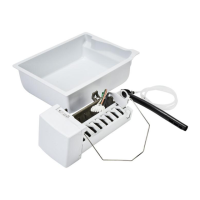
Overview of the compact icemaker used in French door refrigerators.
Steps to remove the storage bin and cover from the icemaker assembly.
View of the icemaker after bin and cover removal, showing access.
Explains the unique features of the Mid-South compact icemaker's operation.
Water enters the mold and freezes, cooled by freezer air.
Thermostat closes, energizing heater and motor to melt ice.
Mold heater melts ice, ejector blade pushes ice out of the mold.
Ejector blade rotates again to eject any remaining ice.
Water valve opens for refill, cycle ends, ready for next freeze.
How to adjust the water fill volume using a screw.
Steps to manually start an ice ejection cycle.
Highlights ON/OFF switch and Thermal Cut out in Mid-South design.
Steps to remove the front cover to access internal components.
Shows the icemaker with the cover removed, exposing key components.
Detailed instructions on how to adjust the water fill amount.
Steps to manually start the ice harvest process.
Visual guide on turning the drive gear to start a harvest cycle.
How to release and remove the wire harness cover.
Details of the cover release mechanism.
Steps to physically remove the icemaker unit.
Procedure for disconnecting the wiring harness.
Demonstrates how to slide out the assembled icemaker.
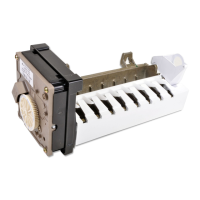
Introduces the Modular Ice Maker and its basic design.
How to adjust the water fill for the modular icemaker.
Locating and understanding the test points on the module.
Explains how wiper contacts control the cycle.
Detailed breakdown of the modular icemaker's operational cycle.
How to perform resistance checks on icemaker components.
Specific resistance values for heater, motor, and water valve coil.
How to use a jumper wire for testing.
Using a jumper wire to energize specific electrical loads.
Procedure for manually initiating an ice harvest cycle.
Steps for performing a test cycle and diagnosing issues.
Common causes and checks for lack of ice production.
Common causes and checks for reduced ice production.
Specific fault diagnosis for compact icemakers.
Specific fault diagnosis for modular icemakers.
Expected ice production rates for different refrigerator types.
Compares ice production rates for different models.
Importance of freezer temperature for ice production.
How cube size and quality indicate water supply issues.
Common water supply problems affecting ice production.
Recommends drill type over self-tapping saddle valves.
Specifies the correct water fill volume for icemakers.
Method for checking water fill using a baby bottle.
Explains the safety interlock system related to door position.
Initial visual checks for no ice production.
Checking the mold for ice and potential water supply issues.
Manually initiating the harvest cycle.
Verifying voltage supply to the icemaker.
Checking for mold heat and water valve operation.




 To Next Page
 General