
 Need help?
Do you have a question about the Whirlpool WH43S1E and is the answer not in the manual?
Clean the appliance interior with a mixture of warm water and baking soda.
Clean the exterior surface with warm water and mild detergent.
Clean the door gasket frequently to ensure a proper seal.
This document is a Use and Care Guide for a Whirlpool refrigerator, Model No. WH43S1E. It provides comprehensive instructions for the safe and proper operation, maintenance, and troubleshooting of the appliance.
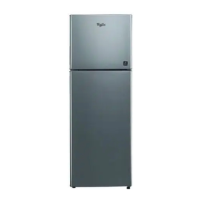
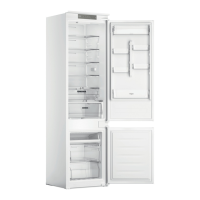
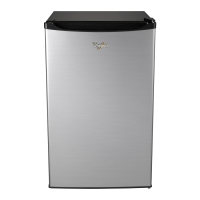
This Whirlpool refrigerator is designed for household use, providing a cooling environment for food storage. It features a freezer compartment for frozen items and a main refrigeration section for fresh food. The appliance uses R600a refrigerant, which is a flammable substance, emphasizing the importance of proper handling and servicing by authorized personnel. The temperature is controlled manually via a dial, allowing users to adjust the cooling intensity. The refrigerator is intended to be a free-standing unit and should not be built-in or placed in a recessed area, ensuring proper air circulation.
The guide outlines several key usage features to ensure optimal performance and safety. Before initial use, all packing materials, including the foam base and adhesive tape holding accessories, must be removed. The refrigerator should stand upright for 4 hours before being plugged into a grounded 3-prong outlet. The temperature control dial, located inside the refrigerator, allows users to set the desired cooling level. The numbers on the dial indicate relative cooling intensity, with larger numbers corresponding to cooler interior temperatures. A setting of "4" is recommended for normal use, while "5-7" provides cooler temperatures and "1-3" provides warmer temperatures. To stop cooling without switching off the power, the dial can be turned to "0".
For efficient operation, food should be stored in sealed containers to prevent odors and drying. Hot food should be cooled down before being placed in the refrigerator to avoid increasing the interior temperature and power consumption. Frequent opening of the door should be minimized to conserve energy.
The refrigerator is equipped with leveling legs on the front corners, which can be adjusted to ensure the appliance is stable and slightly sloped backward, allowing the door to close tightly. This adjustment is crucial for proper function and door sealing.
Regular maintenance is essential for the longevity and efficiency of the refrigerator. The guide provides detailed instructions for cleaning both the interior and exterior of the appliance. The interior should be cleaned with a mixture of warm water and baking soda (1-2 tablespoons per quart of water), using a sponge or soft cloth. Excess moisture should be wiped away, especially around the controls, and the interior should be rinsed thoroughly with warm water and dried with a clean, soft cloth. The exterior surface can be cleaned with warm water and mild detergent, rinsed, and dried with a clean, soft cloth.
The door gasket requires frequent cleaning to maintain a proper seal, which is critical for energy efficiency and preventing frost buildup.
Defrosting the freezer section is a key maintenance task. Frost buildup exceeding 1/4 inch (0.64 cm) increases energy consumption and reduces efficiency. To defrost, food and ice cube trays should be removed from both compartments. If the model includes a drip tray, it should be placed under the freezer compartment to collect water, and may need to be emptied multiple times during the process. The unit should be turned off and unplugged from the outlet. The defrosting process can take several hours, and opening the door can speed it up. Once defrosted, the compartment should be wiped with a soft cloth to remove any remaining water, and the refrigerator temperature should be reset. A critical warning is given against using sharp or pointed objects to remove frost or ice, as this can damage the compartment walls and cooling coils, voiding the warranty.
The guide also covers procedures for handling power failures and preparing the refrigerator for vacations. During a power failure, additional food should not be added, and the door should remain closed. For extended vacations, all food should be removed, the appliance turned off and unplugged, and the interior cleaned with the door left open.
For moving the refrigerator, specific steps are provided: turn off and unplug the unit, remove all food, securely tape down loose items, and tape the door shut. It is advised not to lift or pull the door or door handle during transportation. The appliance should not be tilted over 45 degrees to prevent damage to the sealed system, and strong vibration or impact should be avoided.
Instructions for reversing the door are also included, detailing the removal and reinstallation of hinges and leveling legs. This process requires careful attention and ensures the appliance is not tilted over 45 degrees to prevent damage.
Finally, the guide provides instructions for replacing the interior light, which involves moving the lamp cover, taking it out, rotating the bulb counterclockwise to remove it, and then replacing the bulb and reinstalling the lamp cover.
 General
| Appliance placement | Freestanding |
|---|---|
| Product colour | White |
| Door hinge | Right |
| Reversible doors | Yes |
| Number of compressors | 1 |
| Fridge interior light | Yes |
| Lamp type | LED |
| Number of shelves/baskets in fridge | 4 |
| Door balconies | 4 |
| Egg balcony | Yes |
| Bottle rack | Yes |
| Number of shelves/baskets in freezer | 3 |
| Ice cube tray | Yes |
| Brand | Whirlpool |
| Model | WH43S1E |
| Category | Refrigerator |
| Star Rating | 4 |
| Color | White |
| Cooling Technology | Static |
| Defrost System | Manual |
| Door Lock | No |
| Climate class | SN-T |
| Width | 60 cm |
| Depth | 655 mm |
| Type | Freezer |


 To Next Page