This document is a user manual for a refrigerator, providing comprehensive information on its use, care, and maintenance.
Function Description:
The refrigerator is designed for storing fresh and frozen food and beverages. It features a refrigerator compartment and a freezer compartment. The refrigerator compartment operates with an automatic defrosting system, where occasional water drops on the back wall indicate the defrosting phase. The defrosting water is channeled into a drain and evaporates. The freezer compartment is designed for long-term storage of frozen food and for freezing fresh food. The appliance incorporates a "Total No Frost" system, which prevents ice formation in both the freezer and fridge cavities through a ventilation system that circulates cold air, eliminating the need for manual defrosting.
Important Technical Specifications:
- Lighting System: The refrigerator compartment uses LED lights for better illumination and lower energy consumption compared to traditional light bulbs.
- Freezing Capacity: The quantity of fresh food that can be frozen in 24 hours is specified on the rating plate.
- Storage Temperatures: Ideal storage temperatures for food are preset at the factory.
- Energy Consumption: The compressor operates at an optimum speed to minimize energy consumption.
Usage Features:
- First Time Use: After installation, wait at least two hours before connecting the appliance to the power supply. Allow 4-6 hours for the correct storage temperature to be reached after turning on. An antibacterial anti-odour filter (if available) should be positioned in the fan. An acoustic alarm may sound if the temperature alarm is activated, which can be switched off by pressing a button.
- Refrigerator Compartment:
- Multiflow Air Distribution: Ensures even distribution of cold air for better food preservation. Food can be placed on any shelf, but care should be taken not to obstruct air distribution vents.
- Food Storage Guidelines: Foods that emit large amounts of ethylene gas (e.g., apples, pears) and those sensitive to it (e.g., fruits, vegetables, salad) should be stored separately or wrapped to extend storage life. Avoid storing food too close together to allow for air circulation. Use recyclable plastic, metal, aluminum, glass containers, and cling film for wrapping. For small quantities of food, use shelves above the crisper as it's the coolest area. Liquids and odorous foods should be in closed containers. A bottle holder (on selected models) can prevent bottles from falling.
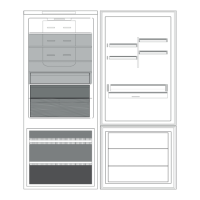
- Storage Zones: The manual defines specific zones for different types of food:
- ZONE: Tropical fruit, cans, drinks, eggs, sauces, pickles, butter, jam.
- COOL ZONE: Cheese, milk, daily food, delicatessen, yogurt.
- COOLEST AREA: Cold cuts, desserts, meat, fish (for models with "0° ZONE" COMPARTMENT, this is the highlighted area).
- FRUIT & VEGETABLE DRAWER: For storing fruits and vegetables.
- Freezer Compartment:
- Food Arrangement: Arrange fresh food in the freezing area, leaving space for air circulation. Do not refreeze partially defrosted food. Wrap food to prevent water, humidity, or condensation penetration.
- Tray:* Useful for accessing frequently used products, freezing, or storing small items.
- Ice Cubes: Fill the ice tray 2/3 with water and place it in the freezer. Do not use sharp objects to remove ice.
- Removing Drawers: Drawers can be pulled out, lifted, and removed to increase freezer volume. Ensure the door is closed properly after replacing food on grilles/shelves.
- Door Reversibility: The direction of door opening can be changed, but if performed by After-sales Service, it may not be covered by warranty. Instructions are in the Installation Guide.
- Accessories:*
- Egg Tray, Bottle Rack, Refrigerator Pad, Freezer Pad, Ice Tray, Knob Humidity Control, Humidity Control, Tuck Shelf.
- Humidity Control:* A regulator (position B for less humid, position A for more humid) allows adjusting humidity for storing fruits or vegetables.
- Tuck Shelf:* A rail system allows this shelf to slide under the front, creating extra space for tall bottles or pitchers.
- Freezer Pad (Alu PAD)*: A metallic panel that helps freeze food faster. It can be removed from the left corner for cleaning.
- Refrigerator Pad:* The fruit & vegetable drawer is equipped with a hygiene grid. This grid prevents contact with natural leakages and is treated with Microban SilverShield® technology to reduce harmful bacteria by up to 99.9%. It can be removed for cleaning by hand or in a dishwasher.
- Storage Times for Home Frozen Foods: Detailed tables provide recommended storage periods for various products in both frozen (-12°C, -18°C, -24°C) and unfrozen (0-3°C, 3-6°C, 6-8°C) compartments.
Maintenance Features:
- Cleaning and Maintenance:
- Always unplug the appliance or disconnect the electrical power supply before cleaning or maintenance.
- Do not use abrasives, flammable fluids, or steam cleaners.
- Clean buttons and the control panel display with a dry cloth only, not alcohol or alcohol-derived substances.
- Clean the appliance occasionally with a cloth and a solution of warm water and neutral cleaning agents specifically made for refrigerator interiors.
- Gasket Replacement: The manual includes a visual guide for replacing the door gasket.
- In the Event of Non-Use:
- Disconnect from power, empty, defrost (if necessary), and clean.
- Keep doors slightly ajar to allow air circulation and prevent mold and bad odors.
- In the Event of a Power Interruption:
- Keep doors closed to maintain cold temperatures as long as possible.
- Do not refreeze partially defrosted food.
- A black-out alarm may activate during prolonged power cuts (in products with electronics).
- Functional Sounds: The manual explains normal operational sounds:
- Buzz from the compressor.
- Gurgling and crackles from refrigerant gas.
- Creaks from the product's structure when the compressor is active/inactive.
- Vibrations can be avoided by ensuring balconies, shelves, and drawers are properly attached and positioned.
- Avoid placing glass containers in direct contact to prevent vibrations.
- Increased compressor noise may occur in summer or when large quantities of food are stored, as the compressor increases speed to minimize energy consumption.
Spare parts will be available for a period of 7 to 10 years, according to specific Regulation requirements.

 Need help?
 General


 To Next Page