© by WilTec Wildanger Technik GmbH Item 52170 Page 9
http://www.WilTec.de
http://www.aoyue.eu 05 2021-1
http://www.teichtip.de
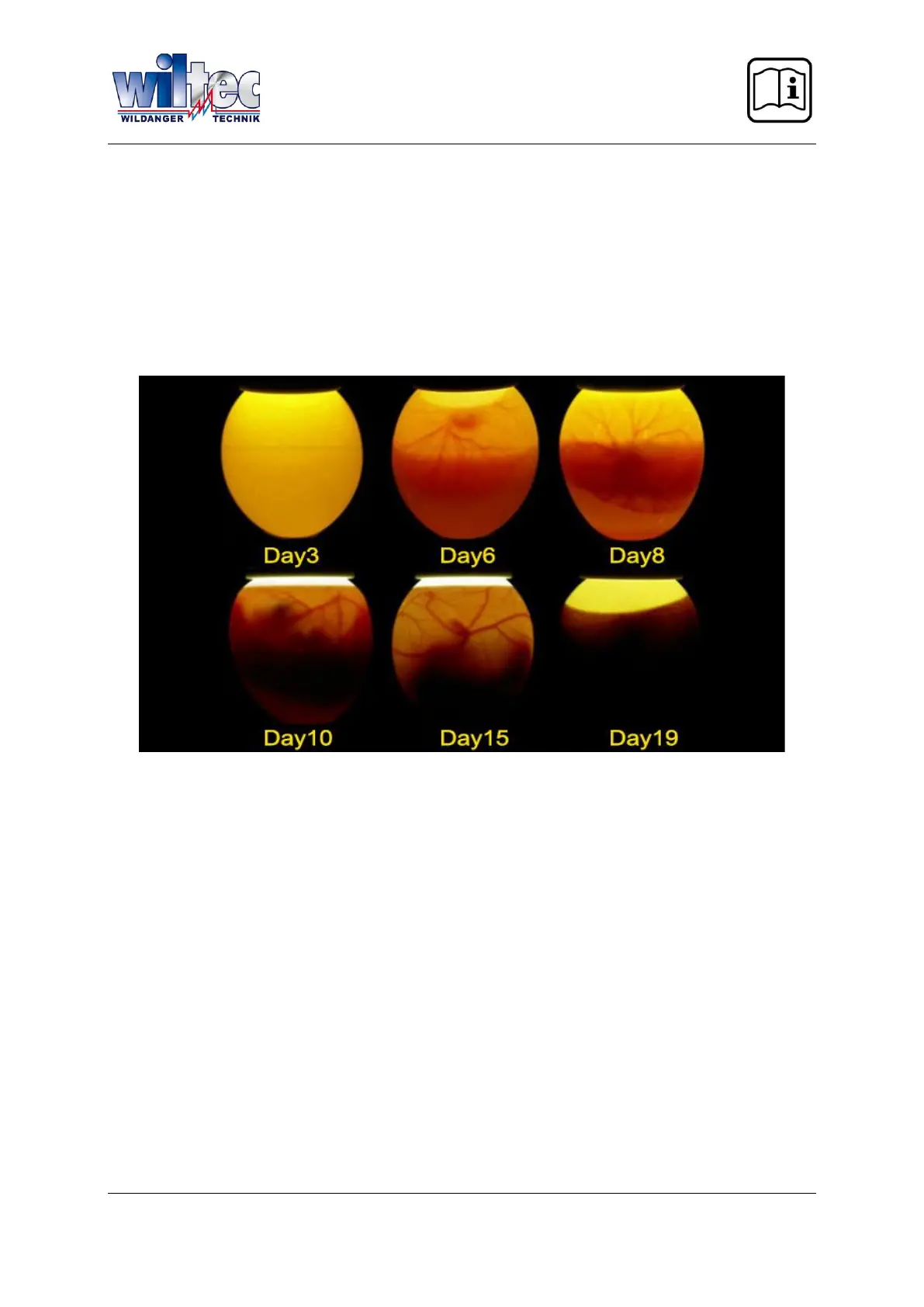
7. The first testing of the eggs (after 5–6 days): Mainly for checking the fertilisation of the eggs. Re-
move the unfertilised, yellow and dead eggs.
The second testing of the eggs (after 11–12 days): Mainly for checking the development of the em-
bryo. A well-developed embryo is bigger and has blood vessels inside it. The air cell should be big and
sectioned off noticeably.
The third test of the eggs (after 16–17 days): Illuminate the egg from the side. A well-developed em-
bryo is bigger and should fill the egg out nearly entirely, letting hardly any light through. If the embryo
is dead, the blood vessels in the egg blurred, parts near the air cell are discoloured yellow and the
sections between the egg and the air cell is not clearly defined.
8. Increase the air humidity during the breeding time and decrease the temperature. This disables the
water in the eggs from evaporating too fast. The most important factor is the air humidity though,
avoiding dehydration and the temperature decrease to avoid too high temperatures and too high hu-
midity. Especially if the hatching time is spreading out over a longer time. The temperature should not
be more than 37.5 ℃ in 19–21 days.


 To Next Page
 Loading...