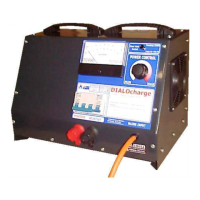
OPERATING THE DIALOcharge:
Both the voltage and the current of the DIALOc harge are controlled simultaneous ly with a single knob, providing an infinite
sel ection between the MINimum and MAXimum range. This is acheived by an analogue triac-driven, phase shitfing duty cycle
control of the MAINS ac input to the transformer. The OUTPUT dc voltage and current are battery and/or load dependant.
CONNECTING THE BATTERY:
Fit the INPUT and OUTPUT cables as described on page 6 : PREPARATIONS : CONNECTIONS
B EFORE MAK ING ANY EL ECTR ICAL CONNE CTI ONS, ENSURE THAT THE 2 40Va c MAI NS IS SWIT CHE D OFF !
•
Ensure the INPUT and OUTPUT circui t breakers are switched to the OFF position.
•
Rotate the POWER CONTROL knob anti-cloc kwise to the MIN position.
•
Connect th e BLACK cable clamp to the battery NEG ATIVE.
•
Connect th e RED cable clamp to the batt ery PO SITIVE.
•
Visually recheck that all the connections are safe and secure.
•
Switch the INPUT and OUTPUT c ircuit breakers to the ON position .
•
Note that the DualMeter will read zero. Press the Dual Meter Switch, the output voltage will be displayed. Release.
•
Slowly rotate the POWER CONTROL knob slowly clockwise until the needle of the DualMeter begins to move from zero.
(This indicates that the DIALOcharge output has matc hed t he battery voltage.)
•
Continue to rotate the knob clokwise to increase the current.
CHARGING THE BATTERY:
During the charging process, it is important to frequently visually test and read the battery voltage via the DualMeter.
FA ST CHARGING :
Fast charging is most useful for boost charging batteries on;
•
vehi cles that require a quick start
•
solar systems. This reduces the GenSet runtime.
The DIALOcharge has the ability to meet the maximum charge rate of the battery, according to its condi tion.
A battery in good condition will accept a much higher rate of charge more readily than an old, sulphated battery.
Batteries can be charged to 80% of full charge by fast charging. The remaining 20% will only be accepted by the battery if the
charging current is at a low rate.
Fast charging is normally quite safe, but it could be det rimental to the life of an old battery if undertaken to frequently.
NORMAL CHARGING :
Normal charging provides a more acceptable and beneficial recharge proces s.
Manually control the c harging current via the POWER CONTROL knob.
The higher the battery voltage and the lower the charging current, the more charged the bat tery is.
The lower the battery voltage and the higher the charging current, the less charged the battery is.
Whi le th e DIALOcharge will not all ow the chargin g current to exceed its maxi mum by means of electronic current limiting, the
user must not allow the battery voltage to exceed the voltages as listed in the table below;
FLAT CHARGING:
Batteries in th is condition have a very low specific gravity of the el ec trolyte and a very high int ernal resis tance. This inhibits
the amount of charging current the battery will draw. The POWE R CONTROL knob will need t o be rotat ed clockwis e clos er to
MAX, effecting a higher setting than normal to obtain even a small amount of c harge current. This is acceptable, but the result
is that the DIALOcharge will supply a higher voltage t o t he battery.
CARE MUST BE TA KEN AT THIS STAG E
As the DIALOcharge overcomes the high internal resistance of the bat tery, the charging current will begin to increas e. The
charging current may even rise to the DIALOcharge’ s maximum output. As the battery begins to accept c harge, the voltage
will reduce to a more realistic value relevent to the state of charge of the battery. Once the battery is becoming more and
more charged the current will decrease and the voltage will begin to climb. The user must not allow the battery voltage to
exceed the voltages as listed in the table above above.
OPERATIONS: OPERATIONS:
BATTERY
NO MI NIAL
VOLTAGE
2V 6V 12V 18V 24V 30V 36V 48V
MAXIMUM CHARGING
TERMINAL VOLTAGE
2.5V 7.5V 15V 22.5V 30V 37.5V 45V 60V
8


 To Next Page
 Loading...