OPERATING THE M18
Now that everything is prepared for operating the M18, please follow these instructions.
Radio System Rules
• Each time you prepare to run your M18, you must clear your frequency to be sure no one else in the area is using the same channel as you.
• There are six possible channels, numbered #1 through #6. Each is represented by a color. Look at the crystal plugged into the back of your
transmitter to determine which channel your M18 is assigned to.
• Always turn your M18 transmitter on fi rst and off last. This will help to prevent your M18 from receiving stray signals from another transmitter or
other source, and running out of control.
• Always have the transmitter turned on before you plug in the battery pack in the model (having the speed controller in ON position).
• Always use new or freshly charged batteries for the radio system. Weak batteries will limit the range of the radio signal between the receiver and the
transmitter. Loss of the radio signal can cause you to lose control of your M18.
RADIO SYSTEM TERMINOLOGY
Take some time to familiarize yourself with these radio system terms that
are used throughout this manual.
BEC (Battery Eliminator Circuitry)
BEC circuitry powers the receiver and steering servo from the main battery
pack. This eliminates the need for using a separate receiver battery pack
to power the radio equipment on the car.
Channel
The 27 MHz frequency band is divided into 6 channels so that up to 6
models can be operated simultaneously. Each channel is referred to by
its fl ag color and channel number according to the following table.
Channel Frequency (MHz) Flag Color
1 26.995 Brown
2 27.045 Red
3 27.095 Orange
4 27.145 Yellow
5 27.195 Green
6 27.255 Blue
Clearing your Frequency
A routine, verbal check to make sure nobody else in your area is
operating on the same channel. Always clear your frequency by calling
out your channel number before operating your model. If the channel is
already in use, wait until it is clear to use.
Crystal
The small, plug-in solid state in device that sets the operating frequency
(channel) on which the radio system will operate. For each channel there
are two crystals: one for the transmitter and one for the receiver. Each
crystal should be marked with either Tx (transmitter) or Rx (receiver).
It is recommended that you use only authentic XRAY crystal sets, and to
change both the transmitter and receiver crystal at the same time.
ESC (Electronic Speed Control)
The electronic device that controls the operation of the car’s motor. An
ESC provides precise, digital proportional throttle and braking control
and uses power very effi ciently so that car’s battery pack lasts a long time
and car runs longer. The ESC has circuitry that prevents loss of steering
and throttle control as the batteries lose their charge.
Frequency Band
The radio frequency band used by the transmitter to send signals to your
car. Your M18 radio system operates on the 27 MHz frequency band.
Neutral Position
The positions that the steering servo and ESC go to when the transmitter
controls are at their neutral settings.
NiMH
Refers to rechargeable, nickel-metal hydride (NiMH) batteries.
Receiver
The radio receiver inside your car that receives signals from the transmitter
and relays them to the steering servo and ESC.
Servo
Small electronic motor unit in your car that operates the steering
mechanism.
Transmitter
The hand-held radio unit that sends throttle and steering signals to your car.
Trim
The fi ne-tuning adjustment for the neutral position of the steering servo
and ESC, made by turning small knobs on the transmitter.
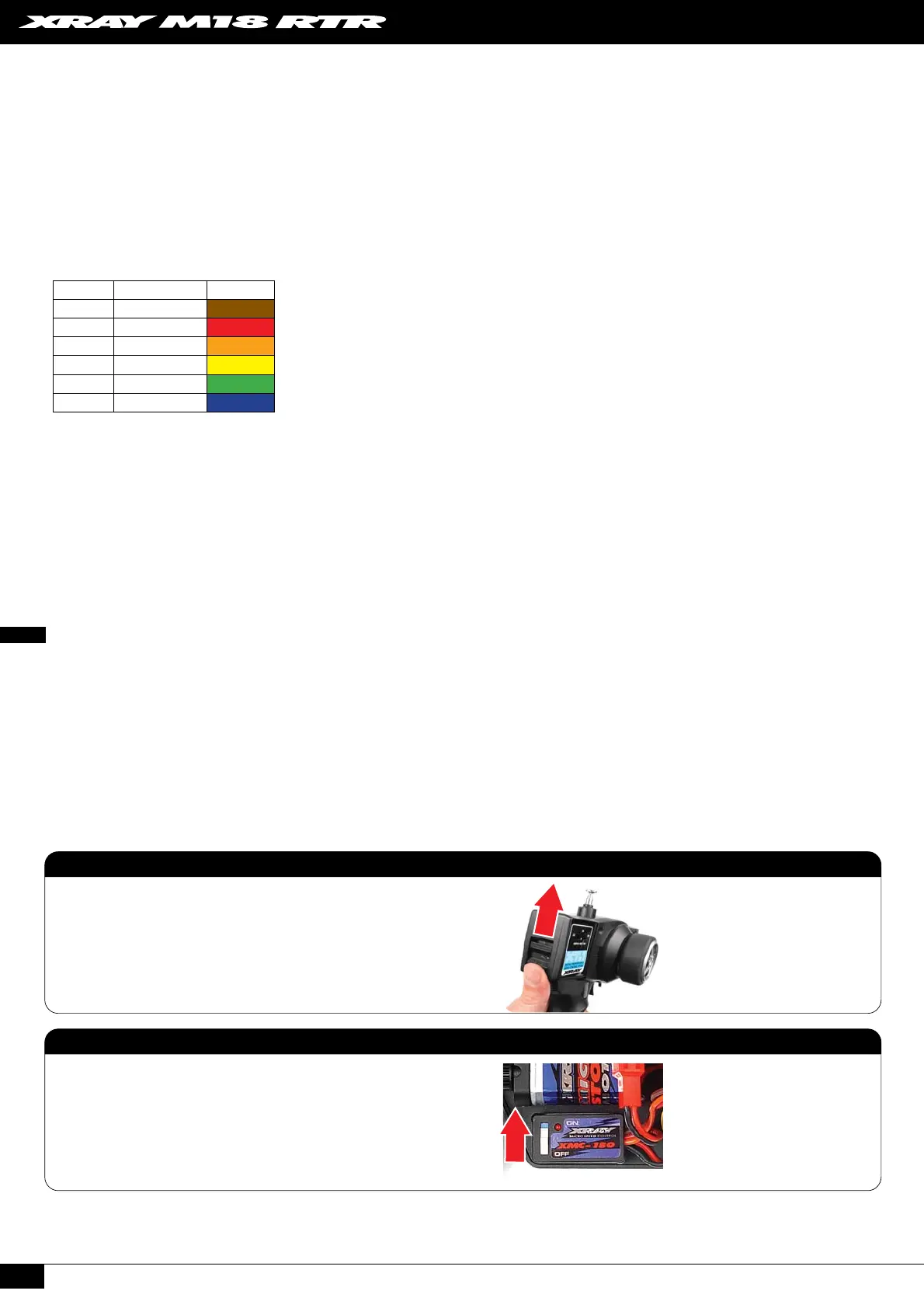
Always turn on the transmitter fi rst by sliding the power switch to the ON
position. The red light should go on. If the red light does not go on, check
for incorrectly installed batteries or weak batteries.
1. Turn on the Transmitter
After the transmitter is on, turn the ESC power switch to the ON position.
The electronics should activate. Check the radio range by walking away
from the car.
2. Turn on the M18
9


 To Next Page
 Loading...