EasyManua.ls Logo

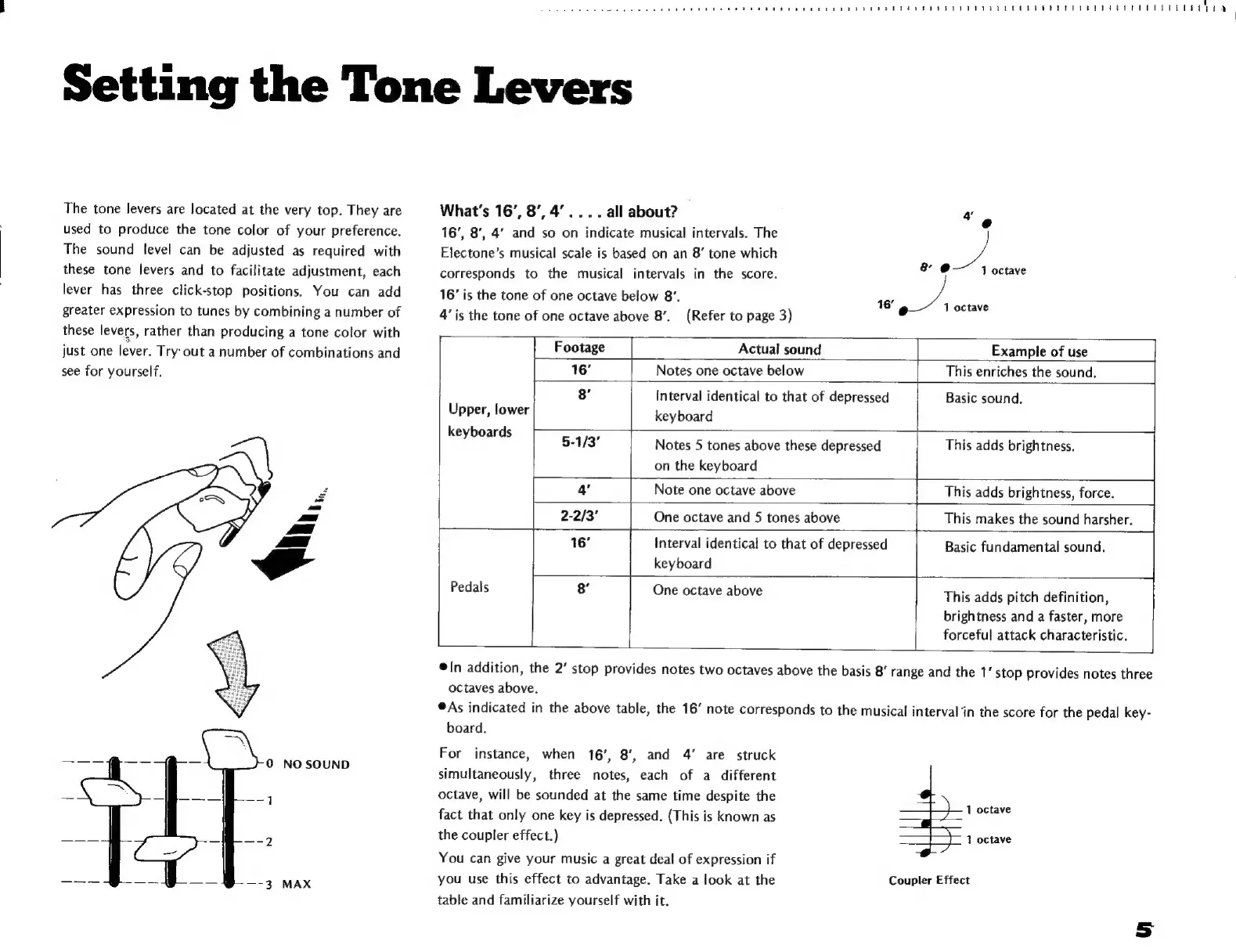
Yamaha D-85 - Setting Tone Levers; Understanding Footage (16, 8, 4); Tone Lever Combinations; Coupler Effect Explained

Yamaha D-85
36 pages
Print Icon
To Next Page IconTo Next Page
To Previous Page IconTo Previous Page
Loading...
|
ig
tw
yay
hae,
sa
re
$
oar
i
ge
w e
Ea
d
d 3
org
bd
rere
PEE
ETE
OG
EFE
IL
BL gl
gl
3
ti
OCH
ET
EER
RG
SULT
RL
ET
ULE
EEG
Papa
Setting
the
Tone
Levers
The
tone
levers
are
located
at
the
very
top.
They
are
used
to
produce
the
tone
color
of
your
preference.
The
sound
level
can
be
adjusted
as
required
with
these
tone
levers
and
to
facilitate
adjustment,
each
lever
has
three
click-stop
positions.
You
can
add
greater
expression
to
tunes
by
combining
a
number
of
these
levers,
rather
than
producing
a
tone
color
with
just
one
lever.
Try
out
a
number
of
combinations
and
see
for
yourself.
0
NOSOUND
-1
52
-3
MAX
What's
16’,
8',
4’...
.
all
about?
16’,
8',
4’
and
so
on
indicate
musical
intervals.
The
Electone’s
musical
scale
is
based
on
an
8“
tone
which
corresponds
to
the
musical
intervals
in
the
score.
16’
is
the
tone
of
one
octave
below
8’.
4'
is
the
tone
of
one
octave
above
8’.
(Refer
to
page
3)
16"
1
octave
Footage
Actual
sound
Example
of
use
16’
Notes
one
octave
below
This
enriches
the
sound.
Upper,
lower
keyboard
Interval
identical
to
that
of
depressed
Basic
sound.
keyboards
on
the
keyboard
Note
one
octave
above
Notes
5
tones
above
these
depressed
This
adds
brightness.
This
adds
brightness,
force.
keyboard
One
octave
and
5
tones
above
Interval
identical
to
that
of
depressed
This
makes
the
sound
harsher.
Basic
fundamental
sound.
One
octave
above
J
This
adds
pitch
definition,
brightness
and
a
faster,
more
forceful
attack
characteristic.
j
en
addition,
the
2’
stop
provides
notes
two
octaves
above
the
basis
8’
range
and
the
1'
stop
provides
notes
three
octaves
above.
9
As
indicated
in
the
above
table,
the
16’
note
corresponds
to
the
musical
interval
in
the
score
for
the
pedal
key-
board.
For
instance,
when
16',
8'
and
4'
are
struck
simultaneously,
three
notes,
each
of
a
different
octave,
will
be
sounded
at
the
same
time
despite
the
fact
that
only
one
key
is
depressed.
(This
is
known
as
the
coupler
effect.)
You
can
give
your
music
a
great
deal
of
expression
if
you
use
this
effect
to
advantage.
Take
a
look
at
the
table
and
familiarize
yourself
with
it.
1
octave
1
octave
Coupler
Effect

Related product manuals