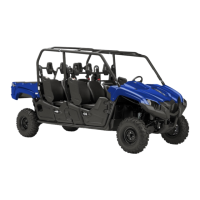
This document is the owner's manual for the Yamaha Viking VI, specifically models YXC70VPXN, YXC70VPHN, and YXC70VPRN. It provides comprehensive information on the vehicle's operation, maintenance, and safety.
Function Description
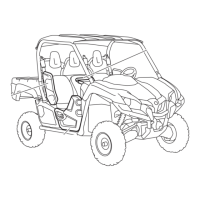
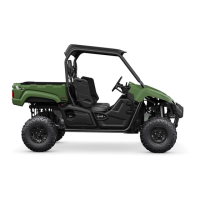
The Yamaha Viking VI is a recreational off-highway vehicle (ROV) designed for off-road use only. It is intended to carry a driver and five passengers, with a focus on sporting, touring, and racing applications. The vehicle features a multi-function meter unit that displays speed, odometer, tripmeters, clock, hour meter, voltage, fuel level, and error codes. It offers various drive modes, including 2WD (two-wheel drive), 4WD (four-wheel drive), and DIFF. LOCK (four-wheel drive with differential lock), allowing the operator to select the appropriate mode for different terrains and driving conditions. The vehicle is equipped with a cargo bed for carrying loads and a trailer hitch bracket and receiver for towing.
Important Technical Specifications
- Dimensions:
- Overall length: 3900 mm (153.5 in) for YXC70VPHN, YXC70VPXN; 4050 mm (159.4 in) for YXC70VPRN
- Overall width: 1570 mm (61.8 in) for YXC70VPHN, YXC70VPXN; 1625 mm (64.0 in) for YXC70VPRN
- Overall height: 1945 mm (76.6 in)
- Wheelbase: 2935 mm (115.6 in)
- Ground clearance: 290 mm (11.4 in)
- Weight:
- Curb weight: 769.0 kg (1695 lb) for YXC70VPXN; 772.0 kg (1702 lb) for YXC70VPHN; 795.0 kg (1753 lb) for YXC70VPRN
- Loading:
- Maximum load: 594.0 kg (1309 lb) (total weight of operator, passengers, cargo, and tongue weight)
- Cargo bed maximum load: 272.0 kg (600 lb)
- Pulling load (gross trailer weight): 6664 N (680 kgf, 1500 lbf)
- Tongue weight (vertical load on hitch): 490 N (50 kgf, 110 lbf)
- Engine:
- Combustion cycle: 4-stroke, liquid cooled
- Valve train: SOHC
- Number of cylinders: Single cylinder
- Displacement: 686 cm³
- Bore × stroke: 102.0 × 84.0 mm (4.02 × 3.31 in)
- Starting system: Electric starter
- Engine Oil:
- Recommended brand: YAMALUBE
- API service SG type or higher, JASO standard MA
- Viscosity grades: 5W-30, 10W-30, 10W-40, 15W-40, 20W-40, 20W-50
- Quantity (without oil filter replacement): 2.20 L (2.33 US qt, 1.94 Imp.qt)
- Quantity (with oil filter replacement): 2.30 L (2.43 US qt, 2.02 Imp.qt)
- Coolant:
- Recommended coolant: YAMALUBE coolant
- Quantity (radiator including all routes): 3.24 L (3.42 US qt, 2.85 Imp.qt)
- Quantity (coolant reservoir up to full level): 0.28 L (0.30 US qt, 0.25 Imp.qt)
- Fuel:
- Recommended fuel: Regular unleaded gasoline (Gasohol [E10] acceptable)
- Minimum research octane: 91
- Fuel tank capacity: 37 L (9.8 US gal, 8.1 Imp.gal)
- Fuel reserve amount: 9.0 L (2.38 US gal, 1.98 Imp.gal)
- Final Gear Oil:
- Type: SAE 80W-90 API GL-5 Hypoid gear oil
- Quantity: 0.40 L (0.42 US qt, 0.35 Imp.qt)
- Differential Gear Oil:
- Type: SAE 80W-90 API GL-5 Hypoid gear oil
- Quantity: 0.18 L (0.19 US qt, 0.16 Imp.qt)
- Tires:
- Front: 25x8-12NHS (MAXXIS/MU09)
- Rear: 25x10-12NHS (MAXXIS/MU10)
- Operating tire pressure (cold, 0.0–594.0 kg load): Front 145.0 kPa (21.0 psi) recommended, 140.0 kPa (20.3 psi) minimum; Rear 165.0 kPa (24.0 psi) recommended, 160.0 kPa (23.2 psi) minimum.
- Brakes: Hydraulic disc brake (front and rear)
- Suspension: Double wishbone (front and rear)
- Electrical System:
- System voltage: 12 V
- Battery: U1-H11L, 12 V, 28.0 Ah
- Headlight: HS1, 35.0 W/35.0 W
- Brake/tail light: 21.0 W/5.0 W
- Auxiliary DC jack system capacity: 10 A (120 W)
- Spark Plug: NGK/CPR7EA-9, gap 0.8–0.9 mm (0.031–0.035 in)
Usage Features
- Safety Information: Emphasizes reading the manual carefully, proper use of seat belts, wearing approved helmets and protective gear, and avoiding operation under the influence of drugs or alcohol. It also warns against operating on public roads, in deep or fast-flowing water, and carrying passengers in the cargo bed.
- Controls and Instruments: Details the main switch, indicator lights (low-range, high-range, neutral, reverse, parking brake, differential gear lock, helmet reminder, seat belt reminder), warning lights (engine trouble, coolant temperature, Electric Power Steering), multi-function meter, light switch, On–Command drive knob, accelerator pedal, brake pedal, parking brake lever, fuel tank cap, doors, seats (with driver seat adjustment), glove compartment, storage compartments, cup holders, cargo bed (with tailgate operation), shock absorber assemblies, trailer hitch bracket, and auxiliary DC jacks.
- Operation: Includes engine break-in procedures (0–15 hours), starting the engine, drive select lever operation (L, H, N, R), On–Command drive knob usage (2WD, 4WD, DIFF. LOCK), parking procedures (on flat areas and slopes), and loading guidelines.
- Safe Use Guidelines: Provides detailed instructions on knowing your vehicle, driver and passenger requirements, occupant protection system, proper use of seat belts, protective structure, steering wheel grip, and operating on different surfaces and terrains (hills, rough terrain, pavement, water, loose/slippery terrain, brush/wooded areas, encountering obstacles).
Maintenance Features
- Periodic Maintenance Charts: Detailed schedules for emission control system and general maintenance/lubrication, including initial and every-interval checks. Items marked with an asterisk require special tools, data, and technical skills, recommending a Yamaha dealer for service.
- Hood and Panels: Instructions for removal and installation of the hood and right rear panel to access internal components.
- Engine Oil and Oil Filter: Procedures for checking oil level, changing oil, and replacing the oil filter cartridge. Emphasizes using recommended YAMALUBE oil and avoiding chemical additives.
- Final and Differential Gear Oil: Instructions for checking oil levels and changing the oil for both final and differential gears.
- Coolant: Procedures for checking coolant level and changing coolant. Warns against removing the radiator cap when the engine is hot.
- Axle Boots: Inspection for holes or tears.
- Spark Plug: Removal, inspection (condition, gap), and installation.
- Air Filter Element: Cleaning and installation procedures. Warns against operating the engine without the air filter element.
- Air Filter Check Hoses: Cleaning to prevent dust or water from affecting the air filter.
- V-belt Case Drain Plug: Draining trapped water from the V-belt case after operating in water.
- Spark Arrester: Cleaning procedure to remove carbon deposits.
- Valve Clearance: Adjustment by a professional Yamaha service technician.
- Brakes: Checking front/rear brake pads, parking brake pads, brake fluid level, and brake pedal operation. Instructions for parking brake lever free play adjustment and brake light switch adjustment. Emphasizes professional service for brake fluid replacement and component replacement.
- Lubrication: Cable inspection and lubrication, brake pedal and accelerator pedal lubrication, rear knuckle upper and lower pivot lubrication, and steering shaft lubrication.
- Wheels and Tires: Wheel removal and installation, tire replacement guidelines (always use recommended size/type, replace in pairs), and tire pressure checks.
- Battery: Removal, charging, and installation procedures for the VRLA battery. Warnings against improper charging and jump-starting.
- Fuses: Location, inspection, and replacement of fuses.
- Headlight and Brake/Tail Light Bulbs: Replacement procedures and headlight beam adjustment.
- Cleaning and Storage: Detailed steps for cleaning the vehicle, including precautions for water entry and brake testing. Long-term storage procedures cover fuel treatment, engine oil application, cable lubrication, raising wheels, exhaust pipe sealing, metal surface coating, and battery maintenance.

 Need help?
 General

 To Next Page