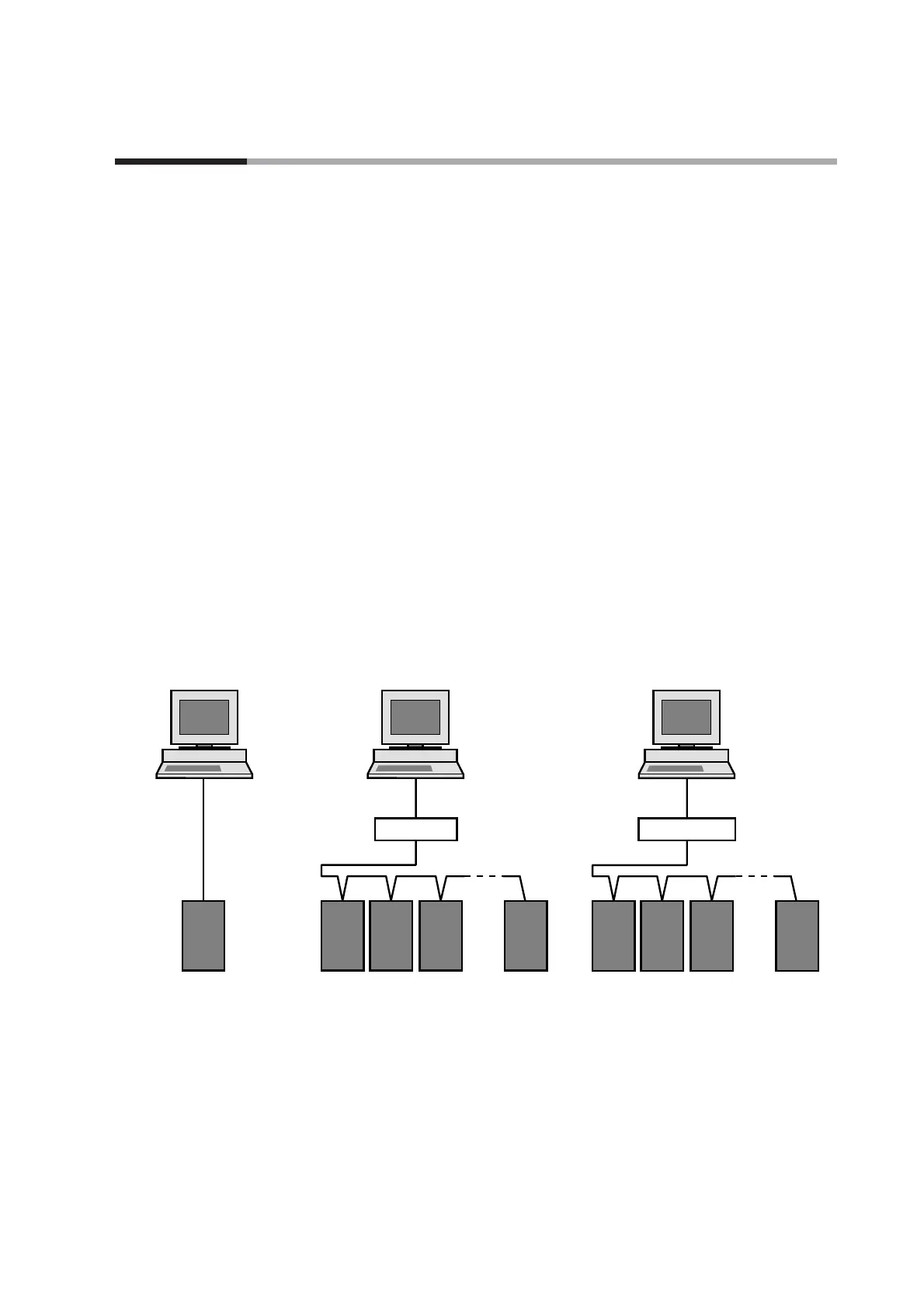
RS-232C
RS-232C connection example
Slave
station
Master station
RS-485 connection example
Slave
station
Master station
Connection between master
station and slave station
RS-232C
RS-485 (5-wire system)
RS-232C/RS-485
converter
RS-485 connection example
Slave
station
Master station
Connection between master
station and slave station
RS-232C
CMC10L001A000
RS-485 (3-wire system)
(*2)
1. Communication functions
• In the RS-232C system, this instrument is connected with one master station (also called a host computer as
which a personal computer or the like is used) in the form of one to one.
In this system, only one instrument can communicate with the master station.
The "station address" must be set to make communication.
• In the RS-485 system, up to 31 instruments (see *1) can be connected with one master station. The “instrument
addresses” are then used to identify mate stations for communication
• The communication procedure and format are in common to the both RS-232C and RS-485.
• The communication protocol and format conform to the RS-232C and RS-485 interfaces.
• When the following procedure is completed during communication, various data for the instrument can be read
or written.
(1)The master station (host computer) transmits a request message to a slave station (instrument)
(2)The master station receives a response message from the slave station.
• Instructions from master station to slave station are classified into two types; “read” and “write”.
• The type of ready/write data can be optionally selected by “data address”.
• CPL (Controller Peripheral Link) communications network is the Yamatake Corporation's host-communications.
• The high-performance communication controller CMC410A102 is available for conversion between the RS-
232C and RS-485 interfaces.
(*1) When the master station is an MA500 DIM or CMC410, it can be connected to up to 16 slave stations.
(
*2) The CMC10L001A000 communication controller is an RS-232C/RS-485 (3-wires type) converter
available from Yamatake Corporation.



 To Next Page