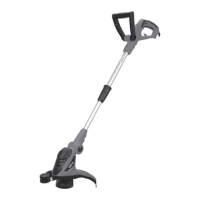
The YT-82830 and YT-82831 are cordless grass trimmers designed for decorative lawn shaping using a high-speed rotating plastic line. Their electric drive makes them significantly quieter than combustion engine tools, allowing for use in residential areas. Being battery-powered, these trimmers can operate in locations inaccessible to mains-powered products. Proper, reliable, and safe operation depends on correct usage, so it's crucial to read the entire operating manual before use and keep it for future reference. The supplier is not responsible for damages or injuries resulting from misuse, non-compliance with safety regulations, or the instructions in this manual. Misuse also voids the user's rights to warranty and guarantee.
The product is supplied complete, but requires assembly before first use. It includes a cutting element guard, a front handle, a rechargeable battery, and a charging station. Note that the YT-82831 model does not include a rechargeable battery or charging station.
Technical Specifications:
- Catalog number: YT-82830, YT-82831
- Rated voltage: 18 V DC
- Cutting speed: 7200 min⁻¹
- Cutting length: 250 / 300 mm
- Cutting line diameter: 1.65 mm
- Length of cutting line on spool: 2.5 m
- Electric protection class: III
- Weight: 2.74 kg
- Noise level (LpA pressure): 85.0 ± 3.0 dB (A)
- Noise level (LwA power): 93.0 ± 3.0 dB (A)
- Vibrations: 2.5 ± 1.5 m/s²
- Battery type (for models with battery and charger): Li-Ion
- Battery capacity (for models with battery and charger): 2 Ah
- Battery energy (for models with battery and charger): 36 Wh
- Charger input voltage (for models with battery and charger): 220 - 240 V~
- Mains frequency (for models with battery and charger): 50 / 60 Hz
- Rated power (for models with battery and charger): 60 W
- Charger output voltage (for models with battery and charger): 21 V DC
- Charger input current (for models with battery and charger): 2.4 A
- Charging time (for models with battery and charger, for listed capacity): 1 h
General Safety Conditions:
Always read all instructions. Failure to follow them can result in electric shock, fire, or injury. The term "electric tool" in these instructions refers to all electrically powered tools, both corded and cordless.
- Workplace: Keep the workplace well-lit and clean. Disorder and poor lighting can cause accidents. Do not operate electric tools in explosive atmospheres containing flammable liquids, gases, or vapors, as electric tools generate sparks that can ignite these substances. Keep children and bystanders away from the workplace; lack of concentration can lead to loss of control over the tool.
- Electrical Safety: The power cord plug must match the outlet. Never modify the plug or use adapters, as an unmodified plug reduces the risk of electric shock. Avoid contact with grounded surfaces (pipes, heaters, refrigerators) to reduce shock risk. Do not expose electric tools to rain or humidity, as water ingress increases shock risk. Do not overload the power cord; avoid using it to carry the tool or to connect/disconnect it. Keep the cord away from heat, oil, sharp edges, and moving parts. Use extension cords designed for outdoor use when working outside. If operating in a damp location is unavoidable, use a residual current device (RCD) to reduce shock risk.
- Personal Safety: Work in good physical and mental condition, paying attention to what you are doing. Do not work when tired or under the influence of medication or alcohol. Always use personal protective equipment, including goggles, dust masks, protective footwear, helmets, and hearing protection. Avoid accidental activation; ensure the switch is in the OFF position before connecting to power. Remove all adjustment tools before starting. Maintain balance and proper posture. Wear protective clothing; keep hair, clothes, and gloves away from moving parts. Use dust extractors if equipped, ensuring proper connection.
Before installing the battery, ensure the switch is off. Only use the charger recommended by the manufacturer. Operate the tool exclusively with the manufacturer-specified battery. Store unused batteries away from metal objects to prevent short-circuiting. If liquid leaks from the battery, avoid contact and rinse with water; seek medical attention if it gets into eyes.
Repairs should only be performed by authorized service centers using original spare parts to ensure safety.
Additional Safety Instructions:
The machine can cause serious injuries. Read the manual carefully, familiarize yourself with proper handling, maintenance, starting, and stopping. The machine is not intended for use by children or persons with reduced physical, sensory, or mental capabilities, or those lacking experience/knowledge. Local regulations may restrict operator age. Do not expose the trimmer to precipitation. Keep the cable away from the cutting element, as it may be hidden in grass and accidentally damaged. Use only manufacturer-provided accessories (plastic line spool); do not use metal blades, wires, or strings. Ensure the cutting element and guard are undamaged before installation, and that at least 1 meter of line is on the spool.
There is a risk of objects being thrown towards the operator and bystanders. The operator is responsible for accidents or threats to others. Do not operate if bystanders (especially children and animals) are nearby. Establish a safety zone of at least 15 meters around the workplace. Despite safety measures, residual risk remains, so use technical and complementary protective measures.
Always wear eye and face protection, protective clothing (long trousers, no loose clothes or jewelry), protective gloves, and hearing protection. Wear non-slip safety shoes; do not work barefoot or in sandals.
Regularly inspect the device as per instructions for efficient and safe operation. Use hearing protectors to prevent permanent hearing damage from excessive noise. Use protective glasses to prevent eye injury from debris.
Familiarize yourself with emergency shutdown procedures. Before use, check that cutting elements, screws, and guards are not worn or damaged. Replace worn parts and tighten loose screws.
Do not tilt the machine during operation; maintain balance. When mowing slopes, move across the slope, never along it. Never touch dangerous moving parts before disconnecting power and complete stoppage. The cutting element may continue to rotate for some time after the motor stops.
Disconnect the machine from power (switch off, unplug from mains for corded tools, remove battery for cordless tools) whenever:
- The operator leaves the machine.
- Obstructions are removed.
- Before checking or cleaning.
- Before inspecting for damage after hitting a foreign object.
- Before immediate testing if the machine starts to vibrate excessively.
Product Service:
- Preparation: Before any assembly or adjustment, disconnect the trimmer from power. Remove the battery pack from the tool socket. Visually inspect the tool; do not operate if any damage is found until repaired.
- Front Handle Installation (II): If not installed, thread the handle through the power cable guard and lock its position with the lever. Adjust the handle position experimentally for operator comfort and terrain, allowing work with bent elbows, straight back, and free movement.
- Cutting Element Guard Installation (III): Insert the guard latches into the trimmer housing and secure with a screw. The guard edge has a blade for automatic line shortening; remove its protector before use.
- Adjustments: Besides the front handle, the trimmer allows adjustment of power cable guard length, lower power cable guard rotation, cutting head rotation, and cutting width.
- Power Cable Guard Length: Continuously adjust the power cord cover length by turning ring (V) towards the open padlock symbol, adjusting, and then turning it towards the closed padlock symbol. Ensure the length does not change spontaneously.
- Edge Mowing (VI): For ergonomic edge mowing, rotate the lower power cable guard. Pull the lock in the direction of the arrow (VI), hold, and turn. There are two locking positions (0° and 180°). Lower the lock ring to ensure it returns to the initial position and the guard is locked.
- Cutting Head Rotation (IV): Rotate the cutting head by 90° by pressing the button on the head (IV). This releases the lock, and an internal spring starts rotation. Manually rotate until it locks in the new position. Restore to previous position by pressing the button and manually rotating until the original lock engages.
- Cutting Width (XI): The eccentric placement of the line shortening blade allows for stepped changes in cutting width. Press and hold the knob, then rotate (XI) and release pressure to lock it at the desired width.
- Auxiliary Wheel (XV): For vertical edge cutting (XV), use the auxiliary wheel on the cutting element guard for easier guidance. For normal horizontal grass cutting, use the spacer guard at the front of the cutting head to protect vertical surfaces.
- Line Replacement: To unwind the line, pull the protruding segment and press the spool lock button (VII). Each press unwinds a few millimeters. Do not unwind beyond the blade guard. The line extending beyond the blade guard will be cut when the trimmer starts. If the line cannot be unwound further, it means the spool is empty and needs replacement.
- Prepare a line segment of the specified length and diameter. Remove the spool cover by pressing both lock buttons (VIII). Remove the spool, clean it and the interior of the spool guard. Attach one end of the line to the spool by threading it through the eyelet and tying (X). Wind the remaining line tightly onto the spool in the direction indicated by the arrow. Avoid crossing or tangling. Leave a few centimeters and thread it through the hole in the spool guard (IX). Mount the spool in the spool guard so its arrow aligns with the cutting element guard's arrow. Mount the spool cover and check free unwinding by manual attempt.
- Workplace Preparation: Before starting, prepare the workplace. Define a safety zone of at least 15 meters where bystanders are not allowed. Ensure no obstacles are present that could cause collisions.
- Connecting to Power (XII): Insert the battery into the power socket, contacts facing inwards and upwards, until it latches. Ensure the battery does not slip out. To disconnect, press and hold the latch, then remove the battery from the housing.
- Starting and Stopping: Ensure the battery is connected, the cutting element guard protector is removed, and the cutting element is not touching any body part or object. Adopt a balanced posture. Hold the front handle with one hand, the rear handle with the other. Press the lock switch with your thumb and the switch with other fingers to start. Holding the lock is not necessary during operation.
- The trimmer stops when the switch is released. The cutting device may rotate for some time after the motor stops. Do not stop the cutting element by pressing the spool against the ground or other objects.
- After complete stoppage, disconnect the trimmer from power by removing the battery, then proceed to maintenance.
- Working with the Trimmer: Do not operate at low speeds or during startup. Move the trimmer from right to left to avoid throwing cut grass towards the operator. Avoid mowing shrubs and bushes, as working near trees can damage bark. Hitting stones, bricks, walls, or similar surfaces can cause rapid line wear. Avoid cutting with the upper right quadrant of the cutting element (XIII) to prevent kickback.
- Useful Tips: Maintain balance and proper posture, especially on slippery, sloping, or uneven ground. Constantly monitor the cutting element. Do not cut in places out of sight. Before starting, inspect the workplace for loose branches and debris. Take regular breaks to reduce the impact of noise and vibration. Work only when healthy; stop if experiencing nausea, headache, vision problems, hearing issues, or dizziness. Cut tall grass gradually from the top to reduce line tangling. Try to cut only with the end of the line. If any part of the trimmer or guard is damaged, replace or repair it before continuing.
Battery Charging Safety:
Before charging, ensure the charger body, cable, and plug are undamaged. Do not use a damaged charger or charging station. Use only the provided charger and charging station. Charging should occur in a dry, enclosed room, protected from unauthorized persons, especially children. Do not leave unattended. If leaving the room, unplug the charger from the mains. If smoke or strange odors come from the charger, unplug it immediately.
The drill/driver is supplied with an uncharged battery. Charge it as per the procedure below using the provided charger and charging station. Li-Ion batteries do not have a "memory effect," allowing charging at any time. However, it is recommended to discharge them during normal use and then charge to full capacity. If this is not possible every time, do it at least every 10-20 cycles. Never discharge batteries by short-circuiting the electrodes, as this causes irreversible damage. Do not check battery charge by short-circuiting the electrodes for sparking.
Battery Storage:
Store batteries between 0-30°C with 50% relative humidity to prolong life (approx. 500 charge-discharge cycles). For long-term storage, charge to approx. 70% capacity and recharge once a year. Avoid excessive discharge, as it shortens life and causes irreversible damage.
During storage, the battery will gradually self-discharge. Self-discharge rate depends on temperature (higher temperature = faster discharge). Incorrect storage can lead to electrolyte leakage; protect leaks with neutralizing agent. If electrolyte contacts eyes, rinse with water and seek medical attention. Do not use a damaged battery.
Dispose of completely worn-out batteries at a specialized waste disposal point.
Battery Transport:
Lithium-ion batteries are classified as dangerous goods. The user can transport the tool with battery or batteries alone by land without additional conditions. For third-party transport (e.g., courier), follow dangerous goods regulations. Contact a qualified person before shipping.
Do not transport damaged batteries. For transport, remove batteries from the tool, protect exposed contacts (e.g., with insulating tape), and secure batteries in packaging to prevent movement. Comply with national dangerous goods regulations.
Charging the Battery:
Before charging, unplug the charger from the mains and clean the battery and terminals with a soft, dry cloth. The battery has a built-in charge indicator: LEDs (XIV) light up when the button is pressed, indicating charge level (more LEDs = more charged). If no LEDs light up, the battery is discharged.
Disconnect the battery from the tool. Insert the battery into the charger socket (XIV). Plug the charger into a mains socket. A red LED lights up, indicating charging is in progress. When charging is complete, the red LED turns off, and a green LED lights up, indicating full charge. Unplug the charger from the mains and remove the battery from the charging station by pressing the latch button.
Note: If the green LED is on when the charger is connected to the mains, the battery is fully charged, and the charger will not start charging.
Maintenance and Storage:
Before any maintenance, disconnect the trimmer from power (unplug corded tools, remove battery from cordless tools). After each use, inspect the tool, paying attention to ventilation openings. Check all elements for alignment, tighten loose screws. Inspect the cutting element. Clean the cutting element guard and spool of grass debris. Replace damaged parts before continuing work. Do not use the trimmer with a damaged guard or spool.
Clean the tool housing with a soft, dry cloth, removing grass, oil, grease, and other contaminants. Store the tool in a dry, enclosed room, disconnected from power. Store in a shaded, dry, well-ventilated place to prevent condensation. The storage area should be inaccessible to unauthorized persons, especially children. Always protect blades with the cover during storage.

 Need help?

 To Next Page
 General