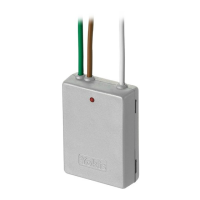
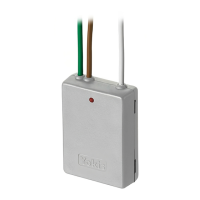
This document describes the Yokis URMET GROUP radio transmitters, which are digital micromodules designed to create a smart home environment. These transmitters are compatible with various Yokis receivers, including Relays, Dimmers, and Shutter Modules, enabling a wide range of control functionalities for lighting and window coverings.
Function Description
Yokis radio transmitters are designed to send wireless commands to compatible receivers, facilitating the automation and remote control of various electrical systems. The product line includes flush-mounted transmitters, remote controls (both standard and flat designs), and wall-mounted remote controls, offering flexibility in installation and user interaction.
Key functionalities include:
- Toggle Relays and Timed Relays: Control on/off states and timed operations for lighting circuits or other electrical loads.
- Staircase Lights Timer: Manage lighting duration in staircases, ensuring energy efficiency.
- Dimmers and Timed Dimmers: Adjust the brightness of lights and set timed dimming sequences.
- Smart Multifunctional Dimmer: Provide advanced dimming capabilities, potentially with scene recall or other smart features.
- Night Saving: A specific feature allowing users to switch off selected lights for a few hours every night, contributing to energy conservation.
- Centralisation of Window Shutters, Screens, and Blinds: Control multiple window coverings simultaneously, enhancing convenience and security.
- Staircase lighting or lighting circuit timing: Automate the on/off cycles of lights in staircases or other circuits.
- Adjust the brightness of one or more lights: Fine-tune lighting levels for ambiance or task lighting.
- A cost-effective solution for the whole house or a single apartment: Offers a scalable and economical approach to home automation.
The transmitters operate in two main modes: Direct Mode and Radio Bus Mode.
Direct Mode:
In Direct Mode, a transmitter is directly linked to one or more receivers. This mode is suitable for controlling individual lights or groups of lights within a limited range. The connection process involves pressing a pushbutton on the transmitter a specific number of times (typically 5 times) to initiate a connection sequence, followed by a brief press on the receiver's 'connect' hole. The transmitter's LED indicates successful radio transmission. A single command can be centralised to up to four receivers in Direct Mode.
Radio Bus Mode:
The Radio Bus Mode allows an unlimited number of receivers to be connected together, forming a robust and expandable radio network. This mode is ideal for larger installations, enabling:
- Sending controls to groups of receivers on the radio bus.
- Sending a control from a transmitter to a receiver that is out of direct range by routing the signal through intermediate receivers.
- Centralising the operation of all lights or all window shutters in a building.
All receivers (MTR2000ER, MTV500ER, MVR500ER) are compatible with the radio bus. Window shutter controls can also be sent via lighting modules and vice versa, offering integrated control.
Increasing Range with an Intermediate Receiver:
To extend the radio range, an intermediate receiver can be integrated into the system. This involves defining a radio bus between receivers, connecting the transmitter to the nearest receiver, and then creating an access point on the intermediate receiver to relay signals.
Centralisation in Radio Bus Mode:
Centralisation in Radio Bus Mode involves creating a radio bus between receivers and then connecting the transmitter's pushbutton to the nearest receiver. This allows a single transmitter to control multiple receivers across the network.
Pushbutton Operating Modes:
Transmitters offer various operating modes for pushbuttons, configurable based on the type of receiver:
- MTR2000ER (Relay): On/Off.
- MTV500ER (Dimmer): Dim/Off, Recall Memory Level.
- MVR500ER (Shutter Module): Up/Stop/Down, Intermediate position.
The default configuration for a pushbutton is operating mode 1 (toggle). Users can change the operating mode by accessing the Configuration Menu (10 presses on any pushbutton) and then pressing the chosen button 1 to 4 times to select the desired function.
Useful Functions:
- Copying a pushbutton: Allows copying the configuration of one pushbutton to another, either on the same transmitter or between different transmitters. The new button will be set to operating mode 1 (toggle).
- Duplicating a transmitter: Enables copying the complete configuration of one transmitter to another.
Important Technical Specifications
- Battery: CR2032 Lithium battery (included).
- Battery life: > 7 years.
- Max. receivers per transmitter button: 4 (in Direct Mode, for more, use Radio Bus).
- Operating temperature: from -10 to + 50°C.
- IP protection: IP54.
- Max. relative humidity: 80%.
- Frequency: 2.4 GHz.
- Transmission: Two-way.
Radio Range:
- Standard range:
- In the same room: < 100 m².
- Open range: 50m (may be reduced by metallic elements, walls, or partitions).
- Power range (New Power Range - soon available):
- Inside 100m² apartments with perpendicular crossing of main wall or ceiling.
- Open range: 250m (may be reduced by metallic elements, walls, or partitions).
Transmitter Models:
- E2BP/E2BPP: 2-channel flush-mounted transmitters (with/without external aerial).
- TLC2C/TLC8C/TLC2CP/TLC8CP: 2-pushbutton and 8-pushbutton remote controls (standard and Power versions).
- GALET8T/GALET8TP: 8-pushbutton flat remote controls (standard and Power versions).
- TLM1T45/TLM2T45/TLM4T45/TLM1T45P/TLM2T45P/TLM4T45P: 1, 2, and 4-pushbutton wall-mounted remote controls (standard and Power versions).
Usage Features
- LED Indication: The transmitter LED lights up only if radio transmission is successful, providing immediate feedback to the user.
- Flexible Wiring: The E2BP/E2BPP models can be wired behind existing pushbuttons or switches. It's not mandatory to wire both channels; a single pushbutton can be connected to a single channel.
- Switch Compatibility: Switches can be used instead of pushbuttons to drive MTR2000ER receivers. The connection procedure involves pressing the switch 5 times rapidly.
- Configuration Menu: A comprehensive Configuration Menu (accessed by pressing any pushbutton 10 times) allows users to define various settings, including:
- Pushbutton operating mode (On/Off, Dim/Off, Up/Stop/Down, Memory recall).
- Radio mode (Direct mode, Radio bus mode).
- Product on radio bus (Lights, Window shutters).
- Copying/clearing connections.
- Restoring default settings.
- Resetting access points.
- Special functions for MTR2000ER (contact pulse mode, contact relay mode, flashing mode).
- Easy Connection Procedure: The direct mode connection is straightforward, involving a sequence of presses on the transmitter and a brief press on the receiver.
- Scalability: The Radio Bus Mode allows for unlimited expansion, making it suitable for both small apartments and larger homes or commercial spaces.
Maintenance Features
- Battery Replacement: The transmitters use a standard CR2032 Lithium battery with a life expectancy of over 7 years, minimizing the frequency of battery changes.
- Default Settings Restoration:
- Pushbutton: To restore default settings for a specific pushbutton, access the Configuration Menu (10 presses) and then press the desired button 15 times.
- Transmitter: To restore all default settings for the entire transmitter, access the Configuration Menu (10 presses) and then press any pushbutton 25 times. This clears all connections and resets the transmitter to its factory state.
- Warranty: Yokis products come with a 5-year warranty from the date of manufacture, covering material defects when used according to instructions. The warranty covers replacement of faulty products but excludes damages caused by negligence, anomalous use, or incorrect installation.
- Technical Support: Urmet S.p.a. provides customer service and export department contacts for technical information and support. Additional information and resources, including a QR code for direct access to www.yokis.com, are available.

 Need help?
 General

 To Next Page