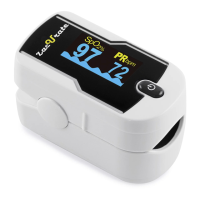
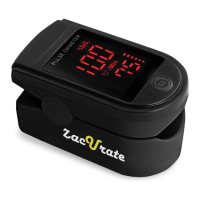
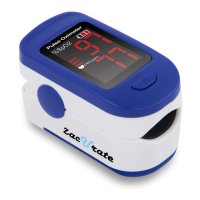
Fingertip
Pulse Oximeter
USER MANUAL
Ver1.1
General Description
SpO
2
stands for peripheral capillary oxygen saturation. Oxygen saturation is defined as the ratio of oxyhemoglobin (HbO
2
) to the
total concentration of hemoglobin (i.e. Oxyhemoglobin + reduced hemoglobin) present in the blood. It is an important physiological
parameter involved in respiration and circulation. The Pulse Oximeter feature herein is small, portable, non-invasive and easy to
use. The user only needs to insert a finger into the chamber to measure his/her SpO
2
level and pulse rate. It has also been proven
to be highly precise and reliable in clinical tests.
Measurement Principle
Oxygenated blood absorbs light preferentially at 905nm (near infrared light), whereas deoxygenated blood absorbs light
preferentially at 660nm (red light). A pulse oximeter works by passing a beam of red and infrared light through a pulsating capillary
bed and then measure the amount of red and infrared light emerging from the tissues via a sensor. To improve accuracy, the 500CL
uses a proprietary algorithm to collect data from pulsatile arterial blood and excludes noise from the tissues. The relative absorption
of light by oxyhemoglobin (HbO) and deoxyhemoglobin is then calculated according to the Beer-Lambert's law and a quantitative
measurement of the users’ oxyhemoglobin status i.e. Oxygen saturation level (SpO
2
) is derived.
Diagram of Operation Principle
1. Red and Infrared-ray Emission Tube
2. Sensor
Precautions For Use
1 Please read the manual carefully before use.
2 Do not use the fingertip pulse oximeter in an MRI or CT environment.
3 Do not use the fingertip pulse oximeter in situations where alarms are required. The device has no alarms.
4 This device is not for continuous monitoring.
5 Do not use the fingertip pulse oximeter in an explosive environment.
6 In order to ensure proper sensor alignment and skin integrity, the maximum application time at a single site for the device
should be less than half an hour.
7 Do not sterilize the device using autoclaving, ethylene oxide sterilizing, or immersing the device in liquid. The device is not
intended for sterilization.
8 Follow local ordinances and recycling instructions regarding disposal or recycling of the device and device components,
including batteries.
9 This equipment complies with IEC 60601-1-2:2014 for electromagnetic compatibility for medical electrical equipment and/or
systems. However, because of the proliferation of radio-frequency transmitting equipment and other sources of electrical
noise in healthcare and other environments, it is possible that high levels of such interference due to close proximity or
strength of a source might disrupt the performance of this device.
10 Portable and mobile RF communications equipment can affect medical electrical equipment.
11 Do not disassemble, repair or modify the equipment.
12 It may be unsafe to:
—use accessories, detachable parts and materials not described in the instructions for use
—interconnect this equipment with other equipment not described in the instructions for use
—disassemble, repair or modify the equipment
13 The medical silicone and ABS plastic enclosure which contact the user’s skin when the device is used have been assessed
by and passed the ISO10993-5 Tests for in vitro cytotoxicity and ISO10993-10 Tests for irritation and delayed-type
hypersensitivity.
14 The fingertip pulse oximeter is dependent on blood flow to obtain an accurate SpO
2
measurement. Verify that nothing is
hindering your blood flow before taking your SpO
2
readings.
15 This device is not intended to diagnose or treat any medical condition or disease. It is intended for non-medical
use by healthy people to monitor their pulse rate and blood oxygen levels. It is for sports and/or aviation use.
People who need SpO
2
and pulse rate measurements because of a medical condition should not use this pulse
oximeter and should consult with their physician.
Inaccurate measurements may be caused by
1 Significant levels of dysfunctional hemoglobin (such as carbonyl - hemoglobin or methemoglobin).
2 Intravascular dyes such as indocyanine green or methylene blue.
3 High ambient light. Shield the sensor area if necessary.
4 Excessive user movement.
5 High-frequency electrosurgical interference and defibrillators.
6 Venous pulsations.
7 Placement of a sensor on an extremity with a blood pressure cuff, arterial catheter, or intravascular line.
8 The user has hypotension, severe vasoconstriction, severe anemia, or hypothermia.
9 The user is in cardiac arrest or is in shock.
10 Fingernail polish or artificial fingernails.
11 Weak pulse quality (low blood perfusion).
12 Low hemoglobin.
Product Features
1 Easy to operate. Measure your SpO
2
non-invasively.
2 Small, light and portable.
3 LED screen displays SpO
2
, Pulse Rate and Pulse Bar.
4 2pcs AAA-size alkaline batteries; low-battery indicator and low power consumption.
5 When no or low signal is detected, the device will power off automatically in about 8 seconds.
Intended Use
The 500CL Fingertip pulse oximeter is a portable non-invasive device intended for spot-checking of oxygen saturation of arterial
hemoglobin (SpO
2
) and pulse rate of children (>12 years old) and adult. The device is for sports and/or aviation use.
Operation Instructions
1 Install two AAA batteries according to the Battery Installation instructions.
2 Place one of your fingers into the finger chamber of the pulse oximeter.
3 Press the on/off button on the front panel to turn the pulse oximeter on.
4 Keep your hand and finger still for the reading. It is recommended that you do not move your body
while taking a reading.
5 Read the data from the display screen.
Tips to getting a good reading
1) Make sure that your finger is inserted deep into the chamber so that the fingertip is placed directly in between the LED sensor
and the LED light source.
2) Avoid making any body movement, especially your finger while taking measurement.
3) Long fingernails may obstruct the light sensor and prevent accurate measurement. Please keep the fingernails short while using
the device.
4) Excessive ambient infra-red light, especially in an overly bright lit room, can interfere with the sensor, preventing an accurate
measurement.
5) Poor blood circulation can affect oximeter readings. Warm your hands and fingers before taking your measurements. Note that
the pulse oximeter is measuring your SpO
2
and PR based on your blood flow. If the blood flow in your finger drops below a certain
level, the pulse oximeter will not be able to get a reading.
6) Some people with medical conditions such as anemia, hypotension and hypothermia may experience an inaccurate reading
during use. In such case, we suggest that you consult a physician.
Front Panel
The pulse bar graph is a useful feature that can be used to determine the reliability of a reading. If the height of the pulse bar is less
than 30%, this indicates signal inadequacy and the displayed SpO
2
or pulse rate value is potentially incorrect. Adjust your finger so
that it is directly between the LED lights and sensor.
Box Content
1. One pulse oximeter
2. One lanyard
3. Two AAA batteries
4. One instruction manual
Battery Installation
1. Open the battery compartment.
2. Install two AAA batteries by matching the plus (+) and
minus (-) signs in the compartment. Note: incorrectly
installed batteries may damage the device.
3. Slide battery cover back until it snaps in place.
Notes:
Please remove the batteries if the pulse oximeter will not
be used for a long period of time.
Please replace the batteries when the battery level
indicator is low.
Using the Lanyard
1. Thread the thin end of the lanyard through the lanyard hole on the device.
2. Thread the thick end of the lanyard through the thin loop (threaded in step 1)
and pull to tighten.
Warnings!
Keep the oximeter away from young children. Small items such as the battery
door, battery, and lanyard are choking hazards.
Do not hang the lanyard from the device’s electrical wire.
Please note that the lanyard tied to the oximeter may cause strangulation due to
its length.
Maintenance and Storage
1. Replace the batteries when the battery level indicator is low.
2. Clean the finger chamber and surface of the oximeter before use.
3. Remove the batteries if you are not planning to use the oximeter for a long period of time.
4. Store the product in a cool and dry place, Extreme moisture may damage the oximeter or affect its lifespan.
5. Dispose battery properly; follow any applicable local battery disposal laws.
Cleaning the fingertip pulse oximeter
It is recommended to clean the oximeter before and after use. To clean, use a soft cloth lightly dampened with water to wipe the
finger chamber and the surface of the oximeter. Allow the oximeter to dry thoroughly before use.
CAUTION: Do not pour or spray liquids onto the oximeter, and do not allow any liquid to enter any openings in the device.
Disinfecting the fingertip pulse oximeter
The oximeter can be disinfected as needed. To disinfect, use a soft cloth lightly dampened with 70% isopropyl alcohol. Other
recommended disinfectants include: 70% ethanol or glutaraldehyde-type 2% liquid disinfectants.
CAUTION: Do not use EtO (Ethylene oxide) or formaldehyde for disinfection.
The lifespan of the pulse oximeter is estimated to be five years if 15 measurements are taken per day and each
measurement takes 10 minutes. Stop using and contact local service center if one of the following incidents occurs:
An error in the Possible Problems and Solutions is displayed on the screen.
The oximeter cannot be powered on even though new batteries are installed.
There is a crack on the oximeter or damage to the display resulting in unidentifiable readings.
The spring is defective.
The button is unresponsive.
The pulse oximeter is factory calibrated. You do not need to calibrate it again during its lifespan.
Specifications
1. Display Type
LED display
2. SpO
2
Display range: 0%~99%
Measurement range: 70%~99%
Accuracy: 70%~99%: ±2%; 0%~69% no definition
Resolution: 1%
A functional tester cannot be used to assess the accuracy of a pulse oximeter monitor or sensor. Clinical testing is used to establish
the SpO
2
accuracy. The measured arterial hemoglobin saturation value (SpO
2
) of the sensors is compared to arterial hemoglobin
oxygen (SaO
2
) value, determined from blood samples with a laboratory CO-oximeter. The accuracy of the sensors in comparison to
the CO-oximeter samples measured over the SpO
2
range of 70%~100%. Accuracy data is calculated using the root-mean-squared
(Arms value) for all subjects, per ISO 9919:2005, Medical Electrical Equipment–Particular requirements for the basic safety and
essential performance of pulse oximeter equipment for medical use.
A functional tester is used to measure how accurately Fingertip Pulse Oximeter is reproducing the specified calibration curve and
the PR accuracy.
The model of functional tester is Index2 FLUKE simulator and the version is 2.1.3.
3. Pulse Rate
Display range: 30bpm~250bpm
Measurement range: 30bpm~250bpm
Accuracy: 30bpm~99bpm, ±2bpm; 100~250bpm, ±2%
Resolution: 1bpm
4. Probe LED Specifications
±
±
5. Power Requirements
Two AAA alkaline batteries
Power consumption: Less than 25mA
Battery life: Two AAA 1.5V, 1200mAh alkaline batteries could be continuously operated as long as 16 hours.
6. Environment Requirements
Operation Temperature: 5°C ~40°C
Storage Temperature: -25°C ~+70°C
Ambient Humidity: 15%~93% no condensation in operation; ≤93% no condensation in storage/transport
Atmosphere pressure: 70kPa~106kPa

 Need help?
 General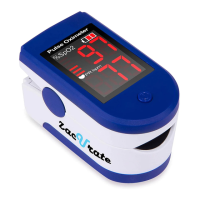

 To Next Page