Need help?
Do you have a question about the Zamp Solar ZS-15A and is the answer not in the manual?
Highlights key benefits and safety aspects of solar power for RVs.
Details features of folding solar kits and their quick setup process.
Details PWM technology, battery compatibility, and charge control features.
Critical safety precautions for using the solar controller and batteries.
Details proper wiring procedures and recommended wire gauges for connections.
Details LCD and LED indications for solar panel and battery abnormal modes.
This document describes the Zamp Solar Controller/Battery Charger, a device designed to manage solar panel input and efficiently charge various battery types in recreational vehicles (RVs). It emphasizes the benefits of solar power for RV owners, such as maximizing battery life, achieving electrical independence, and reducing reliance on generators.
The Zamp Solar Controller/Battery Charger acts as an intermediary between solar panels and RV batteries. Its primary function is to regulate the power flow from solar panels to ensure optimal and safe charging of the battery bank. It utilizes advanced Microcontroller Unit (MCU) control with Pulse Width Modulated (PWM) technology for high-efficiency operation. The controller is compatible with various 12V battery types, including Gel, AGM, Conventional lead-acid (WET), and Calcium batteries.
A key feature of the controller is its built-in regulator, which prevents overcharging, a common cause of premature battery failure. Conversely, it also prevents undercharging, which can occur in solar energy systems, especially with conventional lead-acid or calcium batteries. For these battery types, the unit includes an automatic Equalization feature to address deeply drained batteries and a cycling automatic Equalizing feature every 28 days to maintain battery health.
The controller can be permanently connected to the battery, employing a "floating" process to keep the battery fully charged. This means it will stop charging when the battery is full and automatically resume charging as needed, which also helps reduce water loss and prevent the battery from "drying out." Furthermore, it protects the battery from discharge at night by preventing current from flowing back from the battery into the solar panel when light conditions are low or absent.
The device also incorporates multiple charging protections, including safeguards against reverse polarity, short circuits, over-temperature, and over-voltage. It can be surface-mounted or flush-panel mounted, and its conformal-coating circuit boards and plated terminals are designed for hostile environments, with both waterproof and non-waterproof options available.
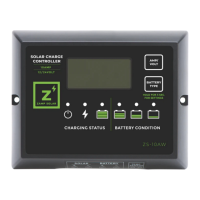
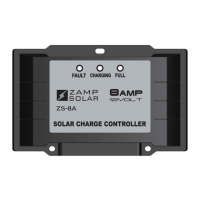
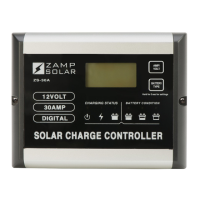
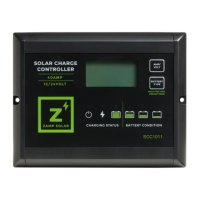
The Zamp Solar Controller/Battery Charger is designed for ease of use and monitoring. It features colored LEDs that visually indicate the operational status and battery conditions. A digital LCD provides detailed information, directly displaying battery voltage, charging current, charging capacity (Amp-hour), battery types, full charge status, and any fault codes.
Users can select the correct battery type by pressing and holding the "BATTERY TYPE" button for 3 seconds. The default setting is AGM Battery, and the controller will automatically memorize the selected type. It's crucial to set the correct battery type to avoid damaging the battery.
Upon power-on, the unit performs a self-qualification mode, displaying a self-test, software version, rated voltage and current, and an external battery temperature sensor test (if connected) before initiating the charging process. During charging, the LCD cycles through battery voltage, charging current, charged capacity (Amp-hour), and battery temperature (if an external temperature sensor is connected) when the "VOLT / AMP" button is pressed. The display differentiates between day-time and night-time operation. When the battery is fully charged, the LCD will alternately display "FUL" and either voltage or amperage every 2 seconds.
The controller supports various charging stages:
The "VOLT / AMP" button allows users to switch between voltage and amperage displays at any time during the charging process. The LCD can also function as an independent voltage meter or thermometer. A voltage below 11.5V indicates a discharged battery requiring recharging.
For installation, the controller is mounted using two plastic spacers and self-tapping screws on a flat surface. Wiring involves connecting the solar panel and battery to clearly marked "Solar" and "Battery" terminals, respectively, ensuring proper wire sizing and the installation of inline fuses (20A for ZS-10A, 30A for ZS-15A) on both circuits for protection.
The Zamp Solar Controller/Battery Charger is designed for durability and minimal maintenance. It is recommended not to disassemble the controller; any repairs should be handled by a qualified person. When working near batteries, eye protection should always be used, and care should be taken to avoid sparks or flames as lead-acid batteries can be dangerous. Short-circuiting the battery should always be avoided.
During installation, it is advised to cover solar panels with a soft cloth to block incoming light, as panels generate energy even when disconnected. This prevents accidental shorting of terminals or wiring, which could cause personal injury or fire. A battery fuse must be installed on each circuit, including the solar controller. It is critical not to reverse connect the wires to the solar panel or battery.
An optional external battery temperature sensor can be connected to the unit. If connected, the controller optimizes charging performance based on the detected battery temperature and provides over-temperature protection, automatically stopping charging if the battery temperature exceeds 65°C. This feature helps prolong battery life and ensures safe operation.
The controller's robust design, including conformal-coating circuit boards and plated terminals, makes it suitable for challenging environments, contributing to its longevity and reliability.
 General
| Rated Current | 15A |
|---|---|
| Maximum Input Power | 200W (12V) / 400W (24V) |
| Display | LCD |
| Input Voltage | 12V/24V Auto |
| Output Voltage | 12V/24V (depending on battery system) |
| Charging Algorithm/Stages | 3-stage (Bulk, Absorption, Float) |
| Battery Types | AGM, Flooded, Gel |
| Protection Features | Reverse Polarity, Overload, Short Circuit |
| Cooling | Natural Convection |


 To Next Page