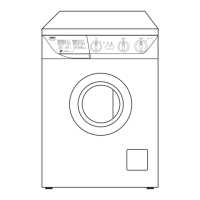
Need help?
Do you have a question about the Zanussi WD 1250 W and is the answer not in the manual?
Safety precautions for installing the appliance.
Guidelines to ensure children's safety around the appliance.
Safety rules for operating the washing machine.
Tips for saving energy, water, and environmentally friendly disposal.
Description of door lock light, detergent dispenser, and child safety feature.
Details of ON/OFF, MAINS-ON, and FABRICS buttons.
Explanation of TEMPERATURE, SPIN SPEED buttons and RINSE HOLD.
Functions of OPTIONS, AUTO DRY, DRYING TIME buttons.
Explanation of the machine's display indicators.
Display indications for program time, delay start, and cycle completion.
Indication of incorrect option selection and fault alarm codes.
START/PAUSE button functions for starting, pausing, and draining.
SKIP/RESET button for clearing memory and selecting special programs.
Setting a delayed start time for programs.
Lights indicating the current phase of the selected program.
Steps for loading laundry, adding detergent and fabric softener.
Turning on the machine and selecting the fabric program.
Selecting temperature, spin speed, RINSE HOLD, and other options.
Setting DELAY START and starting the wash program.
How to change or cancel a program during its cycle.
Procedures for opening the door and completing the program.
Specific steps for drying 2.5 kg of cotton.
Specific steps for autodrying 2 kg of synthetics.
Advice on loading, sorting, and pre-treating laundry.
Guidance on selecting detergents for whites, colors, and delicates.
Explanation of washing, bleaching, ironing, and drying care symbols.
Specifications and consumption data for various washing programs.
Information on timed drying degrees, fabric types, and drying times.
Cleaning the dispenser drawer, recess, and pump.
Maintenance wash, external cleaning, and descaling.
Cleaning the water inlet filter and safety measures against freezing.
Steps for emergency emptying of water from the appliance.
Solutions for machine not starting or not filling.
Troubleshooting drainage, spin, and water on floor problems.
Addressing issues with washing quality due to detergent or load.
Resolving issues with vibration, noise, and the door not opening.
Troubleshooting drying issues and contact for service.
Information on contacting for service and ordering spare parts.
Details of standard, exclusions, and European guarantee policies.
Steps and safety precautions for installing the appliance.
Key technical data of the washer-dryer.
Procedure for unpacking and removing transit bolts.
Recommendations for placing the machine on a stable floor.
Connecting the water inlet hose to a 3/4" thread tap.
Connecting the drain hose to a standpipe or sink.
Adjusting appliance feet for stability and reducing vibration.
Connecting to foul drainage systems for safe water discharge.
Connecting the power supply, wiring codes, and safety warnings.
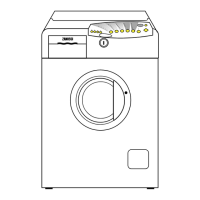
This document is an instruction booklet for a Zanussi Electrolux Washer-Dryer WD 1250 W. It provides comprehensive information on the appliance's functions, usage, maintenance, and installation.
The washer-dryer is designed for effective laundry treatment with low water, energy, and detergent consumption. It features a special wool program with a delicate wash system, an anti-unbalance device for stability during spinning, and automatic cooling of wash water to 60°C before draining (for the 90°C program) to reduce thermal shock and prevent creasing. An ECO valve ensures total detergent use and reduces water consumption. The two drying programs aim to provide soft, relaxed laundry.
The control panel includes several buttons and a display. The ON/OFF button switches the machine on and off. The MAINS-ON light indicates when the machine is on. The FABRICS button allows selection of wash programs based on fabric type (Cottons, Synthetics, Delicates, Wool, Hand Wash). The machine proposes a temperature and maximum spin speed for each program, which can be adjusted. The TEMPERATURE button allows users to increase or decrease the wash temperature, with maximums set for different fabric types (e.g., 90°C for cotton, 60°C for synthetics). The SPIN SPEED button changes the spin speed or selects the RINSE HOLD option, which stops the machine with water in the tub to prevent creasing. If RINSE HOLD is selected, the user must manually drain and spin the laundry later.
The OPTIONS button offers additional functions: PREWASH for heavily soiled laundry (not for wool or hand-wash), SUPER RINSE for those allergic to detergents or in soft water areas (performs 4 rinses instead of 3), and EXTRA QUICK for lightly soiled laundry (not for wool or hand-wash). PREWASH and EXTRA QUICK cannot be selected together.
For drying, the AUTO DRY button allows selection of desired dryness levels for cottons and synthetics (Extra dry, Store dry, Iron dry), with the machine automatically adjusting drying time. The DRYING TIME button allows selection of a timed drying program for cottons (10-130 minutes) or synthetics (10-100 minutes), increasing by 5-minute intervals.
The Display shows various information: three blinking dashes when a program is cancelled or when the machine is switched on after a program has been erased, the duration of the washing program in hours and minutes, selected drying time, a static zero when the machine stops with water in the tub (RINSE HOLD), and a blinking zero when the program is completed. It also shows a "Delay start" time (up to 24 hours) and error messages like "Err" for incorrect option selection or alarm codes (e.g., E10 for water supply, E20 for water draining, E40 for door open) for faults.
The START/PAUSE button starts, pauses, or resumes the program, and also initiates draining and spinning after RINSE HOLD. The SKIP/RESET button clears the program memory (display shows three blinking dashes) or selects special programs like rinse & spin, spin only, or drain only.
To optimize results and care for laundry, it's advised not to overload the machine and to weigh laundry initially. Laundry should be sorted by fabric type, color-fastness, and dirtiness. Unhemmed or torn items should be avoided, and pockets emptied before washing to prevent damage to the drain pump. Hooks should be removed from curtains, and poppers and zips closed. New colored items should be washed separately. When washing fabrics with different temperature requirements, the lowest temperature should be selected. White items should not be washed with colored items. Small items should be washed in a bag or pillowcase.
Only good quality detergents suitable for automatic machines should be used, in correct quantities. Gentle detergent is recommended for wool. Bleach should be used with care. Stubborn stains should be pre-treated. If non-colorfast garments were washed, a rinse and spin program without garments should be run afterward to remove any dye residue. Damp laundry should not be left in a heap for too long before drying. Dark clothes should not be dried with light, fluffy items. Over-drying should be avoided to save energy and prevent creasing. Laundry should be removed promptly after drying. Fabric softener or conditioner can be used to prevent static charge during drying. Delicate items, wool, silk, garments with metal inserts, nylon stockings, bulky items, foam-rubber padded items, or items with residues of setting lotions/hair sprays/nail solvents should not be machine dried due to fire hazards or damage risks. Care labels should always be followed for drying. As a condenser dryer, the water tap must be open and the drain hose must be correctly positioned even during the drying cycle.
The dispenser drawer has compartments for prewash, main wash, and fabric softener. For the first wash, 2 liters of water should be poured into the main wash compartment to activate the ECO valve, followed by a 60°C cotton cycle with half a measure of detergent to remove manufacturing residue. Detergent for prewash and main wash, and fabric softener (not exceeding the "MAX" mark), should be poured into their respective compartments. If a dosing device/ball is used for washing, it must be removed before a drying program.
Before any maintenance or cleaning, the appliance must be disconnected from the electricity supply.
Descaling: Periodically use a water softening powder (separately from laundry) to prevent lime deposits, following the manufacturer's instructions.
After each wash: Leave the door slightly ajar to prevent mold and stagnant smells and preserve the door seal.
Maintenance Wash: Regularly perform a maintenance wash with an empty drum, the hottest cotton wash program, and a normal measure of powder detergent (e.g., Ariel Futur) to prevent residue buildup.
External cleaning: Clean the exterior with soap and water, then dry thoroughly.
Cleaning the dispenser drawer: Regularly remove the drawer (by pressing the catch and pulling out), flush it under a tap, and remove the top part of the additive compartment for thorough cleaning.
Cleaning the drawer recess: After removing the drawer, use a small brush to clean the recess, ensuring all detergent residue is removed. Replace the drawer and run a rinse program without clothes.
Cleaning the pump: Inspect the pump if the machine doesn't empty/spin or makes unusual noises during draining. Disconnect the appliance, wait for water to cool, open the pump door, place a container to collect spillage, pull out the emergency emptying hose, remove its cap to drain water, clean the pump impeller, replace the cap and hose, and screw the pump cover fully in. Never remove the pump cover during a wash cycle if there is hot water.
Cleaning the water inlet filter: If water is hard or contains lime, clean the inlet filter periodically. Turn off the water tap, unscrew the inlet hose, clean the filter with a hard bristle brush, and tighten the inlet hose.
Dangers of freezing: If temperatures drop below 0°C, turn off the water tap, unscrew the inlet hose, and drain water from both hoses into a bowl. Screw the inlet hose back on and reposition the emergency emptying hose. Ensure room temperature is above 0°C before restarting. After draining, pour 2 liters of water into the main wash compartment and run a drain program to activate the ECO valve.
Emergency emptying out: If water is not discharged, unplug the machine, close the water tap, wait for water to cool, open the pump door, drain water using the emergency emptying hose into a bowl, clean the pump, replace the hose and cap, and screw the pump cover back on.
The machine includes a child safety feature to prevent children from being trapped inside. To activate, rotate the button inside the door clockwise until the groove is horizontal (a coin can be used if needed). To disable, rotate the button anti-clockwise until the groove is vertical.
The instruction book should be retained for future reference. The appliance is heavy and care should be taken when moving it. Altering specifications or modifying the product is dangerous. All packing and transit bolts must be removed before use. Plumbing and electrical work must be carried out by qualified persons. The appliance should not stand on the electrical supply cable. If on carpet, adjust feet for air circulation. The appliance is for adult use; children should not tamper with controls or play with it. Check the drum before use as pets and children have been known to climb in. The glass door gets very hot during operation, so keep children away. Keep packaging and detergents out of children's reach. Always unplug and turn off the water supply after use. Do not overload. Only wash and dry machine-washable and dryable fabrics. Empty pockets and fasten buttons/zips before washing. Do not machine wash underwired bras. Avoid washing frayed or torn articles. Treat stains before washing. Do not place coins, safety pins, nails, screws, stones, or other hard/sharp objects in the machine. Do not machine wash garments that have been in contact with volatile petroleum products. Wash small items in a washing bag or pillowcase. Use advised quantities of fabric softener. Check with manufacturers for washing/drying duvets/eiderdowns. Do not leave gas lighters in clothing. Do not tumble dry items with dry cleaning fluid residues. Plastic detergent dispensers should not remain in the drum during drying. Leave the porthole door slightly ajar between washes to preserve the door seal. Do not attempt repairs yourself; contact a Service Force Centre and insist on genuine spare parts.
 General
| Type | Washer/Dryer |
|---|---|
| Maximum spin speed | 1200 rpm |
| Capacity | 5 kg |
| Spin speed | 1200 rpm |
| Loading type | Front Loading |
| Dimensions (H x W x D) | 850 x 600 x 580 mm |

 To Next Page