
 Need help?
Do you have a question about the Zanussi ZFC627WAP and is the answer not in the manual?
Essential safety guidelines for proper and safe appliance operation.
Specific warnings and actions to protect children from appliance hazards.
Steps to turn the freezer on and off using the temperature regulator.
Adjusting the temperature settings for optimal cooling performance.
Resolving unusual noises and continuous compressor operation.
Understanding and rectifying the high temperature warning indicator.
Solutions for excessive frost and ice build-up within the freezer.
Steps for when the freezer is not cooling or its lights are off.
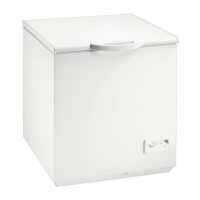
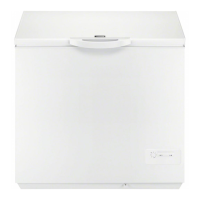
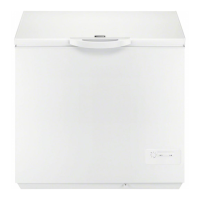
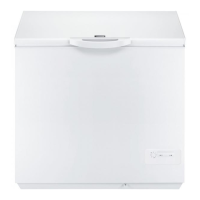
This document is a user manual for Zanussi chest freezers, specifically models ZFC627WAP and ZFC631WAP. It provides comprehensive instructions for safe operation, installation, maintenance, and troubleshooting of the appliance.
The Zanussi chest freezer is designed for freezing fresh food and storing frozen and deep-frozen food for extended periods. It operates by maintaining a low internal temperature, regulated automatically, to preserve food quality. The appliance features a "Fast Freezing" function to rapidly freeze fresh food, which should be activated at least 24 hours before placing food in the freezer. An alarm system is integrated to alert users to high temperatures within the freezer, for instance, due to a power failure. The freezer is equipped with storage baskets to help organize food items.
The manual provides detailed technical data for both models:
| Specification | ZFC627WAP | ZFC631WAP |
|---|---|---|
| Volume (gross) | 263 Litre | 304 Litre |
| Volume (net) | 260 Litre | 300 Litre |
| Height | 868 mm | 876 mm |
| Width | 935 mm | 1050 mm |
| Depth | 665 mm | 665 mm |
| Weight | 42.5 Kg | 45.6 Kg |
| Rising Time | 32 hours | 32 hours |
| Energy Consumption | 0.685 kWh/24h | 0.740 kWh/24h |
| Freezing Capacity | 16 kg/24h | 17 kg/24h |
| Rated Power | 80 Watt | 85 Watt |
| Voltage | 230 Volts | 230 Volts |
| Climatic Class | SN/N/ST/T | SN/N/ST/T |
The climatic class indicates the ambient temperature ranges in which the appliance can operate efficiently:
The appliance uses isobutane (R600a) as a refrigerant, which is a natural gas with high environmental compatibility but is flammable. The electrical connection requires a 13 amp plug fitted with a 13 amp ASTA approved (BS 1362) fuse.
Switching On/Off: The appliance is switched on by inserting the plug and turning the temperature regulator clockwise. It is switched off by turning the temperature regulator to the OFF position.
Temperature Regulation: The temperature is automatically regulated. Users can adjust the coldness by turning the temperature regulator towards the minimum or maximum coldness settings. A medium setting is generally recommended, but the optimal setting depends on room temperature, lid opening frequency, food quantity, and appliance location.
Control Panel: The control panel includes:
Fast Freezing Function: This function is activated by pressing the Fast Freezing switch, indicated by the Fast Freezing light. It should be used at least 24 hours before adding fresh food to be frozen.
High Temperature Alarm: An alarm light indicates an increase in freezer temperature, such as during a power failure. The alarm light switches off automatically once normal conditions are restored. No food should be placed in the freezer during an alarm phase.
Storage Baskets: The freezer includes storage baskets that can be hung on the upper edge of the freezer. Handles can be turned and fixed for secure positioning. Additional baskets can be purchased from a service center.
Opening and Closing the Lid: Due to a tightly closing seal, it may be difficult to reopen the lid shortly after closing because of the vacuum formed inside. Users are advised to wait a few minutes before attempting to reopen the lid and to avoid pulling the handle with immense force.
Freezing Calendar: The manual includes a freezing calendar with symbols indicating different types of frozen goods and their recommended storage times in months.
Cleaning the Interior: Before first use, the interior and accessories should be washed with lukewarm water and a neutral soap, then thoroughly dried. Harsh detergents, abrasive powders, highly perfumed cleaning products, or wax polishes should not be used as they can damage the finish.
Periodic Cleaning:
Defrosting the Freezer: The freezer should be defrosted when the frost layer reaches a thickness of 10-15 mm. The best time to defrost is when the freezer contains little or no food.
Periods of Non-Operation: If the appliance will not be used for long periods, it should be switched off, disconnected from the mains, emptied, defrosted, cleaned, and the lid left open to prevent unpleasant smells. If the cabinet is to remain on, it should be checked periodically to prevent food spoilage in case of a power failure.
Troubleshooting: The manual provides a troubleshooting guide for common issues such as noise, incorrect temperature, lid closure problems, and power issues, along with possible causes and solutions. For electrical work or issues not covered, a qualified electrician or competent person should be consulted.
Environmental Protection: The appliance does not contain gases that damage the ozone layer. It should not be discarded with urban refuse but taken to an appropriate collection point for recycling electrical and electronic equipment. The insulation foam contains flammable gases, and the cooling unit should not be damaged during disposal. Materials used in the appliance are recyclable.




 To Next Page
 General