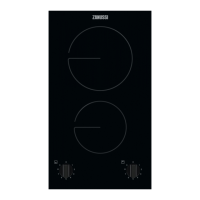
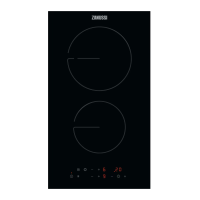
This document is a user manual for a Zanussi ZHTN320X hob, providing essential information for installation, safe operation, maintenance, and troubleshooting.
Function Description
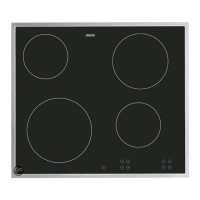
The Zanussi ZHTN320X is a built-in electric hob designed for household cooking purposes. It features two radiant heating cooking zones, controlled by rotary knobs. The hob is intended to be integrated into kitchen work surfaces, offering a streamlined appearance. It provides various heat settings, from keeping food warm to bringing liquids to a boil or deep-frying, allowing for a range of cooking applications.
Usage Features
The hob is designed for straightforward operation with control knobs that allow users to select heat settings from 1 to 6, with 0 being the off position. A power indicator activates when one or more cooking zones are in use and deactivates when they are turned off.
Safety during Use:
- Users are advised to remove all packaging, labeling, and protective film before first use.
- The appliance should not be left unattended during operation.
- Cooking zones should be set to "off" after each use.
- Cutlery or saucepan lids should not be placed on the cooking zones as they can become hot.
- The appliance should not be operated with wet hands or when in contact with water.
- It should not be used as a work or storage surface.
- In case of a cracked surface, the appliance must be immediately disconnected from the power supply to prevent electrical shock.
- When placing food into hot oil, caution is advised due to potential splashing.
- Fats and oils can release flammable vapors when heated, so flames or heated objects should be kept away. Used oil, especially with food remnants, can ignite at lower temperatures.
- Flammable products or items wet with flammable products should not be placed in, near, or on the appliance.
- Unattended cooking with fat or oil is dangerous and can lead to fire; water should never be used to extinguish such fires. Instead, the appliance should be switched off, and the flame covered with a lid or fire blanket.
- The appliance should not be supplied through external switching devices like timers or circuits that are regularly switched on and off by a utility.
- Cooking processes, especially short-term ones, must be continuously supervised.
- Items should not be stored on the cooking surfaces.
- Metallic objects like knives, forks, spoons, and lids should not be placed on the hob surface as they can become hot.
- The appliance should not be used before it is properly installed in the built-in structure.
- If the glass ceramic surface is cracked, the appliance must be switched off and unplugged, or the fuse removed if directly connected to the mains via a junction box, and an Authorized Service Centre contacted.
- Only hob guards designed or indicated by the manufacturer should be used.
Cookware Recommendations:
- Cookware bottoms should be as thick and flat as possible, clean, and dry before placement on the hob surface.
- Cookware made of enameled steel or with aluminum/copper bottoms may cause discoloration on the glass-ceramic surface.
- To optimize cooking results, cookware should not be larger than the diameter of the cooking zone.
Energy Saving Tips:
- Use only the necessary amount of water when heating.
- Always use lids on cookware when possible.
- Place cookware on the cooking zone before activating it.
- Ensure the cookware bottom has the same diameter as the cooking zone.
- Use smaller cookware on smaller cooking zones.
- Place cookware directly in the center of the cooking zone.
- Utilize residual heat to keep food warm or melt it.
Maintenance Features
Regular cleaning and proper care are crucial for maintaining the appliance's performance and appearance.
General Cleaning Information:
- Clean the hob after each use.
- Always use cookware with a clean base.
- Scratches or dark stains on the surface do not affect hob operation.
- Use a special cleaner suitable for the hob surface and a special scraper for the glass.
- Do not use water spray or steam to clean the appliance.
- Clean the appliance with a moist soft cloth and neutral detergents. Avoid abrasive products, abrasive cleaning pads, solvents, or metal objects.
Cleaning the Hob:
- Immediate removal (when hot): Melted plastic, plastic foil, sugar, and food with sugar should be removed immediately to prevent damage to the hob. A special hob scraper should be used at an acute angle to move the blade on the surface, taking care to avoid burns.
- Removal when sufficiently cool: Limescale rings, water rings, fat stains, and shiny metallic discoloration should be cleaned with a moist cloth and a non-abrasive detergent. After cleaning, wipe the hob dry with a soft cloth.
- Shiny metallic discoloration: This can be removed using a solution of water with vinegar and cleaning the glass surface with a cloth.
Safety during Maintenance:
- Do not remove buttons, knobs, or gaskets from the control panel, as water ingress can damage the appliance.
- Clean the appliance regularly to prevent surface material deterioration.
- Deactivate the appliance and allow it to cool down before cleaning.
- Disconnect the appliance from the electrical supply before performing any maintenance.
- If the supply cord is damaged, it must be replaced by the manufacturer, an authorized Service, or similarly qualified persons to avoid a hazard.
Troubleshooting:
The manual provides a basic troubleshooting guide for common issues, such as the hob not activating or operating. It suggests checking the electrical connection and the fuse. If a solution cannot be found, users are advised to contact their dealer or an Authorized Service Centre, providing information from the rating plate and the three-digit letter code for the glass ceramic.
Service and Parts:
- For repairs, contact an Authorized Service Centre and use original spare parts only.
- Lamps within the product and spare part lamps are designed for extreme physical conditions in household appliances or to signal operational status, not for general room illumination.
Disposal:
- Contact the municipal authority for information on proper appliance disposal.
- Disconnect the appliance from the mains supply and cut off the mains electrical cable close to the appliance before disposal.
- Recycle packaging materials in relevant containers.
- Dispose of electrical and electronic appliances at local recycling facilities or municipal offices, not with household waste.



 To Next Page
 General