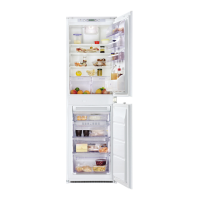
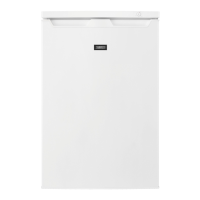
This document is a user manual for a Zanussi freezer, model ZYAN8FW0, providing comprehensive instructions for its installation, safe operation, maintenance, and troubleshooting.
Function Description
The Zanussi freezer is designed for household and similar applications, including farmhouses, staff kitchen areas in shops, offices, and other working environments, as well as by clients in hotels, motels, bed and breakfast, and other residential type environments. Its primary function is to freeze and store fresh food and deep-frozen food for extended periods. The freezer compartment is specifically designed for this purpose, with internal configurations optimized for efficient energy use.
Usage Features
The freezer is designed for ease of use and safety. It can be operated by children aged 8 years and above, and by persons with reduced physical, sensory, or mental capabilities, or lack of experience and knowledge, provided they receive proper supervision and instruction. Children aged 3 to 8 years are permitted to load and unload the appliance if properly instructed.
Temperature regulation is automatic, but users can manually set the internal temperature. The optimal setting depends on factors such as room temperature, frequency of door opening, quantity of food stored, and appliance location; a medium setting is generally recommended.
For freezing fresh food, it should be evenly distributed in the first and second compartments or drawers from the top. To ensure efficient freezing and thawing, food should be divided into small portions and wrapped in appropriate materials like aluminum foil, plastic film, or airtight containers. Labeling and dating frozen food is advised to track its shelf life. Freshness is crucial for good quality, especially for fruits and vegetables, which should be frozen soon after harvest to preserve nutrients.
The freezer drawers facilitate easy access to food packages. For storing large quantities, all drawers except the bottom one can be removed to improve air circulation. Food should be kept at least 15 mm from the door.
Thawing can be done in the refrigerator or at room temperature, depending on the available time. Small frozen pieces can be cooked directly from the freezer, though this will take longer.
The manual also provides hints for energy saving, such as avoiding frequent or prolonged door openings, maintaining a good ventilation, and not covering ventilation grilles. It warns against freezing bottles or cans with liquids, especially carbonated drinks, due to explosion risk, and advises cooling hot food to room temperature before placing it in the freezer. To prevent temperature increases in already frozen food, fresh unfrozen food should not be placed directly next to it. Users are cautioned against eating ice cubes or ice lollies immediately after removal to avoid frostbite, and against re-freezing defrosted food without cooking it first.
Maintenance Features
Regular maintenance is essential for the appliance's longevity and performance. Before any maintenance, the appliance must be deactivated and disconnected from the power supply.
Cleaning the interior involves washing with lukewarm water and a neutral soap, then rinsing and drying thoroughly. Users are warned against using detergents, abrasive powders, chlorine, or oil-based cleaners, as these can damage the finish. The accessories and parts are not suitable for washing in a dishwasher. Door seals should be regularly checked and wiped clean to ensure they are free from debris.
Defrosting is required when the frost layer reaches a thickness of about 3-5 mm. Approximately 12 hours before defrosting, a lower temperature should be set to build up sufficient chill reserve. To defrost, the appliance must be switched off or unplugged, all stored food removed and wrapped, and the door left open. The floor should be protected from defrosting water. Placing a pot of warm water in the freezer compartment can speed up the process, and ice pieces that break away should be removed. After defrosting, the interior must be dried thoroughly. The appliance should then be switched on, the door closed, and the temperature regulator set to maximum coldness for three hours before returning food. Users are cautioned against using sharp metal tools to scrape off frost or mechanical devices to speed up thawing, as these can damage the evaporator.
For periods of non-operation, the appliance should be disconnected from electricity, all food removed, defrosted, cleaned, and the door left open to prevent unpleasant smells.
The manual also covers door reversibility, providing detailed steps for changing the door's opening direction, which involves unscrewing and re-attaching hinges and covers. This operation requires careful handling and adherence to safety warnings.
Troubleshooting guidance is provided for common issues such as the appliance not operating, being noisy, the compressor running continuously, door misalignment, difficulty opening the door, excessive frost/ice, and water flow inside or on the floor. Solutions range from checking power connections and temperature settings to cleaning the water outlet and adjusting the door. If issues persist, users are advised to contact an Authorized Service Centre.
The appliance contains isobutane (R600a), a flammable gas, in its cooling unit, requiring caution to avoid damaging the refrigerant circuit. Only qualified persons should perform maintenance and recharging of the unit. The drain of the appliance should be regularly examined and cleaned to prevent water collection.


 To Next Page
 General