This document provides assembly and usage instructions for ZARGES Z 600 S-PLUS scaffold towers.
Function Description
The ZARGES Z 600 S-PLUS scaffold towers are mobile work platforms designed for temporary work at height. They are intended for use as scaffolding in accordance with the stipulations of EN 1004. The scaffold towers are assembled from individual components, including slip-in frames, advanced guardrails, platforms with or without trapdoors, crosswise boards, lengthwise boards, diagonal braces, horizontal braces, basic braces, stabilisers, wheels, and base steps.
Important Technical Specifications
The scaffold towers are approved in accordance with EN 1004 and fall under scaffolding category 3.
Permissible Load:
- Scaffolding category 3: 200 kg/m²
- Total maximum load: Ranges from 202 kg to 692 kg, depending on the specific model and configuration.
- Maximum platform load: Ranges from 202 kg to 692 kg, depending on the specific model and configuration.
Maximum Platform Height:
- Outdoor use: 8 m
- Completely enclosed spaces: 12 m (for the scaffold towers described in this manual, the maximum platform height in completely enclosed spaces is 10 m).
- Overall maximum platform height: 13.20 m for both normal (0.75 m x 1.8 m / 2.5 m / 3.0 m) and wide (1.35 m x 1.8 m / 2.5 m / 3.0 m) scaffold towers.
Dimensions:
- Normal scaffold tower (0.75 m x 1.8 m / 2.5 m / 3.0 m):
- Width: 675 mm
- Length: 1800 - 3000 mm
- Height (without wheels): 2637 mm
- Stabiliser spread: 3393 - 4593 mm
- Wide scaffold tower (1.35 m x 1.8 m / 2.5 m / 3.0 m):
- Width: 1350 mm
- Length: 1800 - 3000 mm
- Height (without wheels): 2637 mm
- Stabiliser spread: 3393 - 4593 mm
Ballast:
Ballast weights (Order No. 42912) are required for certain configurations and areas of deployment (indoors/outdoors) to ensure stability. The specific quantity of ballast weights needed depends on the assembly type and platform height, as detailed in the parts lists. For scaffolds using the extension for stabilisers, no ballast weights are needed.
Components:
- Slip-in frames: Available in 1m (42905, 42902) and 2m (42904, 42901) heights.
- Advanced Guardrails: Available in 1.8m (42837), 2.5m (42838), and 3.0m (42839) lengths.
- Platforms with trapdoor: Available in 1.8m (42931), 2.5m (42910), and 3.0m (42933) lengths.
- Platforms without trapdoor: Available in 1.8m (42932), 2.5m (42930), and 3.0m (42934) lengths.
- Crosswise boards: Available in 0.75m (42913) and 1.35m (42911) widths.
- Lengthwise boards: Available in 1.8m (42943), 2.5m (42914), and 3.0m (42944) lengths.
- Diagonal braces: Available in 1.8m (42937), 2.5m (42908), and 3.0m (42938) lengths (identifying feature: blue claw).
- Horizontal braces: Available in 1.8m (42935), 2.5m (42907), and 3.0m (42936) lengths (identifying feature: gray claw).
- Basic braces: Available in 1.8m (42886), 2.5m (42887), and 3.0m (42888) lengths.
- Stabilisers S-PLUS: Order No. 42850.
- Wheels: Ø200mm (Order No. 42917).
- Base step: Order No. 42940.
- Anti-twist device: Order No. 42865, prescribed by EN 1004, Point 7.7.1 for stabilisers to prevent twisting.
Usage Features
Assembly:
- Requires at least two persons for scaffold towers with a platform height exceeding 2.50m.
- Must use undamaged and fault-free original spare parts.
- Platforms are set up with a rung spacing of 7 rungs for secure footing.
- Must be set up vertically on a horizontal, level surface with sufficient load-bearing capacity; load-distributing pads may be needed.
- Chassis beams, ballast weights, stabilisers, and stand-off brackets are crucial for structural safety.
- Working on the work platform requires full protection on 3 sides: guard-rail frame, knee protection, and peripheral toeboards. Toeboards are not needed on rest platforms.
- Working on multiple work platforms simultaneously is prohibited.
- When setting up near a wall, stand-off brackets (Order No. 42920) can supplement ballast.
Movement:
- No persons, tools, or material should be on the platform when moving the scaffold tower.
- Movement must be manual, in longitudinal or diagonal directions, on a firm, level, obstacle-free surface, at no more than normal walking speed.
- Vehicles (e.g., forklifts) must not be used to move, lift, pull, or push the scaffold tower.
- The surface for movement must support the scaffold tower's weight.
- For outdoor use or in open buildings, the scaffold tower must be moved to a wind-sheltered position or secured against tipping at wind strengths exceeding 6 on the Beaufort scale (12m/s), at the onset of a storm, or when finishing work.
Safety Regulations:
- Personnel must climb to the work platform from the inside of the tower.
- Bracing against side protection is prohibited.
- Jumping on platforms is prohibited.
- Horizontal loads that could tip the tower (e.g., from working on adjacent constructions) must be avoided.
- Ladders, crates, or similar means to increase platform height are prohibited.
- Tools and materials should be handed upwards, considering their weight to prevent overloading. The person handing the load must not release it until the recipient has a firm hold.
- Scaffold towers with swivel castors can be moved after assembly if the ground slope is no more than 3%. Alignment must be re-checked after final positioning.
- Avoid contact with live equipment when moving.
- Electrical tools (drills, etc.) may only be operated at Safety Extra Low Voltage (48 V), with protective insulation, or if connected with a ground fault circuit interrupter (residual current of 30 mA). BGI 594 (formerly ZH 1/228) stipulations must be followed.
- Tools and materials must be stored on the work platform, leaving a 20 cm passageway at the sides.
- The scaffold tower must not be used to bridge gaps to other buildings or as a stair tower.
- Before use, check vertical alignment and correct if necessary. Also, verify correct and complete setup as per Section 2.8.
Working on Electrical Units:
The scaffold tower must not be used near unprotected live units unless:
- The unit section is disconnected.
- The unit section is secured against re-switching.
- The unit section is checked to ensure it is not live.
- The unit section is short-circuited with a grounding bar.
- The unit section is shielded against adjacent live parts.
Maintenance Features
Cleaning:
- Clean the scaffold with water and commercial cleansers.
- Paint can be removed with turpentine.
- Cleansers must not penetrate the soil; used cleansers must be disposed of according to environmental regulations.
Greasing Moving Parts:
- Grease all moving parts (spindle, swivel castor bearing, catches) with commercial oil.
- For winter use, apply low viscosity oil.
- Wipe off excess oil to prevent it from reaching the treads, which could cause slipping.
- Dispose of grease-soiled cleaning rags according to environmental regulations.
Storage:
- Store components to prevent damage.
- Protect components from weather effects.
- Secure components against slipping, bumping, and falling during transport.
- Do not throw components when loading.
Inspections:
Regular inspections of scaffold components are crucial. If a defect is found, the affected part must not be used.
- Slip-in frame: Check for deformation, crushing, and crack formation.
- Braces (Diagonal / Geländer): Check for deformation, crushing, crack formation, and function of catches.
- Platform: Check for deformation, crushing, crack formation, function of catches, state of the wood, and function of the pass-through flap.
- Toeboards: Check state of the wood and for crack formation.
- Swivel castors: Check rolling capacity, brake function, free movement of spindle (for castors with spindle), and fail-safe mechanism (thumb screw, plug) on chassis beams and basic frame.
- Safety springs: Check for deformation, crushing, crack formation, and tight fit.

 Need help?
 General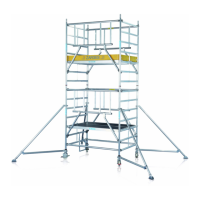

 To Next Page