6
2.4 Safety instructions
for working with
electrical equipment
The following safety instructions must be observed when:
• you are working with electrical equipment on the pole access ladder,
• the pole access ladder is used in the vicinity of electrical units,
• the pole access ladder is used in the vicinity of overhead power lines.
DANGER
DANGER OF ELECTRIC SHOCKS WHEN WORKING WITH ELECTRICAL EQUIPMENT ON THE POLE ACCESS LADDER!
Electrical equipment may only be used on the pole access ladder under the following conditions:
> With protective low voltage (48 V).
> With protective insulation (separation transformer).
> If the equipment is connected via a ground fault circuit interrupter with a residual
current of max. 30 mA.
D
ANGER
DANGER OF ELECTRIC SHOCKS WHEN WORKING IN THE VICINITY OF CURRENT-BEARING UNITS!
Pole access ladders may only be used in the vicinity of such units if the following conditions are met:
> The unit must be disconnected and secured against being switched back on.
> The section of the unit in question must be de-energised.
> The section of the unit must be earthed by means of an earthing strap.
> The section of the unit must be insulated against any adjacent current-bearing
components.
D
ANGER
DANGER OF ELECTRIC SHOCKS WHEN WORKING IN THE VICINITY OF OVERHEAD POWER LINES!
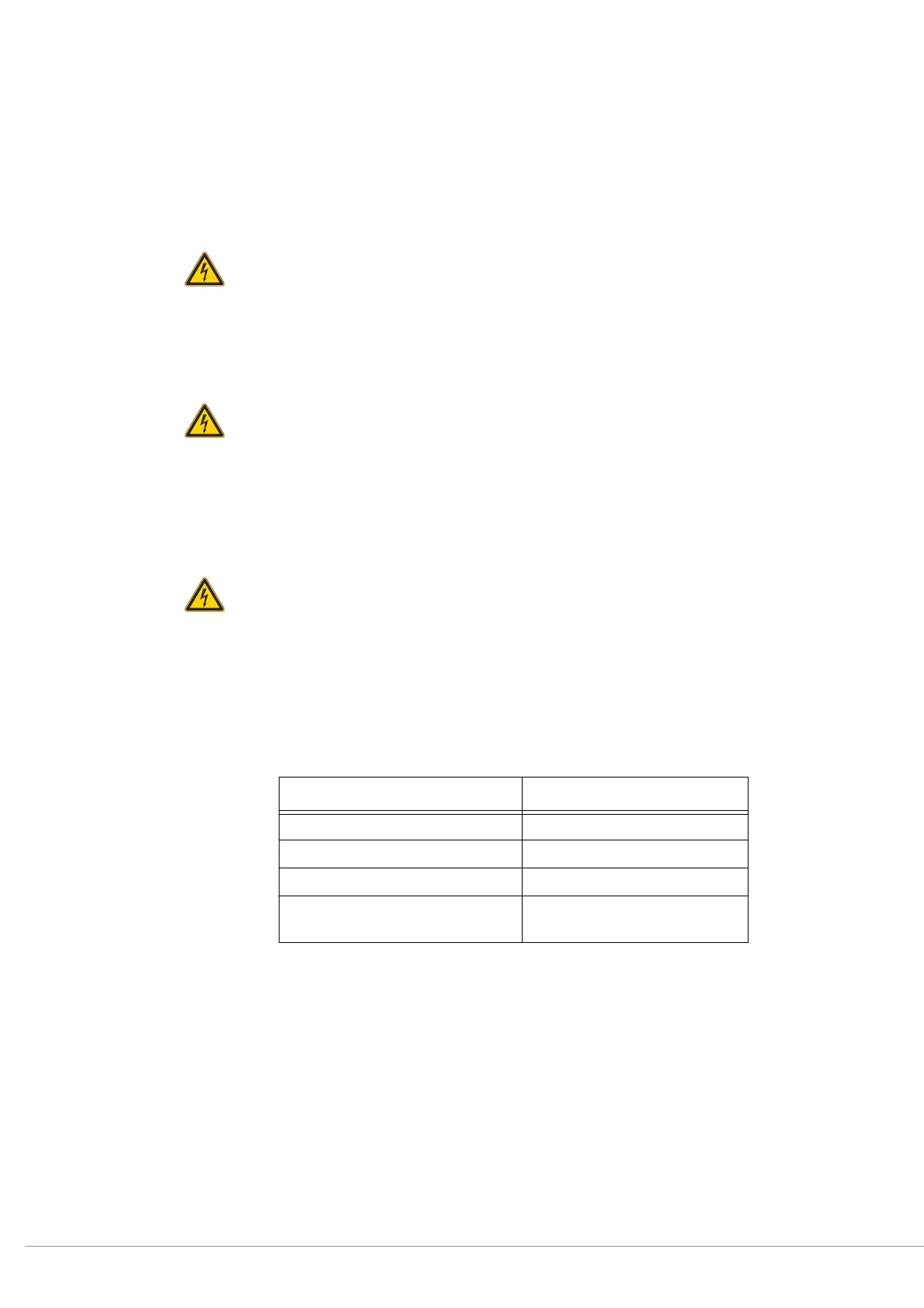
> When working near overhead power lines, observe the safety clearances listed in
the table below.
> When calculating safety clearances, allow for the swinging radius of power lines
and the movement radius of working personnel. The movement radius includes
any objects held by personnel.
> If it is not possible to comply with the safety clearances, have the operating authority
disconnect the power lines and secure them against being switched back on.
Rated voltage (V) Safety clearance (m)
< 1000 V 1.0 m
1 kV – 110 kV 3.0 m
110 kV – 220 kV 4.0 m
220 kV – 380 kV or if the rated
voltage is not known
5.0 m


 To Next Page