8
4. Assembly
4.1 Safety instructions
for assembly
4.1.1 General safety instructions for assembly
• The order for assembly as shown in the illustrations must be observed.
• We recommend that personnel work in pairs to assemble the equipment.
• Before setting up the ladders, check that they are free of soiling (e.g. oil residue,
dirt, snow).
• Do not exceed the maximum permissible load of 150 kg.
• The surface on which the equipment is assembled and used must be level, immobile,
non-slip and of sufficient load-bearing capacity. If necessary, insert load-distributing
pads under the unit.
• On uneven surfaces, use the ZARGES LCS ladder adapter.
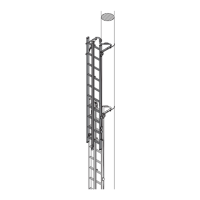
• Ensure that the pole access ladder is set up vertically.
• The top end of the ladder must not protrude beyond the end of the pole.
4.2 Assembly
instructions
The assembly instructions are in the form of diagrams.
5. Use
5.1 Safety instructions
on use
5.1.1 General safety instructions on use
• Before using the product, check the following:
> Have all parts included in the scope of delivery been fitted?
> Is the pole access ladder standing in vertical position (at 90° to the horizontal
plane) on an even and immobile surface of sufficient load-bearing capacity?
> If the subsurface is uneven: Has the ZARGES LCS ladder adapter been used?
> Is the product in perfect condition?
> Are all ladder elements firmly attached to the pole?
> Is the ZAST-OPTIFLEX-R4 safety slide mechanism fitted and fully functional?
(For details of testing, see the operating instructions for the ZAST-OPTIFLEX-R4.)
• Do not use the pole access ladder unless all these questions can be answered
with "yes.“
5.1.1 Specific dangers when using the pole access ladder
D
ANGER
DANGER OF SERIOUS OR FATAL INJURY CAUSED BY FALLING MATERIALS OR TOOLS!
> Never throw ladders, materials or tools, but pass them up or down from person to
person or transport them using a transport rope.
For step-by-step instructions for assembly, see the illustrations
section of this manual on Page 11.


 To Next Page