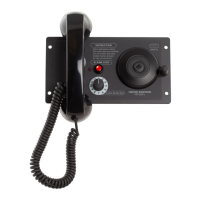
The VSP 12-Way Amplified Batteryless Telephone System is a robust communication solution designed for environments where reliable, independent communication is critical. This system operates without the need for external power, relying instead on a hand-cranked generator for call initiation and conversation power, ensuring functionality even during power outages. It is suitable for a variety of applications, particularly in industrial or marine settings where a dependable intercommunication system is essential.
Function Description
The core function of the VSP 12-Way system is to provide direct, amplified voice communication between up to twelve stations. Each station is equipped with a rotary switch, or "Line Selector," that allows the user to select a specific destination station within the system. Once a destination is selected, a hand-crank is used to generate the necessary power to initiate a call and sustain the conversation. This batteryless operation is a key feature, offering inherent reliability and reducing maintenance associated with battery-dependent systems.
When a call is initiated, the cranking action sends a signal to the selected station, producing a loud beeping tone to alert the recipient. Upon answering, the conversation can proceed with full amplification, ensuring clear audio transmission and reception. The system is designed to provide a guaranteed conversation period of 20 minutes per cranking cycle, which can be extended by simply turning the crank again if longer communication is required. This mechanism ensures that communication is always available as long as a user is present to operate the crank.
The system also incorporates an "ALARM STOP" button, though its specific function is not detailed in the provided excerpt, it typically serves to silence an alarm or signal, indicating a response or acknowledgment. The internal configuration of each station involves DIP switches for setting unique extension numbers, allowing for precise routing of calls within the 12-way network. Jumpers are also used for various internal settings and troubleshooting, ensuring the system can be configured and maintained effectively.
Usage Features
The VSP 12-Way system is designed for straightforward and intuitive operation, making it accessible even in high-stress environments.
- Call Initiation: To make a call, the user first rotates the "Line Selector" switch to the desired extension number of the receiving station. This physical selection ensures a clear intention for the call.
- Power Generation: The next step involves turning the hand-crank clockwise. This action generates the electrical current required to send a signal to the selected station and power the conversation. The manual power generation eliminates reliance on external power sources, making the system highly resilient. The manual indicates that approximately 5 to 6 turns of the crank are sufficient to initiate a call and generate a loud beeping tone at the destination.
- Conversation: Once the call is initiated and the receiving station is alerted, the user lifts the handset and presses the button on the handset. This button must be kept pressed throughout the conversation to maintain the connection and amplification. This "push-to-talk" like functionality ensures that the line is actively engaged only when speaking, potentially conserving generated power.
- Extended Conversation: The system provides a guaranteed 20-minute conversation period per cranking cycle. If a longer conversation is needed, the user can simply turn the crank again to extend the communication time, ensuring uninterrupted dialogue.
- Clear Audio: The "amplified" aspect of the system ensures that conversations are conducted with full power and without distortion, providing clear and intelligible audio, which is crucial in noisy industrial or marine settings.
- Extension Number Setting: Each station is assigned a unique extension number from 1 to 12. This is configured internally using DIP switches. A label strip with numbers 1 to 12 is provided with each station, allowing users to clearly label their station with its assigned extension number for easy identification and selection. This physical labeling enhances usability and reduces the chance of misdialing.
Maintenance Features
The VSP 12-Way system incorporates several features that facilitate maintenance and troubleshooting, ensuring its long-term reliability.
- DIP Switch Configuration: The use of DIP switches for setting extension numbers provides a clear and accessible method for configuring each station. This allows for easy adjustment or re-assignment of extension numbers if the system layout changes. The manual explicitly refers to a "DIP switch for setting VSP extension number" and provides an example of extension number 2 being set.
- Jumper Settings: Jumpers (J2, J3, J6, J7/J8, J9) are used for various internal configurations and troubleshooting. For instance, the manual highlights that missing jumpers on pins J2 and J3 can cause extension numbers 11 and 12 to malfunction, leading to no signal tone. This indicates that checking jumper configurations is a key step in diagnosing certain issues.
- Troubleshooting Guide: The manual includes a dedicated troubleshooting section that addresses common problems and provides possible causes and solutions. This guide is invaluable for on-site maintenance personnel.
- Problem 1: Extension numbers 11 and 12 do not work, no signal tone. Solution: Check for missing jumpers on pins J2 and J3 and insert them if necessary.
- Problem 2: VSP station does not receive calls, no signal tone. Solution: Verify that an extension number is set and that the station has the correct address set on the DIP switch. This points to the importance of correct DIP switch configuration.
- Problem 3: VSP station receives calls from two or more lines. Solution: Verify that the station has only one correct address set on the DIP switch, indicating that multiple DIP switches might be inadvertently set to "ON."
- Problem 4: No call tone when mounting spare part board. Solution: If using boards with inductors, remove jumpers from pins J6 and J7/J8 and insert a jumper on pin J9. This highlights specific configuration changes required when replacing components.
- Modular Design (Implied): The mention of "spare part board" suggests a modular design, allowing for the replacement of individual components rather than the entire unit, which can simplify repairs and reduce downtime.
- Documentation: The existence of a "VSP 12-Way Technical Manual" (A100K10873) is crucial for in-depth maintenance and understanding of the system, providing comprehensive information beyond the user manual.
- Batteryless Operation: While a usage feature, the batteryless nature of the system significantly reduces maintenance by eliminating the need for battery checks, replacements, and disposal, which are common maintenance tasks for battery-powered devices.
- WEEE Compliance: The product is marked with the crossed-out wheeled bin symbol, indicating compliance with WEEE regulations. This means the device is designed to be recycled appropriately at the end of its life, promoting environmental responsibility and simplifying disposal procedures for maintenance teams.
In summary, the VSP 12-Way Amplified Batteryless Telephone System is a reliable, user-friendly, and maintainable communication solution, particularly suited for critical applications where independence from external power and clear voice communication are paramount. Its design emphasizes operational simplicity and provides clear guidelines for troubleshooting and configuration, ensuring its continued functionality in demanding environments.

 Need help?
 General

 To Next Page