EasyManua.ls Logo

Zenith J584W - Page 22

Zenith J584W
80 pages
Print Icon
To Next Page IconTo Next Page
To Previous Page IconTo Previous Page
Loading...
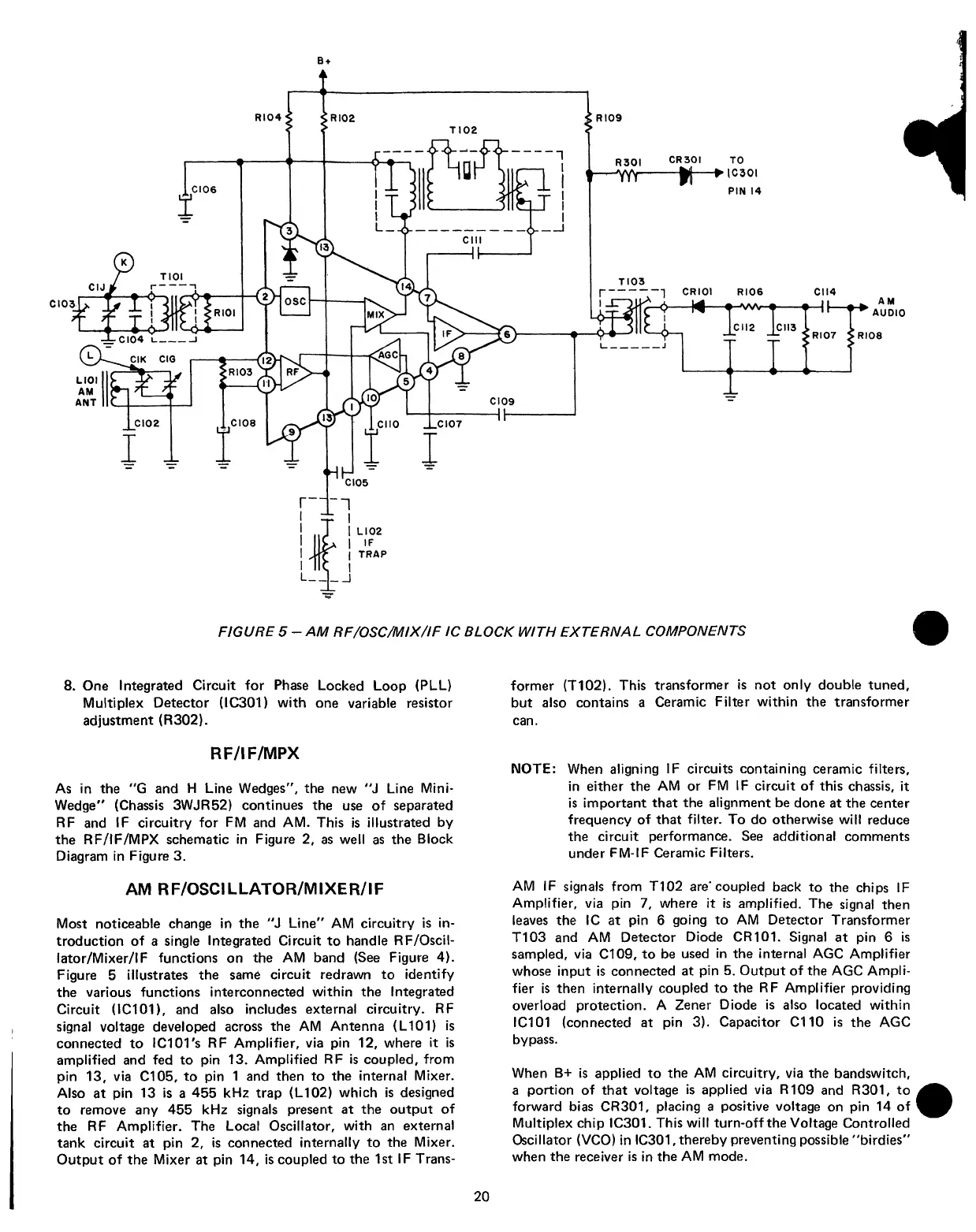
FIGURE
5
AM
RF/OSC/MIX/IF
IC
BLOCK
WITH
EXTERNAL
COMPONENTS
8.
One
Integrated
Circuit
for
Phase
Locked
Loop
(PLL)
Multiplex
Detector
(IC301)
with
one
variable
resistor
adjustment
(R302)
.
RF/IF/MPX
As
in
the
"G
and
H
Line
Wedges",
the
new
"J
Line
Mini
Wedge"
(Chassis
3WJR52)
continues
the
use
of
separated
RF
and
IF
circuitry
for
FM
and
AM.
This
is
illustrated
by
the
RF/IF/MPX
schematic
in
Figure
2,
as
well
as
the
Block
Diagram
in
Figure
3.
AM
RF/OSCILLATOR/MIXER/IF
Most
noticeable
change
in
the
"J
Line"
AM
circuitry
is
in
troduction
of
a
single
Integrated
Circuit
to
handle
RF/Oscil-
lator/Mixer/IF
functions
on
the
AM
band
(See
Figure
4).
Figure
5
illustrates
the
same
circuit
redrawn
to
identify
the
various
functions
interconnected
within
the
Integrated
Circuit
(IC101),
and
also
includes
external
circuitry.
RF
signal
voltage
developed
across
the
AM
Antenna
(L101)
is
connected
to
IC1
01
's
RF
Amplifier,
via
pin
12,
where
it
is
amplified
and
fed
to
pin
13.
Amplified
RF
is
coupled,
from
pin
13,
via
C105,
to
pin
1
and
then
to
the
internal
Mixer.
Also
at
pin
13
is
a
455
kHz
trap
(L102)
which
is
designed
to
remove
any
455
kHz
signals
present
at
the
output
of
the
RF
Amplifier.
The
Local
Oscillator,
with
an
external
tank
circuit
at
pin
2,
is
connected
internally
to
the
Mixer.
Output
of
the
Mixer
at
pin
14,
is
coupled
to
the
1st
IF
Trans
former
(T102).
This
transformer
is
not
only
double
tuned,
but
also
contains
a
Ceramic
Filter
within
the
transformer
can.
NOTE:
When
aligning
IF
circuits
containing
ceramic
filters,
in
either
the
AM
or
FM
IF
circuit
of
this
chassis,
it
is
important
that
the
alignment
be
done
at
the
center
frequency
of
that
filter.
To
do
otherwise
will
reduce
the
circuit
performance.
See
additional
comments
under
FM-IF
Ceramic
Filters.
AM
IF
signals
from
T102
are'coupled
back
to
the
chips
IF
Amplifier,
via
pin
7,
where
it
is
amplified.
The
signal
then
leaves
the
IC
at
pin
6
going
to
AM
Detector
Transformer
T103
and
AM
Detector
Diode
CR101.
Signal
at
pin
6
is
sampled,
via
C109,
to
be
used
in
the
internal
AGC
Amplifier
whose
input
is
connected
at
pin
5.
Output
of
the
AGC
Ampli
fier
is
then
internally
coupled
to
the
RF
Amplifier
providing
overload
protection.
A
Zener
Diode
is
also
located
within
IC101
(connected
at
pin
3).
Capacitor
C110
is
the
AGC
bypass.
When
B+
is
applied
to
the
AM
circuitry,
via
the
bandswitch,
a
portion
of
that
voltage
is
applied
via
R109
and
R301,
to
,
forward
bias
CR301,
placing
a
positive
voltage
on
pin
14
of
Multiplex
chip
IC301.
This
will
turn-off
the
Voltage
Controlled
Oscillator
(VCO)
in
IC301,
thereby
preventing
possible
"birdies"
when
the
receiver
is
in
the
AM
mode.
20