EasyManua.ls Logo

Zenith J584W - Page 23

Zenith J584W
80 pages
Print Icon
To Next Page IconTo Next Page
To Previous Page IconTo Previous Page
Loading...
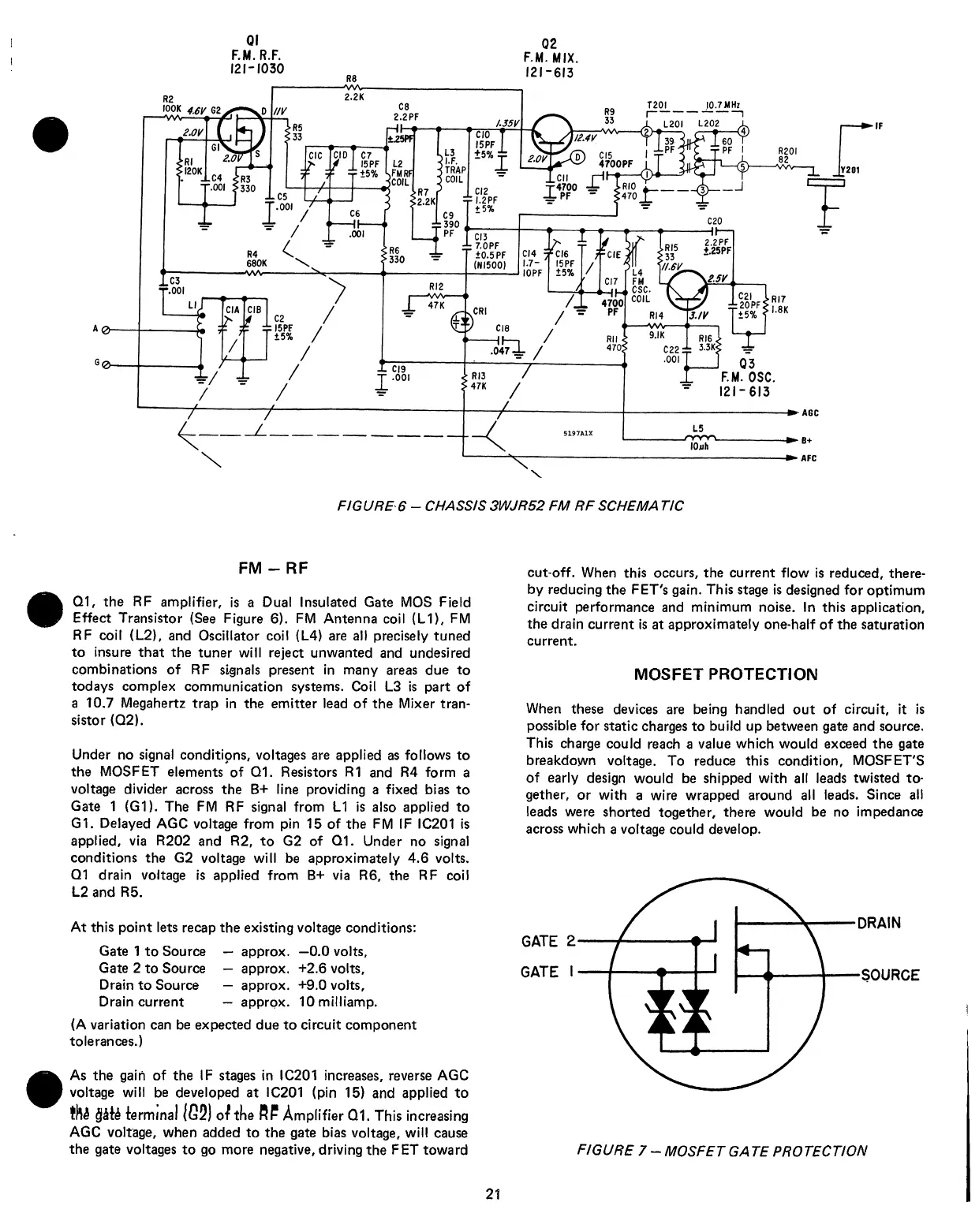
FIGURE
6
-
CHASSIS
3WJR52
FM
RF
SCHEMA
TIC
FM
-
RF
k
Q1,
the
RF
amplifier,
is
a
Dual
Insulated
Gate
MOS
Field
*
Effect
Transistor
(See
Figure
6).
FM
Antenna
coil
(L1),
FM
RF
coil
(L2),
and
Oscillator
coil
(L4)
are
all
precisely
tuned
to
insure
that
the
tuner
will
reject
unwanted
and
undesired
combinations
of
RF
signals
present
in
many
areas
due
to
todays
complex
communication
systems.
Coil
L3
is
part
of
a
10.7
Megahertz
trap
in
the
emitter
lead
of
the
Mixer
tran
sistor
(Q2).
Under
no
signal
conditions,
voltages
are
applied
as
follows
to
the
MOSFET
elements
of
Q1.
Resistors
R1
and
R4
form
a
voltage
divider
across
the
B+
line
providing
a
fixed
bias
to
Gate
1
(G1).
The
FM
RF
signal
from
L1
is
also
applied
to
G1.
Delayed
AGC
voltage
from
pin
15
of
the
FM
IF
IC201
is
applied,
via
R202
and
R2,
to
G2
of
Q1.
Under
no
signal
conditions
the
G2
voltage
will
be
approximately
4.6
volts.
Q1
drain
voltage
is
applied
from
B+
via
R6,
the
RF
coil
L2
and
R5.
At
this
point
lets
recap
the
existing
voltage
conditions:
Gate
1
to
Source
approx.
0.0
volts,
Gate
2
to
Source
approx.
+2.6
volts,
Drain
to
Source
approx.
+9.0
volts,
Drain
current
approx.
10
milliamp.
(A
variation
can
be
expected
due
to
circuit
component
tolerances.)
.
As
the
gain
of
the
IF
stages
in
IC201
increases,
reverse
AGC
|
voltage
will
be
developed
at
IC201
(pin
15)
and
applied
to
terminal
/02)
of
the
RP
Amplifier
Q1.
This
increasing
AGC
voltage,
when
added
to
the
gate
bias
voltage,
will
cause
the
gate
voltages
to
go
more
negative,
driving
the
FET
toward
cut-off.
When
this
occurs,
the
current
flow
is
reduced,
there
by
reducing
the
FET's
gain.
This
stage
is
designed
for
optimum
circuit
performance
and
minimum
noise.
In
this
application,
the
drain
current
is
at
approximately
one-half
of
the
saturation
current.
MOSFET
PROTECTION
When
these
devices
are
being
handled
out
of
circuit,
it
is
possible
for
static
charges
to
build
up
between
gate
and
source.
This
charge
could
reach
a
value
which
would
exceed
the
gate
breakdown
voltage.
To
reduce
this
condition,
MOSFET'S
of
early
design
would
be
shipped
with
all
leads
twisted
to
gether,
or
with
a
wire
wrapped
around
all
leads.
Since
all
leads
were
shorted
together,
there
would
be
no
impedance
across
which
a
voltage
could
develop.
21
FIGURE
7
-
MOSFET
GA
TE
PROTECTION