It’s worth knowing too the relationship between shutter speed and aperture settings. These settings are so
designed that altering from one figure to another on either scale, will double or halve the amount of light
reaching the film. An aperture of f/5.6 is wider than, and will transmit twice as much light as, an aperture of f/8,
and at the same time is smaller than, and will transmit half as much light as, an aperture of f/4. Likewise a
shutter speed of 1/1 25th second is slower than, and will transmit twice as much light as, a speed of 1/250th and
is at the same time faster than, and will transmit half the amount of light as, a speed of 1/60th second. Thus if
you start from a given combination, say 1/1 25th at f/8, and you decide that a shutter speed of 1/250th would be
better for the subject and you want to finish up with the same amount of exposure, you will need to compensate
for the fact that only half the necessary light is reaching the film by opening the aperture one division to f/5.6. If
you had decided that 1/500th were the best speed you would need to open the aperture by two divisions (from
f/8 to f/4) since 1/500th is two divisions up from, or four times the speed of, 1/1 25th second. Remember though
that all combinations of shutter, speed and aperture are a compromise. There is really no 'correct exposure for
any subject, it all depends on the effect you want.
Viewing and focusing
First, make sure your lens is securely attached to the camera by turning it clockwise until no further movement
is possible.
Look through the viewfinder eyepiece (32) and
you can feel safe in the knowledge that there'll be
no parallax problems (no more cut-off heads in
close-up portraits and the like) as you are viewing
and focusing, by means of a ground-glass screen,
through the actual lens that takes the finished
icture. There is a built-in safety margin of
course, in common with many other modern
single lens reflex cameras, the viewfinder
showing an overall area somewhat smaller than
the total film area. This ensures that everything
ou see in the viewfinder appears in the finished
icture despite the fact that slide mounts and
masks in printing equipment actually cover part o
the films image.
Focusing should always be carried out with the aperture wide open, unless of course you want to preview
'depth-of-field, so follow the previous instructions concerning aperture operation. With the camera held to your
eye turn the Focusing Ring (11) towards the right for close distances or towards the left for far distances, until
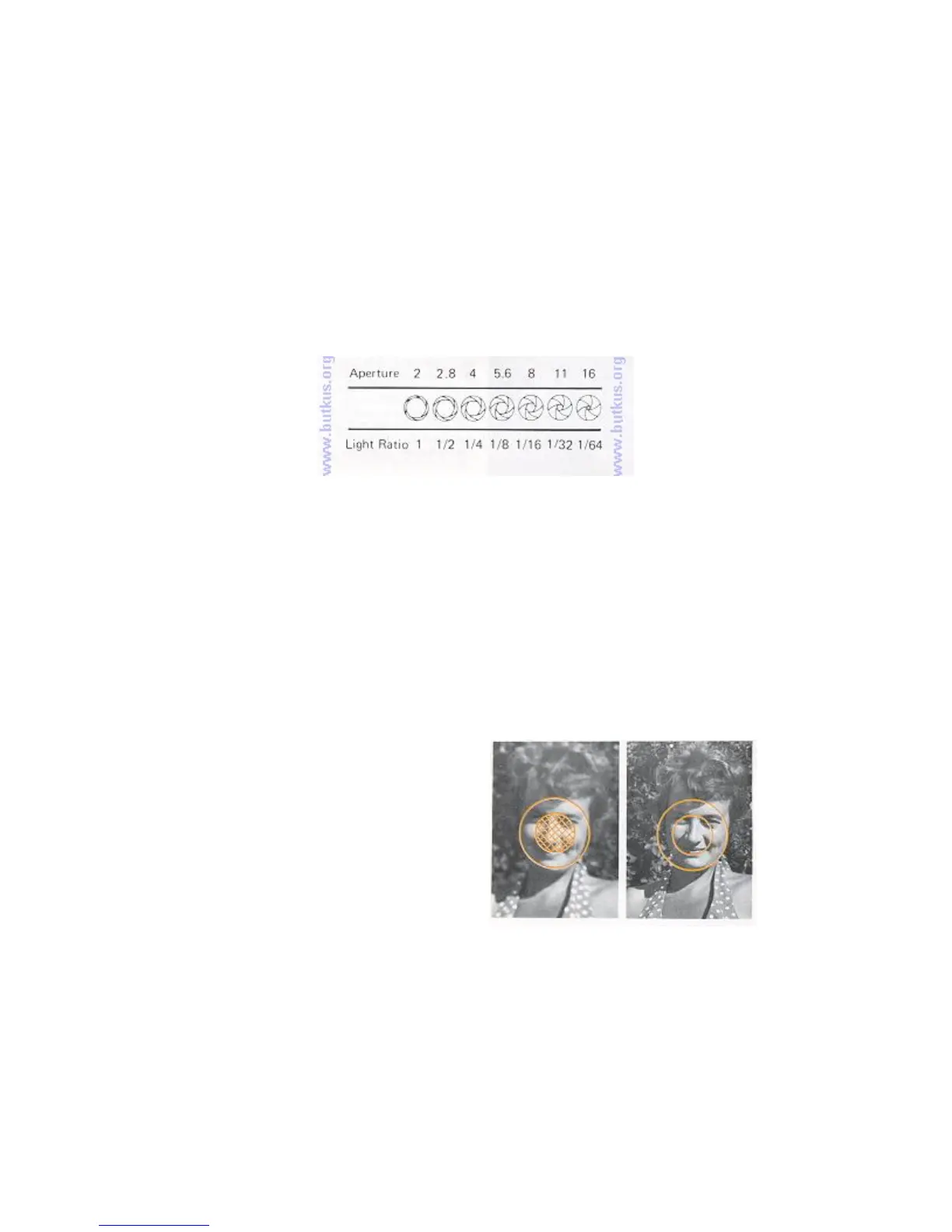
the subject is sharp and clear on the large ground-glass screen. The Zenith TTL camera has in addition in the
center of its screen, two aids for speedier critical focusing, a microprism spot which is composed of literally
hundreds of tiny prisms that distort and accentuate an out-of-focus image. Simply focus the lens until you obtain
a single undistorted image at the center and you are at the point of sharpest focus. This microprism works well


 To Next Page
 Loading...