for the majority of subjects and conditions but for subjects lacking in contrast or color the fine ground-glass
collar around the central spot is probably more helpful -- its quite handy when using long telephoto and wide
angle lenses too. (Aim your camera at this instruction book from about 2 feet away and you'll see how these
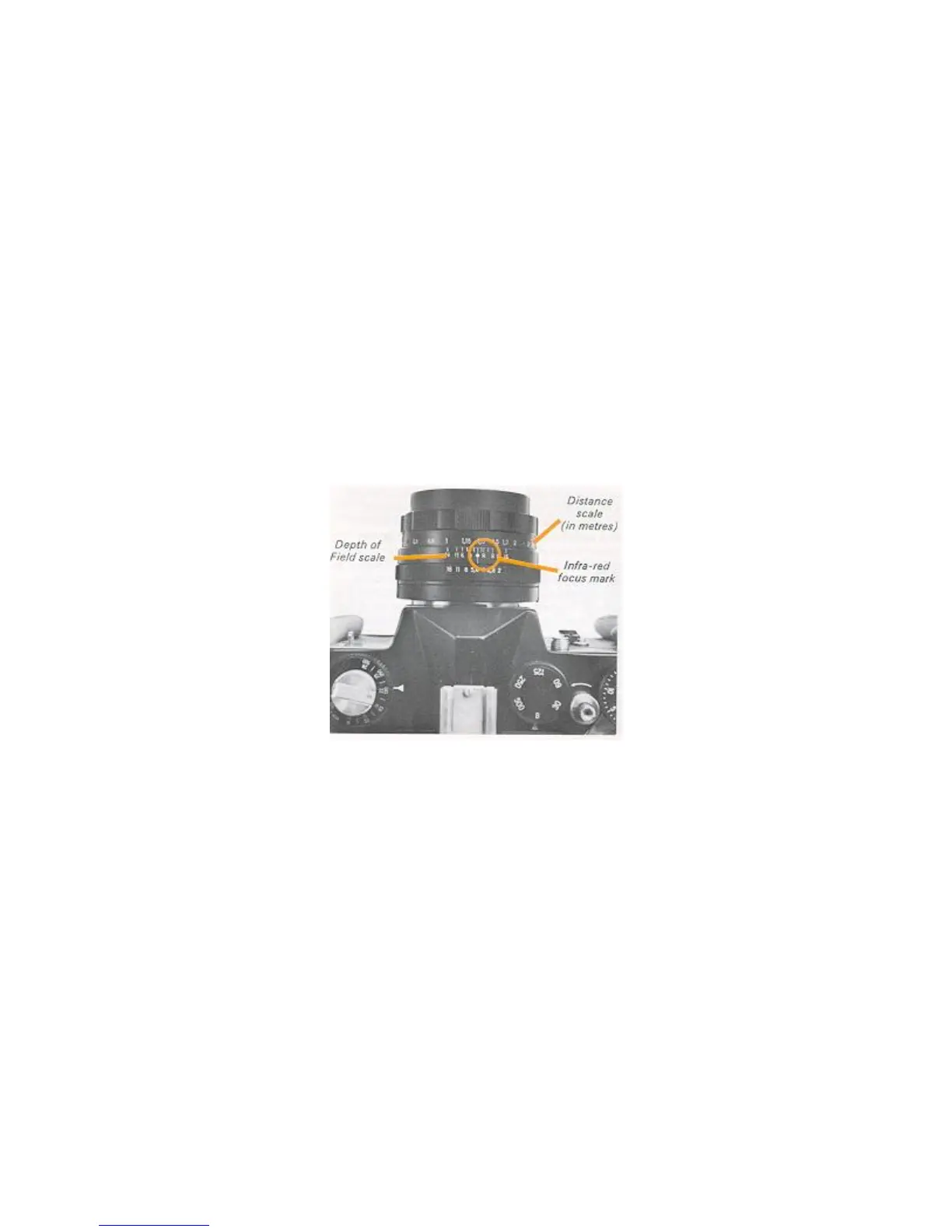
focusing aids work). You can of course also use the Distance Scale (12) of your lens, which is calibrated in
meters, to set the focus. Generally there's no need to check distance, its almost always easier to use the
viewfinder the only time it becomes necessary is when taking flash pictures (see p.24) or when 'depth-of-field is
important.4www.butkus.org
• The Red 'R" just to the right of the Distance Indicator (10) on the Helios44M shows the correction
required for infra-red films. When using infra-red films, first focus in the normal manner, and note the
indicated distance. Then move the Focusing Ring (11) so that that distance is now aligned with the Red
'R. Remember-- this is needed only when using infra-red films which are sensitive to light rays which
focus at a slightly different plane than ordinary light rays.
• "A 16mm diameter prescription lens can be inserted into the Viewfinder Eyepiece (32) and held in place
by Retaining Ring (31). Spectacle wearers may find this helpful for critical work. On certain E/EM
models the detachable Retaining Ring (31) has been replaced by an optional 'slip-on holder. If difficulty
is experienced in obtaining either of these accessories we recommend you contact Visual Aids, East
Street, Bromley, Kent, BR1 1QX.
Depth-of-field
All photographic lenses, when focused on a given subject, will show some objects in front of and behind that
subject more or less sharply. This 'range of extra sharpness is called "depth-of-field" and varies with different
lenses; its greatest with wide angle lenses, and least with telephoto lenses. With any lens, you'll find your depth-
of-field is always greater (more things in focus) at small lens apertures such as f/11 or f/16 and lesser (fewer
things in focus) at larger lens apertures such as f/3.5, f/2.8 or f/2. Depth-of-field is also greater in cases of more
distant subjects than it is with close-up subjects and increases nearly twice as much beyond the subject, your
main point of focus, than it does in front of the subject (towards the camera).
If your picture is such that you want both nearby and distant objects to be in sharp focus then generally the
smallest possible aperture should be used. However, the aesthetic quality of a picture can often be improved by
having the principal subject in sharp focus while other objects in the scene are soft and out-of-focus. Here a
larger aperture is necessary to produce the "differential focus" that de-emphasizes distracting background and/or
foreground detail and thus isolates, and concentrates your viewers attention on, the principal subject.
You may want to preview depth-of-field prior to exposure. This can be done in two ways, first by pressing the
Shutter Release Button (3) smoothly until it reaches the definite stopping point, just before firing the shutter.
This closes the aperture down to its pre-set value and enables you to get an idea (despite the dimness) of what
will or will not be sharp -- the final photograph will be at least as sharp if not sharper than the viewfinder image.


 To Next Page
 Loading...