20
ADVANCED OBSERVATION
GETTING STARTED - ADJUSTMENTS
Star charts and the setting circles are the key to taking your celestial
observation to the next step. They will allow you to find any known
celestial objects your telescope can see. By using the measurements
listed on the mount and the coordinates provided in a star chart,
you will be able to find stars, planets, nebulae, and galaxies. But
before you can properly use the Right Ascension and Declination
coordinate system to find these objects, you will need to Polar Align
your telescope.
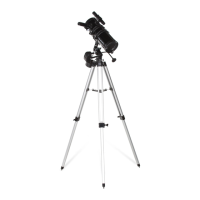
Before you begin Polar Alignment of your telescope, take a
moment to familiarize yourself with the various alignment scales and
adjustments on your Equatorial Mount. You can adjust Declination
and Right Ascension (astronomical equivalents to latitude and
longitude), both in large-scale movements and slow-motion fine-
tuning movements. The procedure for each is explained below.
• Large-scale movement along the longitudinal axis (Right
Ascension) is achieved using the Mount Base Screw. This is the
lowermost knob on your mount. Loosen the mount base screw
and turn the entire mount assembly and OTA together to face
your telescope in a general direction. Once your telescope is
facing that direction, tighten the mount base screw securely
• Broad movement along the latitudinal axis (Declination) is
achieved using the Latitudinal Adjustment Screws. These are the
two large silver screws near the bottom of your mount. Adjust
declination by loosening the screws, raising or lowering the angle
of your scope, and re-tightening the screws.


 To Next Page