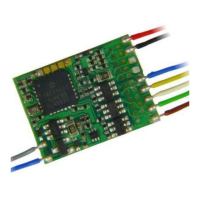
Page 16 Non-Sound Decoder MX618 - MX638 and Sound Decoder MX640 - MX659
The address space required for DCC exceeds the range of a single CV, up to 10239 in fact. Address-
es higher than 127 are stored in CV #17 and #18. Bit 5 in CV #29 is used to select between the short
address in CV #1 and the long address in CV’s #17/18.
Most digital systems (with the possible exception of very old or simple products) automatically calcu-
late the value for the CV’s involved and also set Bit 5 in CV #29 to the proper value when writing the
address, so that the user does not have to deal with the necessary coding.
The “short” (1-byte) loco address (DCC,MM)
In the case of DCC:
The address in CV #1 is only valid if CV #29, Bit 5 = 0.
Otherwise, if CV #29 Bit 5 = 1, the long address in CV
#17 + #18 applies.
The long DCC address applies to addresses >127.
It is only active if CV #29 Bit5 = 1.
14 =
0000 1110
with
Bit 5 = 0
(for short
address)
Bit 0 - Train direction:
0 = normal, 1 = reversed
Bit 1 - Number of speed steps:
0 = 14, 1 = 28
Bit 2 - DC operation (analog): *)
0 = disabled 1 = enabled
Bit 3 - RailCom („bidirectional communication“)
0 = deactivated 1 = activated
Bit 4 - Individual speed table:
0 = off, CV # 2, 5 and 6 are active.
1 = on, according to CV ‘s # 67 – 94
Bit 5 - Decoder address selection:
0 = short address as per CV #1
1 = long address as per CV #17+18
Decoder-controlled consisting (a.k.a. “Advanced consisting”)
The combined operation of two or more locomotives (consisting) can be managed by
- the DCC system (common practice with ZIMO systems, without changing any decoder CV’s) or
- by programming the following decoder CV’s individually, but can also be managed by some
DCC systems (often the case with American made systems).
This chapter only covers the decoder-controlled consisting!
0,
1 – 127
129 - 255
( = 1 - 127
with
inverted
direction )
A common consist address for 2 or more engines can
be entered in this CV to each loco of the same consist.
If CV #19 > 0: Speed and direction is governed by this
consist address (not the individual address in CV #1 or
#17&18); functions are controlled by either the consist
address or individual address, see CV’s #21 & 22.
Bit 7 = 1: Driving direction reversed
Extended consist
address
From SW version 36.6
The value of CV20 multiplied with 100 added together
with the value of CV 19 which result is the address at
consist.
e.g. CV20= 12, CV19=34 is address. 1234
CV20=100, CV19=00 is address 10000
Consist functions
F1 - F8
Functions so defined here will be controlled by the con-
sist address.
Bit 0 = 0: F1 controlled by individual address
= 1: …. by consist address
Bit 1 = 0: F2 controlled by individual address
= 1: …. by consist address
………. F3, F4, F5, F6, F7
Bit 7 = 0: F8 controlled by individual address
= 1: …. by consist address
Consist Functions
F9 – F27
and
headlight control
Select whether the headlights are controlled with the
consist address or individual address.
Bit 0 = 0: F0 (forw.) controlled by individual address
= 1: …. by consist address
Bit 1 = 0: F0 (rev.) controlled by individual address
= 1: …. by consist address
Bit 2 = 0: F9 controlled by individual address
= 1: …. by consist address
Bit 3 = 0: F10 controlled by individual address
= 1: …. by consist address
Bit 4 = 0: F11 controlled by individual address
= 1: …. by consist address
Bit 5 = 0: F12 controlled by individual address
= 1: …. by consist address
Bit 7 = 1: F13 – F27 (all!) ….by consist address
Bit 6 = 1: SW-Version 37.0 and later! Auto-Consist: The
system changes automatically between individual and
consist address, if one of the two addresses has speed
0 and the other has speed >0.
3.5 Analog operation
All ZIMO decoders are capable of operating on conventional layouts with DC power packs, including
PWM throttles, in analog DC as well as in analog AC (Märklin transformers with high voltage pulse for
direction change).
To allow analog operation
CV #29, Bit 2 = 1
must be set. This is usually the case by default (CV #29 = 14, which includes Bit 2 = 1), but analog op-
eration may be turned off in many sound projects (sound decoders). It is recommended to turn ana-
log mode off when operating strictly on DCC!
The actual behavior during analog operation, however, is strongly influenced by the locomotive con-
troller (power pack). Especially in conjunction with a weak transformer, it is easily possible that the



 To Next Page