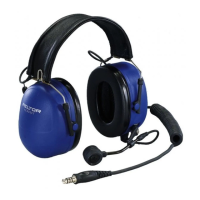
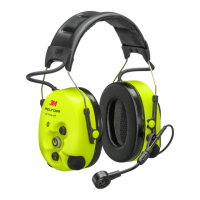
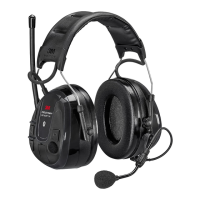
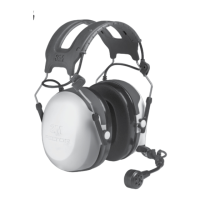
The 3M™ PELTOR™ CH-3 FLX2 Headset is a communication solution designed to provide hearing protection in hazardous noise environments while enabling clear communication. This next-generation protective communication device is available in several variants: MT74H52-110 (Microphone), MT74H52-111 (Microphone and PTT), and HT52-112 (Listen only).
Function Description:
The headset's primary function is to attenuate hazardous noise and loud sounds, protecting workers from hearing loss or injury. Simultaneously, it allows users to listen to and communicate with connected communication devices, such as two-way radios and phones. The MT74H52-111 variant includes a Push-To-Talk (PTT) button for two-way radio communication. The headset features an electrical audio input, allowing external devices to be connected.
Important Technical Specifications:
The CH-3 FLX2 Headset is certified for intrinsic safety, making it suitable for use in potentially explosive atmospheres (ATEX/IECEx certified). It complies with various international standards for hearing protectors, including EN 352-1:2002 (headbands), EN 352-3:2002 (hard hat attachments), EN 352-6:2002 (external audio input levels), ANSI S3.19-1974 (North America), and AZ/NZS 1270:2002 (Australia/New Zealand).
Attenuation values vary by model and cushion type (foam or gel) and attachment style (headband, hard hat, neckband). For example, the MT74H52A-110 headband with foam cushion has a Mean Attenuation (Mf) of 34.0 dB at 500 Hz and an SNR of 31 dB. The HT52A-112 headband with foam cushion has an Mf of 32.9 dB at 500 Hz and an SNR of 30 dB. Models with gel cushions generally offer slightly different attenuation values, often with improved low-frequency performance. The Noise Reduction Rating (NRR) for North American models is typically around 24-26 dB.
The electrical input level for which the sound pressure level is equal to 82 dB(A) is 290 mV. The operating temperature range for all variants is -20°C (-4°F) to 50°C (122°F), with a storage temperature range of -20°C (-4°F) to 40°C (104°F) and relative humidity less than 90%.
Usage Features:
The headset is designed for ease of use and adjustability.
- Fitting: The ear cups can be tilted outwards for placement over the ears, ensuring the headband sits across the top of the head. The height of the ear cups is adjustable by sliding them up or down along the supporting arms.
- Hard Hat Attachment: For hard hat versions, the earmuffs attach to a back plate that locks into the hard hat slot. The earmuffs can be rotated into operating, ventilation, or standby positions.
- Neckband: The neckband is placed around the neck, with the earmuffs over the ears and head straps positioned over the top of the head and overlapped to secure the ear cups.
- Microphone: The speech microphone should be positioned very close to the mouth (less than 3 mm / 1/8 inch) for optimal performance in noisy environments. It includes an adjustable screw for precise positioning and can be fitted with a protective tape (HYM1000).
- Connectivity: The headset connects to communication devices via a cable with a locking button. Users should ensure the correct cable is used and the radio volume is turned down before connecting. A function test is recommended before entering a noisy environment.
- Push-To-Talk (PTT): The PTT function facilitates two-way radio communication using an integrated PTT button, a PTT adapter, or the radio's PTT button. Users press the PTT button when speaking and release it when finished.
Maintenance Features:
Regular maintenance is crucial for maintaining the headset's protective capabilities, hygiene, and comfort.
- Cleaning: Ear cups, headbands, and ear cushions should be cleaned with a cloth dampened with warm soapy water. Immersion in water is strictly prohibited. If the hearing protector gets wet, the ear cups should be turned outwards, ear cushions and foam liners removed, and allowed to dry before reassembly.
- Inspection and Replacement: Ear cushions and foam liners should be inspected regularly for cracks and leaks. For regular users, these components should be replaced at least twice a year. Only product-specific 3M replacement parts (e.g., Hygiene kit HY84, Gel rings HY80) should be used. Unauthorized parts may impair intrinsic safety and reduce protection.
- Hard Hat Adapter Replacement: The hard hat adapter can be replaced by removing screws and attaching a new adapter according to packaging instructions.
- Storage: The product should be stored in a clean, dry area, in its original packaging, away from direct heat, sunlight, dust, and harmful chemicals. Headband and neckband versions should be stored without force or compression on the cushions. Hard hat versions should be in the work mode position with cushions uncompressed.
- Disposal: The headset contains electrical and electronic components and must be disposed of according to national regulations and local recycling systems for electronic equipment.

 Need help?





 To Next Page
 General