9
For safe operation of the water heater, the temperature and pressure
relief valve must not be removed from its designated opening nor
plugged. The temperature-pressure relief valve must be installed
directly into the tting of the water heater designed for the relief valve.
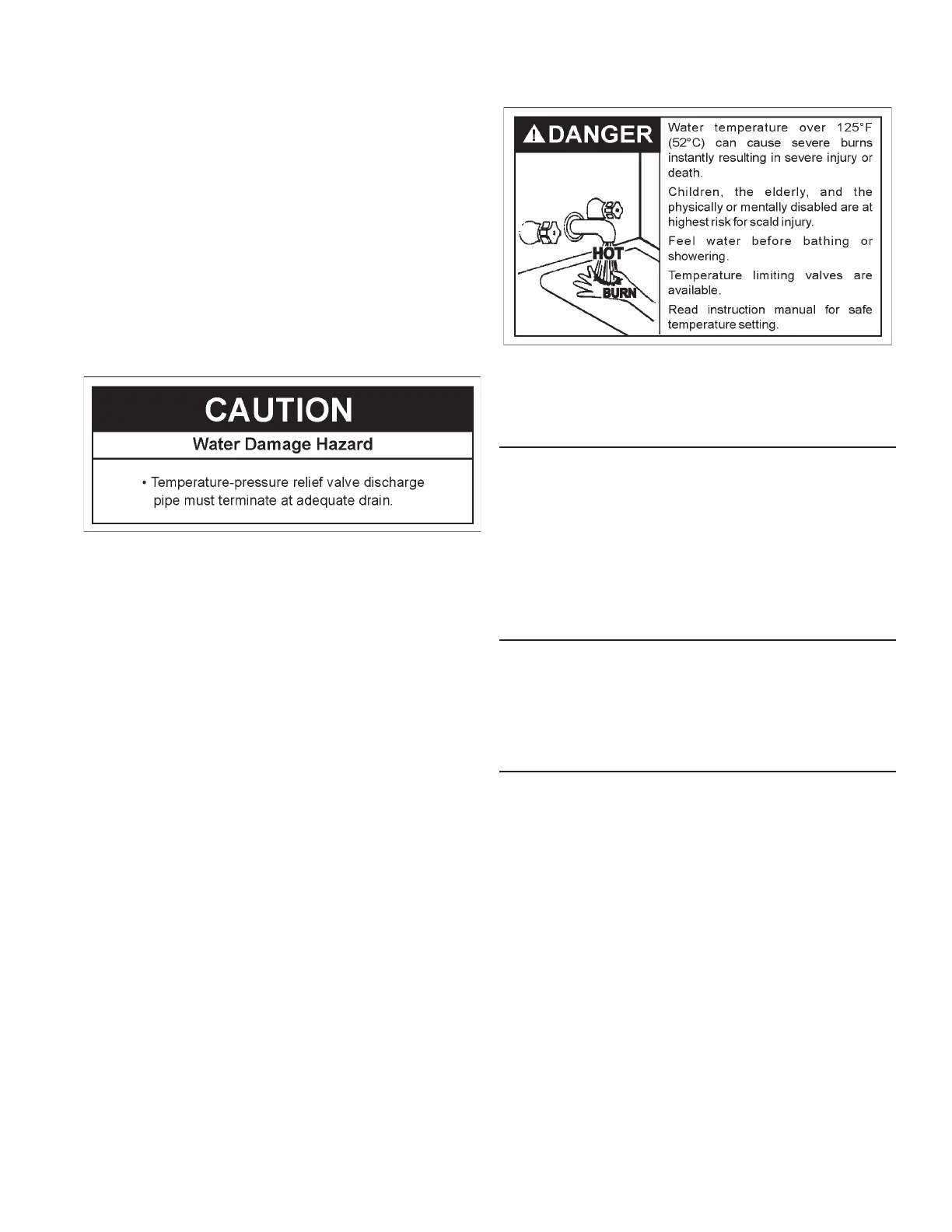
Install discharge piping so that any discharge will exit only within 6
inches (15.2 cm) above, or at any distance below the structural oor.
Be certain that no contact is made with any live electrical part. The
discharge opening must not be blocked or reduced in size under
any circumstances. Excessive length, over 30 feet (9.14 m), or
use of more than four elbows can cause restriction and reduce the
discharge capacity of the valve.
No valve or other obstruction is to be placed between the relief valve
and the tank. Do not connect discharge piping directly to the drain
unless a 6” (15.2 cm) air gap is provided. To prevent bodily injury,
hazard to life, or property damage, the relief valve must be allowed
to discharge water in adequate quantities should circumstances
demand. If the discharge pipe is not connected to a drain or other
suitable means, the water ow may cause property damage.
The Discharge Pipe:
• Shall not be smaller in size than the outlet pipe size of the valve,
or have any reducing couplings or other restrictions.
• Shall not be plugged or blocked.
• Shall be of material listed for hot water distribution.
• Shall be installed so as to allow complete drainage of both the
temperature-pressure relief valve and the discharge pipe.
• Shall terminate a maximum of six inches above a oor drain or
external to the building. In cold climates, it is recommended that
the discharge pipe be terminated at an adequate drain inside
the building.
• Shall not have any valve or other obstruction between the relief
valve and the drain.
The temperature-pressure relief valve must be manually operated
at least once a year. Caution should be taken to ensure that (1) no
one is in front of or around the outlet of the temperature-pressure
relief valve discharge line, and (2) the water manually discharged
will not cause any bodily injury or property damage because the
water may be extremely hot. If after manually operating the valve, it
fails to completely reset and continues to release water, immediately
close the cold water inlet to the water heater, follow the draining
instructions in this manual, and replace the temperature-pressure
relief valve with a properly rated/sized new one.
If you do not understand these instructions or have any questions
regarding the temperature-pressure relief valve call the toll free
number listed on the back cover of this manual for technical
assistance.
Once the water heater is installed and lled with water, check
the operation of the temperature-pressure relief valve. Follow the
instructions in the Maintenance section of this manual.
WATER LINE CONNECTIONS
This manual provides detailed piping installation diagrams (see back
section of this manual) for typical methods of application. For the heater
inlet and outlet connections, di-electric unions are recommended. The
water heater may be installed by itself, or with a separate storage
tank, on both single and two-temperature systems. When used with
a separate storage tank, the circulation may be either by gravity or by
means of a circulating pump. When a circulating pump is used it is
important to note that the ow rate should be slow so that there will be
a minimum of turbulence inside the heater.
CLOSED WATER SYSTEMS
Water supply systems may, because of code requirements or such
conditions as high line pressure, among others, have installed devices
such as pressure reducing valves, check valves, and back ow
preventers. Devices such as these cause the water system to be a
closed system.
THERMAL EXPANSION
As water is heated, it expands (thermal expansion). In a closed system
the volume of water will grow when it is heated. As the volume of water
grows there will be a corresponding increase in water pressure due
to thermal expansion. Thermal expansion can cause premature tank
failure (leakage). This type of failure is not covered under the limited
warranty. Thermal expansion can also cause intermittent temperature
pressure relief valve operation: water discharged from the valve due to
excessive pressure build up. This condition is not covered under the
limited warranty. The temperature-pressure relief valve is not intended
for the constant relief of thermal expansion.
A properly sized thermal expansion tank should be installed on all
closed systems to control the harmful effects of thermal expansion.
Contact a local plumbing service agency to have a thermal
expansion tank installed.




 To Next Page