EasyManua.ls Logo

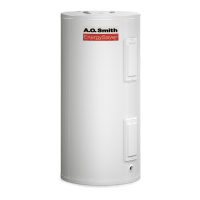
A.O. Smith ENL-40-240V-45 - User Manual

A.O. Smith ENL-40-240V-45
28 pages
Print Icon
To Next Page IconTo Next Page
Loading...
January 2015
100263105
Residen al Electric
Water Heater
Installa on Instruc ons and
Use & Care Guide
Keep this manual in the pocket on heater for future reference whenever maintenance, adjustment or service is required.
Retain your original receipt as proof of purchase.
LOW LEAD
C
O
NTENT
DO NOT RETURN THIS UNIT TO THE STORE
Read this manual and the labels on the water heater before you install,
operate, or service it. If you have di culty following the direc ons, or
aren’t sure you can safely and properly do any of this work yourself:
Call our Technical Assistance Hotline at 1-800-527-1953 . We can help you with
installation, operations, troubleshooting, or maintenance. Before you call, write
down the model and serial number from the water heaters data plate.
Incorrect installa on, opera on, or service can damage the water heater, your house
and other property, and present risks including re, scalding, electric shock, and
explosion, causing serious injury or death.
Table of Contents Page
IMPORTANT SAFETY INFORMATION ................................. 3
GETTING STARTED ............................................................6
INSTALLATION ................................................................... 7
TROUBLESHOOTING .......................................................17
MAINTENANCE ............................................................... 21
DIAGRAMS .....................................................................25
REPAIR PARTS ..........................................................26
Question and Answer IconNeed help?

Do you have a question about the A.O. Smith ENL-40-240V-45 and is the answer not in the manual?

Overview

This document provides installation, operation, and maintenance instructions for a residential electric water heater.

Function Description:

The residential electric water heater is designed to heat and store water for household use. It utilizes electrical heating elements to raise the water temperature to a desired level, which is then maintained by thermostats. The unit includes safety features such as a Temperature and Pressure (T&P) Relief Valve to prevent excessive temperature and pressure buildup, and an ECO (Energy Cut Off) reset button to shut off power in case of overheating. The water heater is intended for use in residential settings and requires proper installation, including connection to the cold water supply, hot water line, and an electrical junction box. An expansion tank may also be required in certain installations to accommodate thermal expansion of water.

Important Technical Specifications:

  • Voltage and Wattage: The manual emphasizes checking the water heater's data plate for specific voltage and wattage information, as these are crucial for proper electrical connection and operation. Different models may have varying voltage requirements (e.g., 120/208/240/277/416/480 Volt single or three-phase operation).
  • Temperature Settings: The water heater is factory set to approximately 120°F (49°C). However, the manual provides a table showing the time required to produce a serious burn at various water temperatures, ranging from 120°F (49°C) taking more than 5 minutes to 155°F (68°C) taking about 1 second. This highlights the importance of adjusting the thermostat to a safe temperature, typically between 120°F (49°C) and 125°F (52°C) to prevent scalding.
  • Pressure Relief Valve: The T&P relief valve is a critical safety component designed to open if the water temperature or pressure exceeds safe limits. The manual recommends a Pressure Reducing Valve (PRV) if the incoming main cold water supply pressure exceeds 50-60 psi to protect the water heater and household plumbing.
  • Anode Rod: The tank is equipped with an anode rod, which is a sacrificial component designed to protect the tank from corrosion. Its material (e.g., magnesium, aluminum, or zinc) is not specified but its function is crucial for tank longevity.
  • Heating Elements: The water heater typically contains upper and lower heating elements, each controlled by a thermostat. The specific wattage and voltage of these elements are model-dependent.
  • Expansion Tank: For closed water systems, an expansion tank is often required to absorb the increased volume of water due to heating, preventing excessive pressure buildup in the system. The manual specifies that the expansion tank should be sized to accommodate the water heater's capacity and the system's pressure.

Usage Features:

  • Thermostat Adjustment: Users can adjust the water temperature by rotating the thermostat dial. The manual strongly advises against setting the temperature too high to prevent scalding and to conserve energy. It recommends using a Thermostatic Mixing Valve at the hot water outlet to further reduce the risk of scalding by blending hot and cold water to a safe temperature.
  • ECO Reset Button: In case of overheating, the ECO (Energy Cut Off) reset button will trip, shutting off power to the heating elements. Users can reset this button after identifying and resolving the cause of overheating.
  • Drain Valve: The water heater is equipped with a drain valve at the bottom, allowing users to drain the tank for maintenance, storage, or to prevent freezing.
  • Hot and Cold Water Connections: The unit connects to the household's cold water supply line and provides heated water to the hot water line. Proper shut-off valves are essential for isolation during maintenance.
  • Electrical Connection: The water heater requires a dedicated electrical circuit, connected via an electrical junction box on top of the unit. The manual provides wiring diagrams for various electrical configurations (single-phase, three-phase, single element, dual element, and "off peak" operation).

Maintenance Features:

  • Annual Maintenance: The manual recommends several annual maintenance tasks:
    • Drain and Flush Tank: To remove sediment buildup, which can reduce efficiency and lead to premature failure.
    • Inspect Anode Rod: The anode rod should be inspected and replaced if more than 6 inches of the core wire are exposed. This is crucial for preventing tank corrosion.
    • Operate T&P Relief Valve: Annually operating the T&P valve helps ensure it is not stuck and functions correctly. The valve itself should be inspected every 2-4 years.
  • Heating Element Replacement: Instructions are provided for replacing heating elements, including safety precautions like turning off power and checking for voltage before working on the unit.
  • Thermostat Replacement: The manual details the steps for replacing thermostats, emphasizing electrical safety and the use of a non-contact circuit tester.
  • Troubleshooting Guide: A comprehensive troubleshooting section helps users diagnose common issues such as no hot water, insufficient hot water, slow hot water recovery, low water pressure, T&P relief valve discharge, and water odor. It provides possible causes and corrective actions for each problem.
  • Parts List: The manual includes detailed repair parts diagrams and lists, allowing users to identify and order specific components for replacement. This includes elements, thermostats, gaskets, anode rods, and the T&P relief valve.
  • Winterization: For periods of non-use or in areas prone to freezing, the manual advises draining the water heater to prevent damage from frozen water.

A.O. Smith ENL-40-240V-45 Specifications

General IconGeneral
BrandA.O. Smith
ModelENL-40-240V-45
CategoryWater Heater
LanguageEnglish

Related product manuals