14/40 - 647008/002 - 2000/05 it-en
6.2.1.1.2. Selection of the type of curve
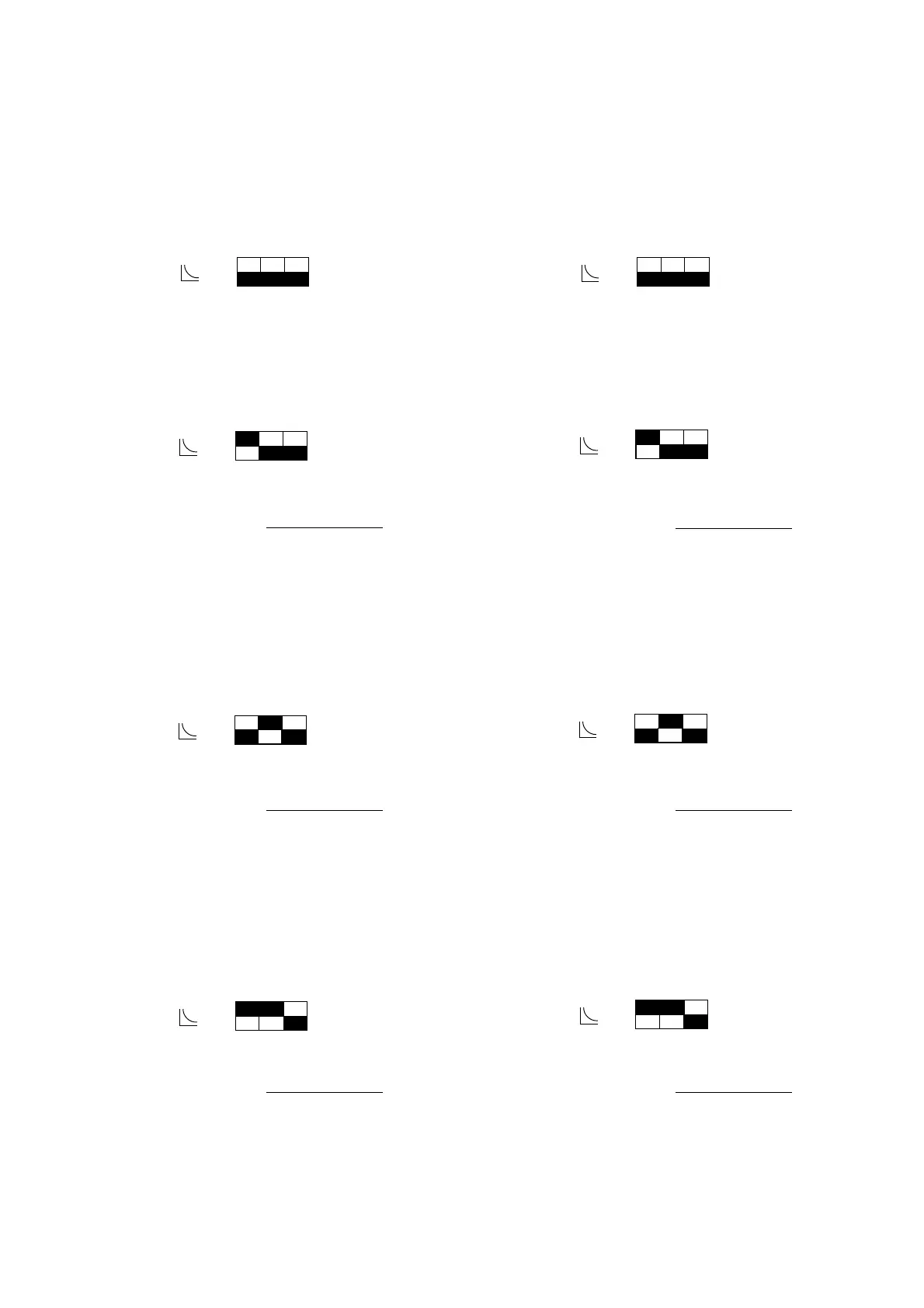
One of four different time-current relationships can be selected
by means of 2 of the 3 dip switches indicated in fig. 1 ref. M (see
para. 6.2.1.1.).
The sum of the values selected indicates the type of preselected
curve, according to the following table.
Fixed time-delay curves
(DefiniteTime: “b”= 1; K=0.1...1.6)
Set the dip-switches as follows:
Mathematical relationship to calculate t>: t> = K x 1
Normally inverse time-delay curves
(Normal Inverse: a= 0.02; b=0.14; K=0.1 ...1.6)
Set the dip-switches as follows:
Mathematical relationship to calculate t>:
0.14
t> = K x
[ I / I>
]
0.02
-1
where I represents the overload current and I> the protec-
tion threshold value set.
Curves with very inverse time-delay
(Very Inverse:
a
=1;
b
=13.5; K=0.1...1.6)
Set the dip-switches as follows:
Mathematical relationship to calculate t>:
13.5
t> = K x
[ I / I> ]
1
-1
where I represents the overload current and I> the protec-
tion threshold value set.
Extremely inverse time-delay curves
(Extremely Inverse:
a
=2;
b
=80; K=0.1...1.6)
Set the dip-switches as follows:
Mathematical relationship to calculate t>:
80
t> = K x
[ I / I> ]
2
-1
where I represents the overload current and I> the protec-
tion threshold value set.
=0
=0
=1
=2
=3
=1
=2
=3
6.2.1.1.2. Scelta del tipo di curva
Può essere selezionata una tra quattro diverse relazioni tem-
po-corrente, mediante i 2 dei 3 dip switch indicati in fig.1 rif. M
(vedi par. 6.2.1.1.).
La somma dei valori selezionati indica, secondo la seguente
tabella, il tipo di curva prescelto.
Curva a tempo fisso
(DefiniteTime: “b”= 1; K=0,1...1,6)
Impostare i dip switch in questo modo:
Relazione matematica per calcolare t>: t> = K x 1
Curva a tempo normalmente inverso
(Normal Inverse: a= 0,02; b=0,14; K=0,1 ...1,6)
Impostare i dip switch in questo modo:
Relazione matematica per calcolare t>:
0,14
t> = K x
[ I / I>
]
0,02
-1
dove I rappresenta la corrente di sovraccarico e I> il valore
di soglia di protezione predisposto.
Curva a tempo molto inverso
(Very Inverse: a=1; b=13,5; K=0,1...1,6)
Impostare i dip switch in questo modo:
Relazione matematica per calcolare t>:
13,5
t> = K x
[ I / I> ]
1
-1
dove I rappresenta la corrente di sovraccarico e I> il valore
di soglia di protezione predisposto.
Curva a tempo estremamente inverso
(Extremely Inverse: a=2; b=80; K=0,1...1,6)
Impostare i dip switch in questo modo:
Relazione matematica per calcolare t>:
80
t> = K x
[ I / I> ]
2
-1
dove I rappresenta la corrente di sovraccarico e I> il valore
di soglia di protezione predisposto.



 To Next Page