b)Humidity: 35%~75%
c)Pressure: 700hPa~1060hPa
3. Principle and Caution
3.1. Principle of measurement
The measurement of pulse oximeter is that it uses a multi-functional oxyhemoglobinometer to
transmit some narrow spectrum light bands through blood samples, and to measure attenuation of
spectrum with different wavelengths according to the characteristic that RHb, O
2
Hb, Met Hb and
COHb absorb the light of different wavelength, thereby determining O
2
Hb saturation of different
fractions. O
2
Hb saturation is called “fractional” O
2
Hb saturation.
Fractional O
2
Hb saturation = [O
2
Hb / (RHb + O
2
Hb + Met Hb + COHb) x 100
Oppositely, pulse oxygen oximeter measures functional O
2
Hb saturation:
Functional O
2
Hb saturation = [O
2
Hb / (RHb + O
2
Hb)] x 100
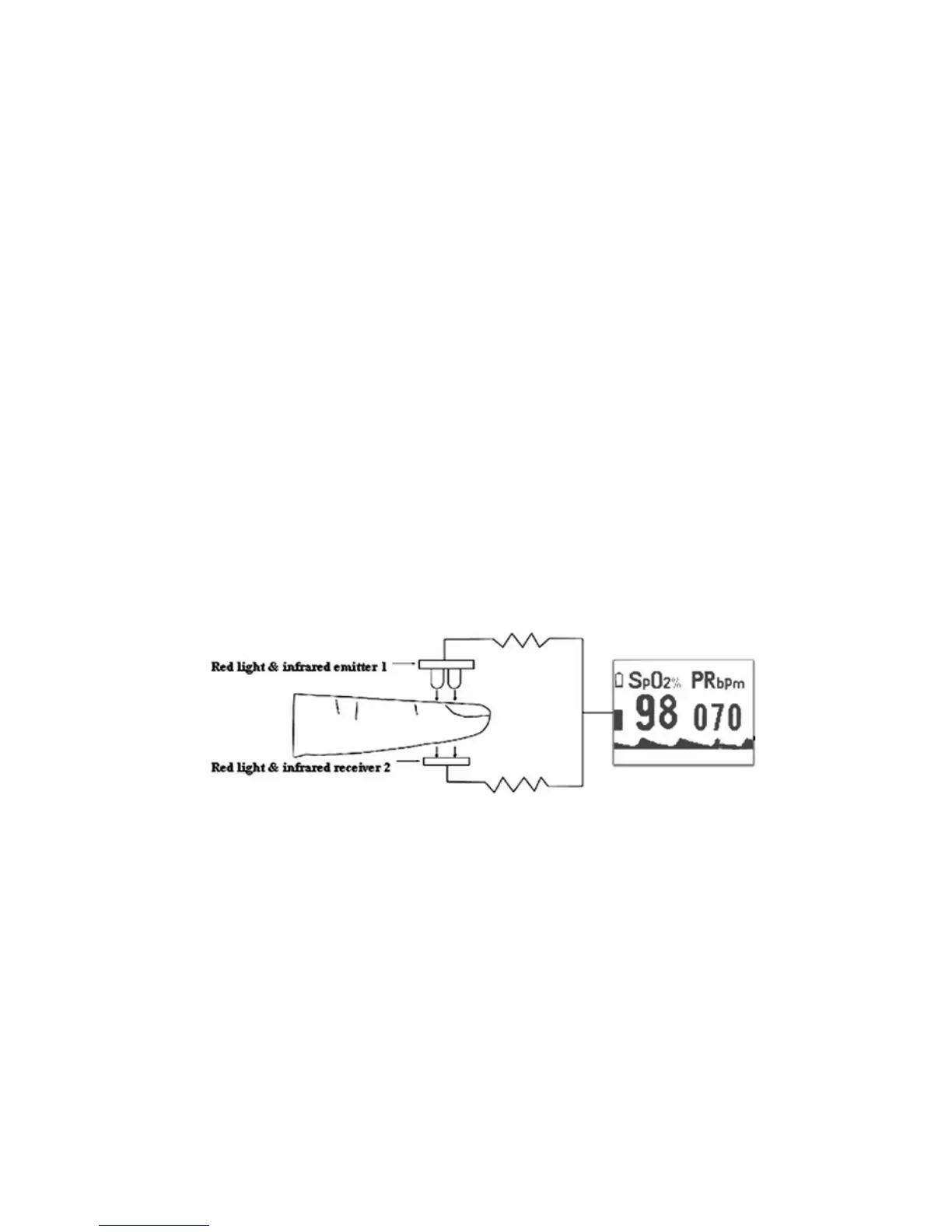
Present SpO
2
oximeter transmits light of two wavelengths only, red light (wavelength 660 nm) and
infrared (wavelength 940nm), to differentiate HbO
2
from HbR. One side of the sensor contains two
LEDs, and the other side contains a photoelectric detector. SpO
2
oximeter measures HbO
2
saturation
in the blood by the light plethysmograph when the pulse beats. The result is quite precise when
HbO
2
saturation is over 70 % ~ 100%.
Figure1. Operating Principle
3.2. The attention of Operation
A. The equipment should be fully tested to see if it can be used normally before using.
B. The finger should be placed properly (see the attached illustration of this manual), or else it
may cause inaccurate measurement.
C. The SpO
2
sensor and photoelectric receiving tube should be arranged in a way with the testee’ s
arteriole in a position in between.
3


 To Next Page