
 Need help?
Do you have a question about the Acer Chromebook Vero 514 and is the answer not in the manual?
Instructions to register your Acer product online via the Acer website.
Instructions on how to power on the Chromebook for the first time.
Guide to setting up language, keyboard, and network connection.
Steps for first-time sign-in, creating a Google Account, or browsing as a guest.
Identifies key components and features on the front of the Chromebook.
Details the keyboard layout, function keys, shortcuts, and touchpad functionality.
Information on ports available on the left, right, and bottom of the Chromebook.
Technical details and specifications for USB Type-A and Type-C ports.
Answers questions about software compatibility, app access, and file management.
Explains Google Account usage and setting up parental controls for children.
Provides resources for help and additional information on Chromebooks and Chrome OS.
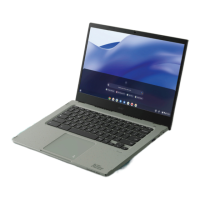
The Acer Chromebook Vero 514 and Acer Chromebook Enterprise Vero 514 are designed for users seeking a blend of productivity, entertainment, and sustainability. These Chromebooks run on Chrome OS, offering a streamlined and secure computing experience.
At its core, the Acer Chromebook Vero 514 functions as a portable computing device, enabling users to perform a wide range of tasks from web browsing and document creation to multimedia consumption and gaming. It leverages the Google ecosystem, providing access to a vast array of applications through the Google Play Store and web-based services. The device is powered by a Google Account, which integrates seamlessly with services like Gmail, Google Drive, and Google Calendar, ensuring that user data and preferences are synchronized across the ecosystem.
The Chromebook features a display that serves as the primary visual output, available in both touch and non-touch options, catering to different user preferences for interaction. For audio, it includes internal microphones for sound recording and a headset/speaker jack for connecting external audio devices such as speakers, headphones, or headsets with microphones. Stereo audio output is delivered through integrated speakers located on the bottom of the device.
Connectivity is a key aspect of the Chromebook's functionality. It offers multiple USB ports, including USB Type-C ports with DC-in capability and USB Type-A ports, allowing for connections to various peripherals, external storage devices, and power adapters. The USB Type-C ports support DisplayPort™ for video output and can also be used for USB charging. An HDMI port is also included for high-definition digital video connections, enabling users to extend their display to external monitors or projectors. Wireless connectivity is facilitated through network access, allowing the Chromebook to connect to the internet and access cloud-based services.
For security, the Chromebook incorporates a Kensington lock slot, providing a physical security option to deter theft. Some models may also feature an optional fingerprint reader for unlocking the device, adding a layer of biometric security. The integrated webcam, equipped with a physical shutter, allows for video communication while also providing privacy control.
The Acer Chromebook Vero 514 is designed for ease of use, starting with its initial setup. Upon first boot, users are guided through selecting their language settings and connecting to a network. The device requires acceptance of the Terms of Service and will automatically download system updates to ensure the latest Chrome OS features are available. First-time sign-in involves either creating a new Google Account or signing in with an existing one. A guest browsing option is also available for users who prefer not to sign in with a Google Account.
Interaction with the Chromebook is primarily through its keyboard and touchpad. The keyboard includes dedicated function keys that provide quick access to hardware and software controls, such as screen brightness, volume, and navigation functions like previous page, reload, full-screen mode, next window, and screenshot. Common keyboard shortcuts are also available to expedite tasks, including taking screenshots, toggling caps lock, and projecting the screen.
The touchpad serves as a pointing device, responding to finger movements across its surface. Basic actions include clicking by pressing down anywhere on the touchpad. Two-finger tap or holding Alt while tapping with one finger simulates a right-click. Two-finger swiping enables vertical and horizontal scrolling. The drag-and-drop feature allows users to move items by selecting with one finger and moving with a second, then releasing both.
File management is handled through the Files app, where all user files are stored. The Chromebook supports local file transfers using compatible external storage devices like USB thumb drives and removable hard drives. Users can also upload files, photos, and videos to Google Drive, making them accessible across different devices.
The Chromebook's integration with the Google Play Store allows users to download and install a wide variety of apps for productivity, entertainment, and more. It also supports Microsoft Office software through web-based versions, enabling users to work with Word, Excel, and PowerPoint documents.
For parental controls, the device emphasizes signing in with a child's personal Google Account during setup. This allows for the addition of school accounts after onboarding and helps manage the child's online experience.
The Acer Chromebook Vero 514 is designed with certain maintenance considerations to ensure its longevity and performance. Basic care tips include proper handling and protection from physical damage. Turning the computer on and off correctly helps maintain system stability.
Taking care of the computer involves keeping it clean and free from dust and debris. The AC adapter also requires care to prevent damage and ensure proper power delivery. Cleaning and servicing should be performed according to manufacturer guidelines to avoid damaging components.
Battery maintenance is crucial for optimal performance and lifespan. Guidelines for safe battery usage should be followed, including avoiding extreme temperatures and deep discharges. The internal battery is designed to provide power when the device is not connected to an AC source. The battery indicator light provides visual feedback on the charging status: amber when charging and blue when fully charged in AC mode.
The device incorporates ventilation and cooling fans to prevent overheating. It is important not to cover or obstruct these openings to ensure adequate airflow and maintain optimal operating temperatures.
For vision care, users are advised to take breaks and adjust screen settings to reduce eye strain, although specific vision care features are not detailed in the provided information.
In case of questions or issues, the Chromebook offers built-in help resources. Users can access the "Explore" app on their Chromebook for assistance or visit the official Chrome OS support website for more information. Regular system updates, automatically downloaded by the Chromebook, contribute to ongoing security and performance enhancements, reducing the need for manual software maintenance.
 General
| RAM | 8 GB LPDDR4X |
|---|---|
| Operating System | Chrome OS |
| Battery Life | Up to 10 hours |
| Webcam | 720p HD |
| Display | 14-inch FHD (1920 x 1080) IPS |
| Processor | Intel Core i5-1235U |
| Storage | 256 GB PCIe NVMe SSD |
| Weight | Approximately 1.4 kg (3.09 lbs) |
| Ports | HDMI |
| Wireless Connectivity | Wi-Fi 6 |
| GPU | Intel Iris Xe Graphics (integrated) |
| Material | Post-consumer recycled plastic |


 To Next Page