3
Controls
Notch/Low Cut Filter
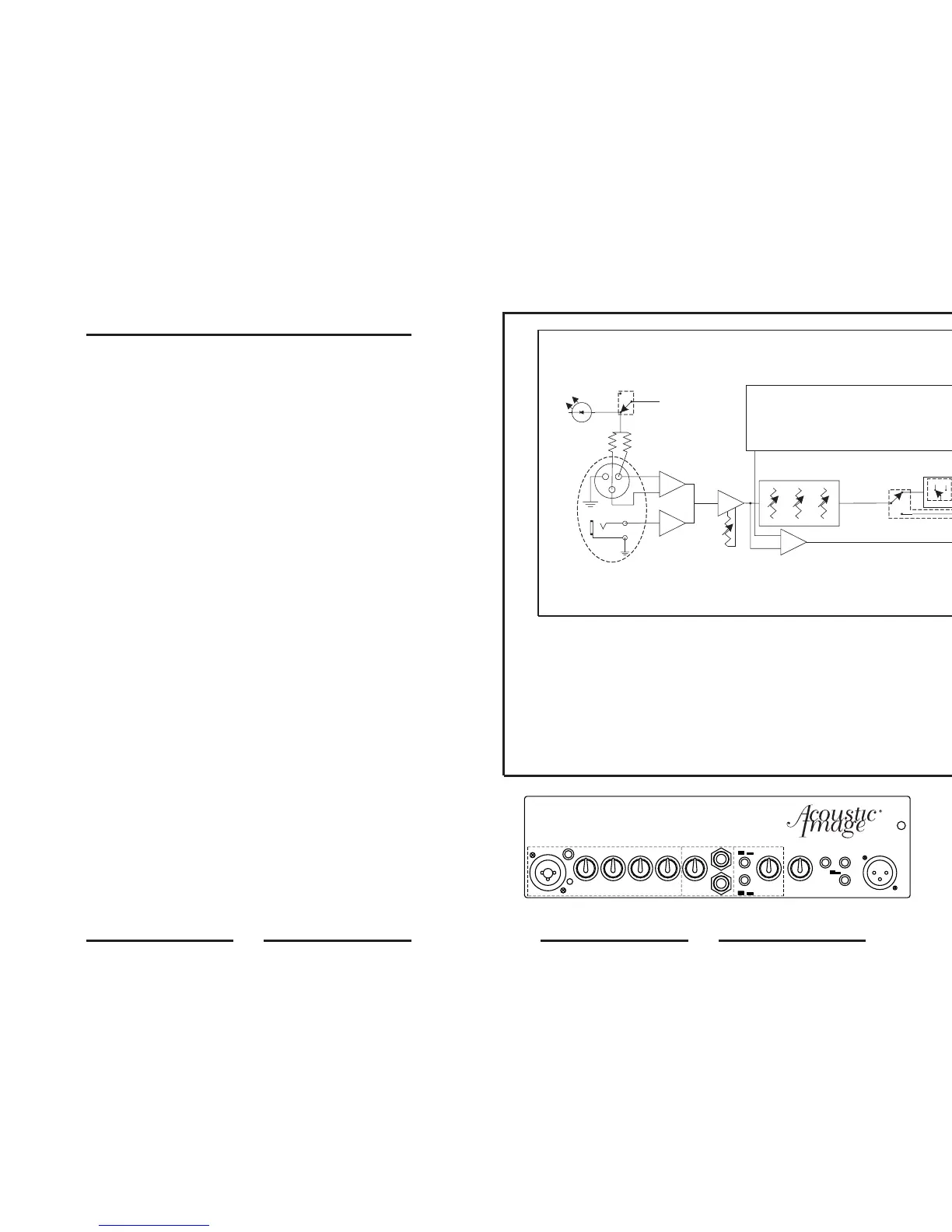
The preamp has the following controls in each channel: input level, bass, mid,
treble and effects level. In addition,there is a variable frequency, selectable
notch/low cut filter in each channel and a master level control that affects both
channels.
The input level controls the level of the signal at the input stage of the preamp.
The master volume controls the level of the signal at the output of the preamp
(at the input of the power amp). Set the master control at “12 o’clock” and the
input level at zero. The input level should then be used to control the overall
output of the unit. The two controls are provided to allow independent control of
“house” volume and “stage” volume when the unit is used as a stage monitor
with a connection to a house PA. See the discussion under “Direct Out” below.
The maximum volume at which the system will play is limited by the capability
of the speaker system. A 10-inch driver in a small cabinet has a limitation in
how loudly it will play. If more volume is needed, use a Contra EX extension
cabinet or take a feed from the Direct Out jack to a PA system or another
amplifier.
Each tone control has a center detent at the flat position. Experiment with
settings to achieve the frequency balance that sounds best to you. In general,
small values of boost and cut are best. The amp is designed with flat frequency
response so only minor corrections should be required to compensate for room
effects or “peaky” pickups in order to maintain the balanced response desired
for acoustic instrument amplification. To minimize electronic noise, avoid
operating all controls simultaneously at their maximum settings.
The bass control is a shelving-type that affects frequencies below 250 Hz and
with a maximum boost/cut of 15 dB. The mid control affects frequencies
between 300 Hz and 2000 Hz and has a maximum boost/cut of 15 dB. The
treble control is also a shelving-type that affects frequencies above 1000 Hz
with a maximum boost/cut of 25 dB.
The notch/low cut filter is a fixed amplitude, variable frequency type that inserts
either an 18 dB cut or a 12 dB per octave rolloff at frequencies between 30 and
800 Hz, depending on the position of the control. Approximate frequency
settings are noted on the frequency control. Note that the first half of the
control’s rotation affects frequencies from 30 to 70 Hz, the last half of the
rotation affects frequencies between 70 and 800 Hz. This is done so that there
is plenty of control in the critical low frequency range. The notch filter is used to
Level
Tone
4
Signal Flow Diagram
Contra Control Panel
LevelLevel Bass Mid Master
Direct Out
Treble
Send
Return
Effects
Loop
Notch Cut
OnOff
Freq
Input
Mute
Ground
lift
Post
EQ
Off On
Phantom
Filter
30
70
800
Power
Bass Mid Treble
N/C Switc
Notch
Input
buffers
Input
level
3 band EQ
Filter
switch
Filt



 To Next Page