Need help?
Do you have a question about the Acura Trailer Hitch and is the answer not in the manual?
Explains DANGER, WARNING, CAUTION, and NOTICE symbols and their implications for user safety.
Guide on how to properly connect the 7-pin trailer connector into the vehicle socket.
Instructions for safely disconnecting the 7-pin trailer connector from the vehicle socket.
Procedures for handling water submersion of the 7-pin socket and connector, including drainage.
Warning against using the positive charging circuit when the engine is off to prevent battery issues.
Instructions for replacing trailer fuses and troubleshooting persistent issues by consulting a dealer.
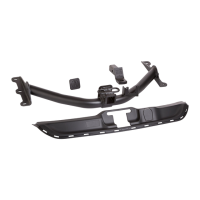
This document serves as the Trailer Hitch User's Information Manual for an Acura MDX, specifically detailing the operation and maintenance of the vehicle's trailer hitch system. The manual emphasizes safety, proper usage, and fuse replacement procedures to ensure the safe and effective operation of the trailer hitch.
The trailer hitch system is designed to enable the Acura MDX to tow a trailer. A key component of this system is the 7-pin connector, which provides electrical connections for various trailer functions, such as lighting and potentially a charging circuit or electric brake. The manual outlines the procedures for connecting and disconnecting a trailer's 7-pin connector to the vehicle's socket, ensuring a secure and functional electrical link between the vehicle and the trailer. The system also incorporates fuses to protect the electrical circuits from overcurrents, which is crucial for both the vehicle's and the trailer's electrical integrity.
The manual provides clear, step-by-step instructions for connecting and disconnecting the 7-pin connector. To connect, users are instructed to first inspect the inside of the socket for any foreign material or water and clean it if necessary. Then, the socket lid should be opened, and the trailer's 7-pin connector inserted into the socket. A critical step for secure connection is to hook the lid-retaining tab onto the connector-retaining tab, which prevents accidental disconnection during towing.
For disconnecting the 7-pin connector, the process involves lifting the socket lid to release the retaining tab, and then gently pulling the 7-pin out to unplug it. Users are explicitly warned against prying out the connector with force, which could damage the components. After disconnection, it is important to close the socket lid securely to protect the socket from environmental elements.
Special precautions are highlighted to prevent damage and ensure safety. Users are advised not to use the positive (+) charging circuit of the 7-pin connector when the engine is off, as this could weaken the battery and make starting the engine difficult. This emphasizes the importance of understanding the electrical load and its impact on the vehicle's battery.
Another crucial usage feature relates to water exposure. If the socket has been submerged in water, the 7-pin connector must be disconnected, and the socket lid securely closed. The manual issues a "NOTICE" warning that failure to disconnect the 7-pin connector before submersion could cause the vehicle to blow a fuse. If the connector itself is submerged, the socket lid should be opened to allow the water to drain out, preventing potential electrical issues.
Maintenance of the trailer hitch system primarily revolves around the electrical components, specifically fuse replacement. The manual includes detailed information on the trailer fuses, located in both the rear fuse box and the relay box. It provides tables listing the fuse number, amperage, the circuits protected, and the type of blade fuse required.
For the rear fuse box, fuses are identified for "BACK LIGHT," "HAZARD," "SMALL LIGHT," and "CHARGE" circuits. In the relay box, a fuse is specified for the "ELEC BRAKE" circuit. This detailed breakdown allows users to identify the correct fuse for a specific circuit if it blows.
If a fuse blows, users are directed to refer to the vehicle owner's manual for general fuse replacement information. A key maintenance instruction is that if the same fuse blows again soon after replacement, the user should consult with an authorized Acura dealer. This indicates a potential underlying electrical issue that requires professional diagnosis and repair, rather than continuous fuse replacement. The manual also illustrates the appearance of a blade fuse, which is the type used in these circuits, aiding in correct identification during replacement.
Overall, the manual provides essential information for the safe and effective use and basic maintenance of the Acura MDX trailer hitch, focusing on electrical connections and fuse management.
 General
| Material | Steel |
|---|---|
| Installation | Professional installation recommended |
| Hitch Class | Class III |
| Receiver Size | 2 inches |
| Finish | Powder coated |
| Compatible Models | Acura MDX, Acura RDX, Acura TLX |
| Towing Capacity | Varies by model (typically 3, 500 to 5, 000 lbs) |

 To Next Page