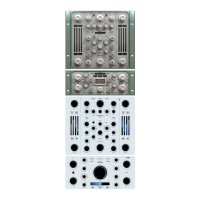
6) It is interesting to experiment with the POWER control identified by the small wheel
with the letter P. Tiger allows for variable integration of the exponent used in the detec-
tor, leading to a more responsive and transparent behavior of the detector as the value
increases at the expense of perceived distortion. CAUTION: PU consumption is con-
siderably low when value 1 and 2 (lowest setting) is selected.. As the order increases,
attack times shorten (so the detector becomes more sensitive to signal transients),
but the “real” release value will increase. No problem! Tiger allows you to get around
this with the attack and release shape modulation controls or the morph control.
See the section on the POWER function for more information on this topic.
7) Take action on the attack shape modulation control via the ASHMOD (attack shape
modulation) control. Intuitively, values below the middle position reduce the transient,
while higher values emphasize it. If the attack is in the minimum place and ASHMOD
is in the minimum, the attack time becomes zero (and the compressor turns into a
limiter).
You can imagine this control as a tool for controlling the transient.
See the section on the ASHMOD function for more information on this topic (notably,
the considerations for SINGLE and HOLD modes are of interest).
8) Act on the release shape modulation control via the RSHMOD (release shape mo-
dulation) control. Values less than the middle position tend to warp the release to
make the compressor more aggressive and colorful at the expense of more perceived
distortion. In comparison, larger values tend to decrease distortion while making the
compressor less aggressive at the same time. If the release is in the minimum position
and RSHMOD is also in the minimum, the release time becomes zero (and the com-
pressor becomes a saturator).
One can imagine this control as a tool to control distortion and aggressiveness in the
compression action.
See the section on the RSHMOD function for more information on this topic (the HOLD
mode considerations are fascinating).
9) intervene on the morphing control via the MORPH control, which allows you to
change the type of dynamic action from compression to a limiter to a saturator. In
detail, the limiter action makes it possible to effectively increase the loudness value of
the signal, while the saturator action turns Tiger into a powerful saturator. Especially in
the latter circumstance, it is beneficial to set an appropriate oversampling value to limit
aliasing, that is, non-musical and unwanted harmonic distortion.
See the section on the MORPH function for more information on this topic.
10) Use the MIX control to determine the DRY/WET signal amount. The control helps
create a New York compression effect, where the processed signal is mixed with the
dry signal (effectively reducing the apparent RATIO ratio of the compressor). New York
compression is particularly valued on drum buses.
Refer to the section on New York compression.
11) Intervene on the oversampling value to reduce aliasing and unwanted distortion.
In general, an oversampling value of 2x or higher is recommended for a mastering
session in the case of pure compression (MORPH in the COMP position), at least 4x or
higher in the case of limiting (MORPH in the LIM position), and at least 8x in the point
of saturation (MORPH in the SATU position). In the case of a Master Bus, a half value
might be correct. There is no rule for the possibility of individual tracks. In general high
oversampling values allow better handling of harmonic distortion. Tiger has oversam-
pling based on linear phase filters, and as such, they do not introduce alterations in
phase response. In addition, we have selected oversampling filters to optimize tran-
sient response. It should be noted that at higher values of oversampling, there is a pe-
nalty in transient response for better handling of harmonic distortion. However, values
up to 16x have a negligible impact
12) Use the DS button to improve compressor response at critical values for attack
and release.
Refer to the section on DS control.
13) Cycle back to step 2 until a satisfactory result is obtained.


 To Next Page
 Loading...