Need help?
Do you have a question about the Adam T Series and is the answer not in the manual?
Describes the high-frequency response adjustment switch.
Describes the low-frequency response adjustment switch.
Explains the volume control knob.
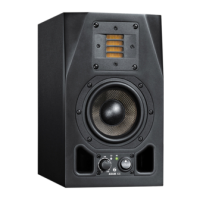
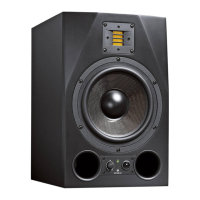
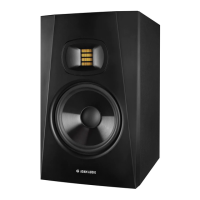
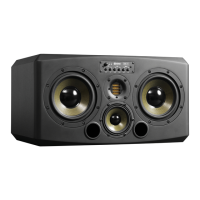
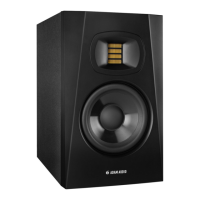
The ADAM Audio T Series monitors are professional reference monitors designed for music production, video post-production, and radio broadcast studios. They are engineered to provide rock-solid imaging, a wide sweet spot, superior transient response, extended frequency response, and unmasked clarity and detail across the audio spectrum. Their compact dimensions allow for flexible placement in various room sizes.
The T Series monitors are active loudspeakers, meaning they have built-in amplifiers and do not require external amplification. They are designed to reproduce audio signals accurately, allowing users to make informed decisions during the creative process that will translate faithfully to other playback systems.
A key component of the T Series is the proprietary U-ART 1.9” tweeter. Unlike conventional dome or cone tweeters that use a piston action, the U-ART tweeter employs a pleated membrane. This design alternately draws air into its folds and squeezes it out as the folds expand and contract in response to audio signals. This method produces four times as much air movement as piston-based designs, resulting in higher sound pressure levels (SPLs) with lower distortion. The U-ART tweeter delivers pristine details with greater clarity and offers superior off-axis performance, reducing listening fatigue even at louder volumes.
The U-ART tweeter is integrated into a precision waveguide, which ensures highly uniform dispersion of high frequencies. This creates an incredibly wide sweet spot, allowing users more freedom of movement from a rigid mix position.
The monitors feature an all-new polypropylene woofer and a rear-firing bass-reflex port. This combination provides ultra-smooth, highly accurate midrange and extended bass response.
Custom-matched Class D amplifiers and power supplies are used for optimal performance. The U-ART tweeter is powered by a 20 W amplifier, while the woofer is served by a 50 W amplifier. The powerful 4:1 velocity transfer ratio of the U-ART tweeter, combined with these amplifiers, enables listening at very loud levels without listening fatigue.
DSP-controlled driver crossovers ensure seamless transitions between drivers at the crossover frequency, preventing any gaps in the sound spectrum. The T Series also features all-new beveled cabinets, which minimize diffraction and contribute to superior imaging. This allows for pinpoint accuracy in hearing the discrete placement of panned tracks in the stereo field.
The T Series monitors offer versatile connections and controls on their sturdy metal backplate, making them adaptable to virtually any professional system.
For audio input, each monitor includes a balanced XLR connector and an unbalanced RCA jack. The XLR connector is designed for balanced audio with a nominal +4 dBu level, while the RCA jack accepts unbalanced audio with a nominal -10 dBV level. A 2-way switch allows users to select between these two input connectors. The XLR connector follows industry standard wiring: Pin 1 for ground, Pin 2 for positive (hot), and Pin 3 for negative (cold).
Each monitor is equipped with its own Level control knob. This knob allows users to increase or decrease the monitor's volume. The "0 dB" setting is generally optimal for most situations. This individual level control is particularly useful for balancing output levels between left and right monitors, especially in asymmetric control rooms.
Two 3-way switches, labeled "HF" (High Frequency) and "LF" (Low Frequency), are provided to adjust the monitor's frequency response. These switches can boost or cut the respective frequency ranges by 2 dB. A "0" setting on each switch maintains a flat frequency response. These controls allow users to adapt the monitors to the acoustic signature of their room. For instance, if a room is heavily treated with absorptive acoustic materials, the HF switch can be set to "+2 dB" to restore high-frequency detail. Conversely, in a live or bright-sounding room, the HF switch can be set to "-2 dB" to compensate. For bass response, if monitors must be placed closer than 16 inches from a wall, the LF switch can be set to "-2 dB" to counteract the natural bass boost from the boundary effect. If an exaggerated bass response is desired, the LF switch can be set to "+2 dB".
The T Series monitors automatically accept AC voltages ranging from 100 to 240V at 50/60 Hz, eliminating the need for manual voltage selection. A Power switch activates the monitor, indicated by an associated green LED. The monitor connects to the AC mains via a standard three-prong IEC AC power receptacle.
For optimal placement, the monitors should be positioned on speaker stands, a console bridge, or a desktop, ideally about three feet from the mix position. This ensures that direct sound is louder than reflected sound, minimizing comb filtering and preserving precise imaging. Placing monitors in mirror images relative to nearby walls (e.g., left monitor equidistant from left wall as right monitor from right wall) helps achieve balanced bass response. For the flattest bass, each monitor should be at least 16 inches from the nearest wall. The tweeters should be at ear level, and monitors should be toed-in to form an equilateral triangle with the listener's ears for a solid phantom center image and accurate localization.
To ensure the longevity and optimal performance of the T Series monitors, several maintenance guidelines are provided.
Before any cleaning, the monitors should always be switched off. Users should be aware that the speaker drivers generate a significant electromagnetic field, so magnetically sensitive items should be kept at least half a meter (20 inches) away.
It is crucial to prevent liquids from entering the cabinet. Wet cloths should not be used for cleaning, and cleaning fluids should never be sprayed directly near the loudspeakers. Flammable or acidic chemicals are also unsuitable for cleaning.
The loudspeaker cones are delicate and should not be touched if at all possible. If dusting is necessary, a very soft brush can be used lightly. For general cleaning, a lint-free, damp (not wet) cloth is recommended.
For shipping purposes, it is highly recommended to retain the original loudspeaker packaging. This packaging is designed to protect the monitors from damage during transit. ADAM Audio cannot be held responsible for damages resulting from improper packaging when loudspeakers are shipped for repair or other reasons.
In case of troubleshooting, users are advised to check cables, signal sources, and for electromagnetic interference before contacting support. If a problem persists, contacting ADAM Audio or a local representative is recommended.
The monitors require a burn-in period for optimal performance. Playing complex program material through them for at least eight hours before critical use is advised. At the end of each session, the monitors should be turned off before any connected equipment is powered down.
The T Series monitors comply with international directives on the Restriction of Hazardous Substances (RoHS) and Waste Electrical/Electronic Equipment (WEEE). Information on safe disposal methods should be sought from local authorities when the time comes. The products also comply with the EU Electro-Magnetic Compatibility (EMC) Directive and the EU General Product Safety Directive.
A standard two-year warranty is provided from the date of purchase. Registering the products online extends this warranty by an additional three years, totaling five years. The warranty covers defects in materials and workmanship but excludes damages from incorrect installation, improper use, faulty ancillary equipment, unauthorized repairs, accidents, or environmental factors beyond ADAM Audio's control. For warranty claims, users should contact their ADAM Audio dealer or national distributor.
 General
| Series | T Series |
|---|---|
| Enclosure Type | Bass reflex |
| Type | Studio Monitor |
| Inputs | XLR, RCA |
| Tweeter Size | 1.5" |

 To Next Page